
Ultimate First Article Approval Checklist For A New Supplier
The first commercial batch from a new intermediate supplier is not a formality. Here is the checklist, the five approval outcomes, and how to log the call.
Table of Contents
Approximately 56% of drugs currently in clinical use contain at least one chiral center, and the proportion of single-enantiomer drug approvals has risen steadily since the FDA issued its landmark 1992 policy on stereoisomeric drugs [1].
Between 2013 and 2022, single-enantiomer drugs accounted for 59% of FDA small-molecule approvals, while racemic approvals dropped to 3.6% — down from 11% in the prior decade [2]. The European Medicines Agency has not authorized a new racemic drug since 2016 [3].
This regulatory shift means that pharmaceutical manufacturers increasingly require chiral intermediates — building blocks that carry the correct three-dimensional configuration from which the final API is constructed. If an intermediate arrives with compromised stereochemical purity, every downstream step inherits that defect. A 95% ee intermediate cannot become a 99.5% ee API without expensive re-resolution. In the worst case, the wrong enantiomer passes undetected into the drug substance.
The lesson is not theoretical. The thalidomide tragedy of the 1960s — where the (S)-enantiomer caused teratogenic birth defects while the (R)-enantiomer provided sedation — directly led to the modern regulatory framework requiring enantiomeric characterization for all chiral drugs [4].
Subsequent research revealed that even pure (R)-thalidomide undergoes in vivo racemization, converting to the harmful (S)-form under physiological conditions [4]. This finding underscores why chiral purity is not just a release specification — it is a patient safety parameter.
Enantiomeric excess (ee%) is a quantitative measure of how much one enantiomer dominates over its mirror image in a mixture. It is calculated as:
ee% = |[R] − [S]| / ([R] + [S]) × 100
where [R] and [S] are the concentrations (or area percentages from chromatography) of each enantiomer [5]. A racemic mixture (50:50) has 0% ee. A single, completely pure enantiomer has 100% ee. A sample containing 80% R and 20% S has 60% ee.
Many buyers and even some quality teams use “enantiomeric excess” and “optical purity” interchangeably. They are numerically equivalent in ideal conditions but are fundamentally different measurements [6]:
Parameter | Enantiomeric Excess (ee%) | Optical Purity |
What it measures | Actual molar ratio of enantiomers (by HPLC, GC) | Observed optical rotation vs. pure enantiomer rotation |
Instrument | Chiral HPLC / GC / SFC | Polarimeter |
Accuracy | Direct quantification of each enantiomer | Indirect — assumes linear concentration-rotation relationship |
Key limitation | Requires method development (column selection) | Inaccurate when specific rotation is small or when multiple chiral centers exist; non-linear behavior at high concentrations |
Regulatory preference | Preferred by FDA, EMA, and ICH Q6A | Accepted as supporting data only; insufficient as sole chiral control |
The China National Center for Drug Evaluation (CDE) explicitly warns that using specific rotation alone to control chiral purity is inadequate, “especially when the drug’s specific rotation value is small and multiple chiral factors exist” [7].
This is a critical point for intermediate buyers: a COA that lists only specific rotation without chiral HPLC data does not provide verified stereochemical control.
Chiral high-performance liquid chromatography (HPLC) is the gold standard for determining enantiomeric purity in pharmaceutical intermediates [8].
The technique uses a chiral stationary phase (CSP) that interacts differently with each enantiomer, causing them to elute at different retention times. The peak areas are then used to calculate ee%.
The most widely used chiral columns are manufactured by Daicel (Chiral Technologies), with the polysaccharide-based coated series being the industry workhorses:
Column | Stationary Phase | USP Designation | Best Suited For |
Chiralpak AD-H | Amylose tris(3,5-dimethylphenylcarbamate) | USP L51 | Broad range; aromatic intermediates |
Chiralcel OD-H | Cellulose tris(3,5-dimethylphenylcarbamate) | USP L40 | Basic compounds; amines; alkaloids |
Chiralpak AS-H | Amylose tris[(S)-1-phenylethylcarbamate] | USP L90 | Acidic compounds; carboxylic acids |
Chiralcel OJ-H | Cellulose tris(4-methylbenzoate) | USP L80 | Esters; ketones; aryl compounds |
Chiralpak IA/IB/IC | Immobilized polysaccharide derivatives | — | Solvent-tolerant; compatible with chloroform, THF, DMSO |
The immobilized I-series columns (IA, IB, IC, ID, IE, IF) represent a significant advance over traditional coated columns. Because the chiral selector is chemically bonded to the silica substrate, these columns tolerate a wider range of solvents — including chloroform, dichloromethane, and DMSO — that would irreversibly destroy coated CSPs [9].
For intermediate manufacturers working with diverse chemistries, this robustness translates directly into method development efficiency.
A chiral HPLC method used for release testing must be validated per ICH Q2(R1) with the following key parameters [8]:
Parameter | Typical Requirement | Why It Matters for Intermediates |
Resolution (Rs) | ≥ 1.5 (baseline separation) | Ensures minor enantiomer peak is not buried under major peak tail |
LOD (Limit of Detection) | ≤ 0.05% | Must detect trace wrong enantiomer below specification threshold |
Accuracy (Recovery) | 98–102% | Confirms that spike-recovery experiments return expected values |
Precision (RSD) | ≤ 2% (intra-day) | Batch-to-batch ee% reporting must be reproducible |
Beyond chiral HPLC, several other techniques are used depending on the compound and available equipment:
ICH Q6A — the harmonized guideline on specifications and acceptance criteria for new drug substances — provides the foundational framework for chiral control through Decision Tree #5. Key requirements for chiral drug substances developed as single enantiomers include [10]:
Crucially, ICH Q6A explicitly allows intermediate testing as a valid control strategy: “Assurance of control also could be given by appropriate testing of a starting material or intermediate, with suitable justification” [10].
This means that the ee% data on your intermediate COA is not just informational — it is a regulatory control point that can substitute for downstream testing if properly justified.
The China CDE provides tiered ee% recommendations based on the biological activity of the wrong enantiomer [7]:
Risk Level of Wrong Enantiomer | Minimum ee% | Maximum Enantiomeric Impurity |
No activity or only mild side effects | ≥ 98.0% | ≤ 1.0% |
Inactive but with mild side effects | ≥ 99.0% | ≤ 0.5% |
Severe side effects | ≥ 99.5% | ≤ 0.25% |
These criteria apply to the final drug substance, but intermediate buyers should negotiate specifications that leave a purity margin for downstream processing. An intermediate with 99.0% ee leaves no room for stereochemical erosion during subsequent steps.
Understanding ee% theory is only useful if you can identify what genuine chiral control looks like on a Certificate of Analysis. The following checklist separates real stereochemical data from cosmetic entries:
Enantiomeric purity is not necessarily a static property. Under certain conditions — acidic or basic environments, elevated temperatures, or even physiological conditions — enantiomers can interconvert.
This process is called racemization or chiral inversion, and it directly affects whether the ee% value on a COA remains valid throughout storage and use.
The most documented example is thalidomide: even pure (R)-thalidomide converts to a racemic mixture under physiological conditions, meaning that administering the “safe” enantiomer does not prevent exposure to the “harmful” one [4].
Another example is ibuprofen: approximately 63% of the inactive (R)-ibuprofen converts to the active (S)-form in vivo, but the reverse does not occur [6].
For pharmaceutical intermediates, the practical implication is clear: if the chiral center is at a position susceptible to racemization (e.g., alpha to a carbonyl, adjacent to an aromatic ring with labile protons), the ee% at release may not represent the ee% at the time of use.
Buyers should request stability data that includes chiral purity monitoring — not just assay and impurity profiles. For guidance on storage conditions that protect against degradation, see our article on pharmaceutical intermediate storage conditions.
When an intermediate contains a single chiral center, controlling ee% involves one stereochemical decision point. But complexity scales exponentially with each additional stereocenter. An intermediate with n chiral centers has 2n possible stereoisomers — only one of which is the desired product.
Chiral Centers | Possible Stereoisomers | Undesired Isomers | Control Challenge |
1 | 2 | 1 | Single enantiomeric pair; one chiral HPLC method |
2 | 4 | 3 | Diastereomers separable by achiral HPLC; enantiomers need chiral method |
4 | 16 | 15 | Multiple chiral methods; process control at each stereocenter |
6 | 64 | 63 | Extreme complexity; ee% at each step; full process control required |
For intermediates with multiple chiral centers, the China CDE recommends controlling ee% at each synthetic step rather than relying solely on final-product testing: “For drugs with two or more chiral centers, the number of possible optical isomer impurities in the final product is large, and quality control is difficult.
Control through the entire process by strict control of process conditions during synthesis and strict control of the optical purity of each chiral raw material and intermediate” [7].
This is precisely the challenge in suzetrigine intermediate sourcing, where four chiral centers generate 16 possible stereoisomers, and in empagliflozin intermediates, where six stereocenters create 64 possible configurations.
In both cases, the COA for each intermediate in the synthesis chain should report ee% (or diastereomeric ratio for non-enantiomeric impurities) — not just the final intermediate.
Chiral purity has a direct and often dramatic impact on intermediate pricing. Achieving 99.5% ee typically requires one or more of the following: asymmetric synthesis (expensive chiral catalysts or auxiliaries), classical resolution (sacrificing 50% of theoretical yield), enzymatic resolution (specialized equipment and enzyme costs), or chiral chromatography at preparative scale (column and solvent costs). Each method adds cost and reduces throughput.
The economic logic is straightforward: a 95% ee intermediate may cost 30–40% less than a 99.5% ee equivalent, but the downstream cost of upgrading purity — if it is even feasible — typically exceeds the initial savings. For intermediates destined for high-value single-enantiomer APIs, the total cost of ownership favors high ee% at the source.
For a broader understanding of how quality parameters factor into intermediate pricing, see our guide on pharmaceutical intermediate pricing factors.
It depends on the position of the chiral center in the synthesis and the biological activity of the wrong enantiomer. As a starting point, use the CDE tiered recommendations: ≥98% for low-risk enantiomers, ≥99% for mild side effects, and ≥99.5% for severe side effects. For intermediates early in the synthesis where subsequent steps can improve purity, a lower specification may be acceptable with justification. For late-stage intermediates directly feeding the API, match or exceed the final drug substance specification.
Specific rotation can serve as a rapid screening tool, but it should not be the sole chiral control method. The China CDE and ICH Q6A both prefer direct enantiomeric quantification by chiral HPLC or equivalent techniques. Specific rotation is unreliable when the rotation value is small, when multiple chiral centers exist, or when non-chiral impurities affect the measurement [7].
Enantiomeric excess (ee%) measures the ratio of mirror-image enantiomers. Diastereomeric excess (de%) measures the ratio of diastereomers — stereoisomers that are not mirror images. For intermediates with a single chiral center, ee% is the relevant metric. For intermediates with multiple chiral centers, both ee% (for enantiomeric pairs) and de% (for diastereomeric pairs) may be needed. Diastereomers have different physical properties and can often be separated by conventional (achiral) HPLC, while enantiomers require chiral methods [5].
Chiral centers alpha to carbonyl groups, adjacent to aromatic rings with labile protons, or at benzylic positions are most susceptible to racemization. Request stability data that includes chiral purity monitoring under ICH stability conditions. If the supplier cannot provide this data, consider conducting your own stability study before committing to a specification.
“Chiral purity” is not a standardized term. It may refer to ee%, optical purity, or a qualitative chiral HPLC pass/fail result. Always ask for the specific numeric value (ee% or % of undesired enantiomer), the analytical method, and the column used. Ambiguity in chiral reporting is a red flag.
The first commercial batch from a new intermediate supplier is not a formality. Here is the checklist, the five approval outcomes, and how to log the call.
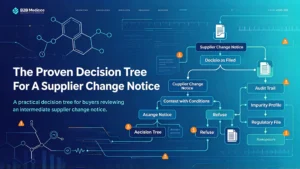
A buyer-side decision tree for handling an intermediate supplier change notice — what to accept, contest, or reject, and how to log the call.

A supplier discontinuation is a deadline, not just bad news. The questions to ask in writing, the last-time-buy calculation, and the files to collect in time.

Manufacturer and supplier of pharmaceutical APIs and intermediates. Contact us for technical support and sourcing solutions.