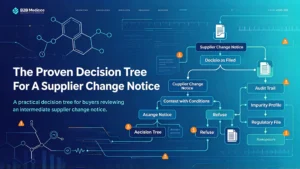
The Proven Decision Tree For A Supplier Change Notice
A buyer-side decision tree for handling an intermediate supplier change notice — what to accept, contest, or reject, and how to log the call.
Table of Contents
Empagliflozin — the SGLT2 inhibitor behind Jardiance, Glyxambi, and Synjardy — generated $8 billion in global revenue for Boehringer Ingelheim and Eli Lilly in 2024 (Mordor Intelligence, SGLT2 Market Report 2026). That revenue stream is now fragmenting as patent protections expire region by region, creating a cascade of intermediate demand.
Region | Patent Status | Market Impact |
India | Expired March 11, 2025 | 71 new brands in one month; prices dropped 80–90% (Economic Times, April 2025) |
Ex-US (global) | Compound patent nominally expired March 2024 | Regional generic entries accelerating through 2025–2027 (TheraRadar, 2026) |
United States | Core composition patent (US7579449) with PED extension expires ~Feb 2029; last OB patent Dec 2034 | Generic entry projected 2029+, contingent on Hatch-Waxman settlement (DrugPatentWatch; NCBI Bookshelf, Table 2) |
India’s market tells the story most clearly: unit sales doubled from 1.95 million to 3.46 million per month within four months of patent expiry (Business Standard / Pharmarack, July 2025). Every one of those tablets requires empagliflozin API — and every kilogram of API requires intermediates. The global SGLT2 inhibitor market is projected to reach $19.76 billion by 2031 (Mordor Intelligence), with empagliflozin holding the single largest molecule share.
For intermediate buyers, the implication is straightforward: demand is not theoretical. It is already translating into procurement volume.
Empagliflozin (CAS 864070-44-0) contains six chiral centers — three on the glucose ring (C2–C6) and one on the tetrahydrofuran ring (C3). The β-C-glycosidic linkage at the anomeric carbon is the single most critical stereochemical feature: the α-anomer is pharmacologically inactive and must be controlled below 0.1% in the final API (CATO Chemical, Empagliflozin Impurity Guide).
The industrial synthesis route disclosed by Boehringer Ingelheim (Wang et al., Organic Letters, 2014, 16, 4090–4093; DOI: 10.1021/ol501755h) proceeds through four key stages, each generating a commercially significant intermediate:
Stage | Reaction Type | Key Intermediate Produced | CAS Number | Chiral Relevance |
1 | Friedel-Crafts acylation + SNAr etherification | Aryl ketone (benzophenone intermediate) | 915095-87-3 | (S)-THF moiety installed here — ee% of this step determines downstream stereochemistry |
2 | Carbonyl reduction (silane/AlCl₃) | Bromo/chloro diaryl ether | 915095-89-5 | No new chiral center — but THF ee% carried forward |
3 | I/Mg or Br/Mg exchange → gluconolactone addition → β-methyl glycoside formation | Acetoxy Empagliflozin (per-acetylated intermediate) | 915095-99-7 | β-anomeric selectivity created here — α:β ratio is the critical COA field |
4 | Deacetylation (LiOH or NaOMe) | Empagliflozin API | 864070-44-0 | All six chiral centers fixed — α-anomer must be ≤0.1% |
Three observations matter for procurement:
First, the (S)-tetrahydrofuran moiety is installed in Stage 1 and carried unchanged through every subsequent step. If the intermediate retest date has expired and the ee% has drifted, that error propagates into the final API with no correction opportunity.
Second, the β-anomeric selectivity is created in Stage 3 during the glycosidation sequence. The Wang et al. process achieves β-selectivity through a thermodynamic equilibration (α:β methyl furanoketal → β-pyranoketal over 3–5 hours at 40°C) followed by a stereoselective silane reduction (ScienceDirect, Comprehensive Chirality 2024). This is the step where α-anomer impurity is either controlled or lost.
Third, Acetoxy Empagliflozin (CAS 915095-99-7) is the last protected intermediate before deprotection. Its purity, anomeric ratio, and impurity profile directly predict the quality of the final API — making it the single most informative intermediate to evaluate when selecting a supplier.
Empagliflozin’s molecular structure contains six stereocenters in fixed configuration: (2S,3R,4R,5S,6R) on the glucopyranose ring and (3S) on the tetrahydrofuran ring. Each one is a separate quality control event — not a single “chiral purity” number on a COA.
Chiral Center | Configu -ration | Created at Stage | Wrong Stereo = | COA Method |
C2 (anomeric carbon) | S (β-anomer) | Stage 3 — glycosidation + silane reduction | α-anomer impurity (pharmacologically inactive) | Chiral HPLC; typical spec ≤0.1% |
C3 | R | Inherent to D-glucose starting material | Epimer at C3 | Chiral HPLC |
C4 | R | Inherent to D-glucose | Epimer at C4 | Chiral HPLC |
C5 | S | Inherent to D-glucose | Epimer at C5 | Chiral HPLC |
C6 | R | Inherent to D-glucose | Epimer at C6 | Chiral HPLC |
THF C3 | S | Stage 1 — SNAr with (S)-3-hydroxytetrahydrofuran | (R)-THF epimer — wrong side-chain stereochemistry | Chiral HPLC; ee% typically ≥99.5% |
Five of the six centers (C3–C6 on glucose) originate from the D-glucose starting material — they are structurally inherent and rarely invert under normal process conditions. The two that can invert and must be explicitly controlled are:
Not every intermediate in the synthesis route is commercially traded at volume. Four intermediates dominate procurement discussions, and each has specific COA fields that matter more than a generic “assay ≥98%” claim.
Intermediate | CAS | Role in Route | Critical COA Fields | Red Flag if Missing |
(S)-3-[4-[(2-Chloro-5-iodophenyl)methyl] phenoxy]tetrahydrofuran | 915095-94-2 | Aryl iodide for I/Mg exchange (Stage 3 entry point) | ee% (chiral HPLC); iodine content; residual solvents (THF) | No ee% data → THF stereochemistry unverified |
(3S)-3-[4-[(5-Bromo-2-chlorophenyl) methyl]phenoxy] tetrahydrofuran | 915095-89-5 | Aryl bromide — alternative to iodide route; requires n-BuLi at −78°C | ee% (chiral HPLC); moisture content (KF); bromine residual | No KF data → moisture can degrade organolithium step |
Acetoxy Empagliflozin | 915095-99-7 | Per-acetylated intermediate — last protected stage before deacetylation to API | α:β anomeric ratio (chiral HPLC); total impurities; residual solvents (DCM, toluene, ethyl acetate per ICH Q3C) | No anomeric ratio → α-anomer level unknown; the most dangerous omission |
(S)-3-Hydroxytetrahydrofuran | 86087-23-2 | Starting chiral building block — determines THF C3 stereochemistry | ee% (chiral GC or HPLC); water content; optical rotation [α]D | ee% <99.5% → downstream (S)-THF moiety compromised |
Among these four, Acetoxy Empagliflozin (CAS 915095-99-7) is the most procurement-significant. It sits at the final protected stage — its anomeric purity, impurity profile, and residual solvent levels directly predict the quality of the deprotected API. A supplier who cannot provide the α-anomer fraction on this intermediate’s COA is, in practical terms, telling you they do not control the stereochemistry that defines empagliflozin’s pharmacological activity.
The Wang et al. process was implemented at metric-ton scale for Jardiance’s commercial launch (Org. Lett. 2014, 16, 4090). Scaling from lab to production, however, creates three quality risks that intermediate buyers should understand:
The I/Mg exchange (i-PrMgCl·LiCl at −20°C) or Br/Mg exchange (n-BuLi at −78°C) requires strict cryogenic control. Temperature excursions above −40°C during the bromide route lead to reduced β-selectivity and elevated α-anomer formation. At commercial scale, efficient mixing at −78°C is a recognized engineering challenge — inadequate mixing creates local hot spots where stereochemistry drifts (DearChem, Scale-up Analysis, CN105399735A).
The organolithium and organomagnesium intermediates are pyrophoric and moisture-sensitive. Water content above 0.1% in the THF solvent or in the aryl halide intermediate (CAS 915095-89-5) deactivates the metalation, reduces yield, and generates degradation products 9a/b documented in the Wang et al. paper. This is why the COA’s Karl Fischer moisture data matters for this intermediate specifically — not as a generic QC field, but as a predictor of whether the downstream glycosidation will work.
The Et₃SiH/AlCl₃ reduction in CH₂Cl₂/MeCN at −5°C to +25°C creates the β-anomeric carbon via an oxocarbenium ion intermediate. The facial selectivity depends on Lewis acid concentration, silane addition rate, and temperature. Process deviations shift the α:β ratio — and once the ratio is set, only crystallization of the per-acetylated intermediate (from ethanol) can remove the α-anomer.
If crystallization is skipped or incomplete, the α-impurity carries into the final API (ScienceDirect, Comprehensive Chirality 2024). This explains why the improved route by Shi et al. (Chinese Journal of Pharmaceuticals, 2018, 49, 1100) reports α-empagliflozin content <0.1% only after optimized crystallization.
Acetoxy Empagliflozin (CAS 915095-99-7) — the per-acetylated intermediate that sits at the last protected stage before deacetylation. Its anomeric purity (α:β ratio) directly predicts the API’s pharmacological quality.
The α-anomer at the anomeric carbon (C2) is pharmacologically inactive. It is a designated impurity with its own CAS number (1620758-33-9) and must be controlled below 0.1% per standard API specifications. It forms during the glycosidation and silane reduction steps and can only be removed by crystallization of the per-acetylated intermediate.
The foundational composition patent (US7579449) with pediatric extension expires approximately February 2029. Method-of-use patents extend to December 2034. Actual generic entry timing depends on Hatch-Waxman Paragraph IV litigation outcomes (TheraRadar; DrugPatentWatch).
Six: five on the glucopyranose ring (C2–C6, configuration 2S,3R,4R,5S,6R) and one on the tetrahydrofuran ring (C3, configuration S). The β-anomeric configuration at C2 and the (S)-THF configuration are the two that require active process control — the others are inherent to the D-glucose starting material.
≥99.5% ee. The (S)-THF stereochemistry is installed in Stage 1 and propagates unchanged through the entire synthesis. ee% below this threshold introduces the (R)-THF epimer as a structural impurity that cannot be removed by downstream purification.
A buyer-side decision tree for handling an intermediate supplier change notice — what to accept, contest, or reject, and how to log the call.
A supplier discontinuation is a deadline, not just bad news. The questions to ask in writing, the last-time-buy calculation, and the files to collect in time.
Rejected batch? What to do in the first hour, how to write the notice, who pays the costs, and the escalation path when a supplier stalls.

Manufacturer and supplier of pharmaceutical APIs and intermediates. Contact us for technical support and sourcing solutions.