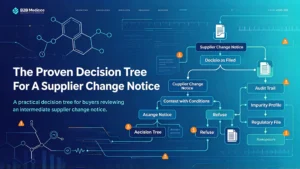
The Proven Decision Tree For A Supplier Change Notice
A buyer-side decision tree for handling an intermediate supplier change notice — what to accept, contest, or reject, and how to log the call.
Table of Contents
A supplier discontinuation notice is a deadline rather than a surprise. This buyer guide covers the questions to ask in writing, the last-time-buy calculation, the documents to collect before the records are archived, and the order to do it all in.
A discontinuation notice usually arrives as three short lines in an email: the item is being phased out, please confirm your remaining requirements by a given date. Most buyers read it as bad news and start hunting for a replacement the same afternoon. That instinct is understandable, and it is a week or two early.
The stretch right after the notice is the only period when the outgoing supplier still has the batch records, the people who ran your campaigns, and a commercial reason to be helpful. Whatever you fail to collect in that window is expensive to rebuild or simply gone. Buyers who spend the first week on paperwork tend to get a calmer transition than buyers who spend it on quotations.
Establish which of three situations you are actually in. They look identical in an email and diverge completely afterwards.
A genuine discontinuation means the item is going away. The plant has stopped, or will stop, making it. Nothing you say changes the outcome, and your job becomes managing an ending.
A production move is different: the same chemistry continues at another site or on another line. The item stays available, but the material will arrive from a plant your customer’s dossier does not mention. That is a change-control conversation, not a sourcing crisis, and it is usually negotiable.
A market withdrawal is the most commonly misread. The manufacturer still makes the product but has stopped serving a particular region, grade, or pack size. Volume, documentation scope, or a regulatory decision usually sits behind it, and a conversation about terms has more leverage than a search for a new supplier.
The cost of getting this wrong is real. Treating a production move as a discontinuation can push you into qualification work you did not need. Treating a discontinuation as a move leaves you waiting for a quotation that will never come. On the manufacturing side, most notices we send are commercial decisions rather than technical failures: a campaign that no longer fills a reactor, a raw material that became awkward to buy, a grade nobody else orders. None of those are arguments you can win, and knowing that early saves weeks.
Verbal reassurance on a call is worth nothing eighteen months later. Put the questions in an email the same week and keep the reply.
| What to confirm | Why it matters | What “answered” looks like |
|---|---|---|
| Last date you can place an order | The commercial cut-off and the production cut-off are frequently different dates | A date in writing, plus who has authority to extend it |
| Last date they can ship | Decides how much of your consumption the final campaign must cover | A date, and whether it moves if you commit to volume |
| Stock still held at their warehouse | Free volume that costs you nothing to ask about | Batch numbers, quantities, and the dates on those batches |
| Whether the decision is reversible | Some notices become “yes” once a customer commits to a campaign-sized order | A straight answer, even if it is no |
Two of those questions are commercial and two are operational, and different people inside the supplier’s organization answer them. Ask all four in the same message so the answers cannot be played against each other. If your supplier agreement already names who must be told when a product is withdrawn, quote that clause in your reply. A clause that is written but never invoked gets forgotten by everyone except you.
Most buyers answer this question by taking twelve months of consumption and adding padding. It is the wrong calculation, because the number that decides your order is not how much you use — it is how long you will be without a source.
Four inputs produce the figure. Your consumption rate, including whatever seasonal or campaign peaks your production plan already contains rather than a smooth annual average. Your realistic qualification time, taken from your own history of adding sources, not from a supplier’s optimistic estimate. The shelf life of the material, because stock that expires during the bridge is not stock. And an allowance for the first replacement candidate failing, which happens often enough that treating it as an exception is a planning error.
| Input | Where the number comes from |
|---|---|
| Consumption during the bridge | Your own production plan, peaks included |
| Qualification time | How long comparable source additions took in your own records |
| Shelf life limit | The retest window or expiry date as written on the material you already hold |
| Allowance for a failed first candidate | A judgement you make once, not a number a supplier gives you |
The constraint that catches people out is usually the third. Buyers calculate a generous requirement, receive it, then discover that holding two years of a moisture-sensitive intermediate is a bigger problem than the shortage they were insuring against. From the supplier’s side, we would rather quote a larger final order than watch a customer run dry — the awkward conversation is always about ageing material, not tonnage.
This is the part of a supplier discontinuation that gets skipped, and it is the part that hurts later. While the item is current, the supplier’s quality and technical staff can answer questions about it in an hour. After the last campaign closes, those people move to other products, the records are archived, and requests for detail start taking weeks if they are answered at all.
| What to ask for | Why you will want it |
|---|---|
| Batch record summaries for your campaign history | The only view of what actually varied while the item was made for you |
| Analytical method detail: column, conditions, reference standard source and lot | A replacement’s certificate is meaningless to compare without it |
| Trend of key parameters across recent batches | Lets you set realistic acceptance criteria for a new source |
| Change history: what changed, when, and why | Explains shifts you may have attributed to your own process |
| Packaging and storage rationale | Tells you what the material tolerates during a long bridge |
| Status of any regulatory filing that names the item | Your customer may have to update something, and only the supplier knows what the filing says |
Ask for the method detail first. It is the item buyers most often assume they already have, because the certificate looks complete, and it is the one thing a new supplier genuinely cannot guess. Six months after the final shipment, the person who ran your campaign may have left the company; the records nobody requested are the records nobody sends later.
If the material sits inside a regulatory submission, the same urgency applies to the parts of the regulatory file your customer’s dossier depends on.
It is worth reading the last few certificates from the outgoing source properly, rather than filing them because the batch was released. A certificate read line by line at this point tells you which parameters you actually rely on, and that list becomes what you demand from a replacement.
Once the last order arrives, the question shifts from sourcing to holding. Three things go wrong most often, and none are about money.
The first is storage. A drum that sat comfortably in a climate-controlled warehouse for a few months behaves differently after two years in a warm ambient store, and the conditions printed on the label are a floor, not a plan. Check what you are actually able to provide before you accept a large final delivery, not after.
The second is mixing. Material from the outgoing source and material from the new source will eventually meet in the same batch or the same finished lot, and the two are not interchangeable just because the specification lines match. This is exactly where how two sources behave from batch to batch decides whether your process runs the same way — and it is usually visible before the first commercial lot, if anyone looks.
The third is paperwork drift. Retest dates, batch numbering, and packaging formats from a new source will not match the old ones, and a warehouse team working from habit will eventually pick up the wrong drum. A short written note to the people who handle the material is cheaper than an investigation.
Here the sequence matters more than the effort. Buyers under time pressure tend to request quotations from several suppliers at once and treat the first acceptable price as progress. What actually determines the timeline is how quickly someone can be qualified, and qualification starts with the specification you already approved, not with a price list.
Send the old specification, the old analytical method, and a sample of the material you currently hold. A supplier who receives those can tell you within days whether they can match the profile or only match the chemical name. Send nothing but the product name and you will receive a quotation that says yes to everything and commits to nothing. That is why re-quoting a discontinued item is best treated as a new project rather than a continuation of the old order.
Then use the mechanism that exists for exactly this purpose. A trial order placed before any commercial volume is where the differences show up: drying behaviour, particle size, the way the material handles on your line. Nothing in a certificate substitutes for it, and the items that pass a trial cleanly are the ones that then move through approval without surprises.
The qualification itself has two halves. There is the technical half — specification, method, sample, trial — and the compliance half, which asks whether the documents behind the new source hold up on their own. A replacement that passes the first half and stalls in the second is the most common way a supplier discontinuation costs three extra months.
This is also the moment to be honest about why a second source is a qualification project rather than a spare quotation kept in a filing cabinet. Buyers who start that project after a notice are always behind schedule. Buyers who started it two years earlier are choosing between options.
The most useful thing to come out of a supplier discontinuation is a contract change, and it costs nothing while supply is running normally.
Ask for a notice period and, more importantly, for the two dates in writing: when you can last order, and when they can last ship. Notice periods vary and are a commercial decision rather than a regulated one, so the number matters less than the obligation to give a date you can plan against. Add a sentence requiring the documentation handover described above; a duty to hand over records is only enforceable if it is written down.
Then look at what the event exposed. If one supplier carried the whole requirement, the exposure was there long before the notice, and it is worth naming it as a single-source exposure on a critical intermediate rather than treating it as this year’s bad luck. A discontinuation is rarely the first signal; it is simply the one that could not be ignored.
Nothing in this guide removes the disruption. It shortens it. The buyers who come out of a supplier discontinuation with a working supply line are almost always the ones who spent the first two weeks collecting paper instead of chasing quotations — and who, by the time the last drum shipped, already knew what the replacement had to match.
A buyer-side decision tree for handling an intermediate supplier change notice — what to accept, contest, or reject, and how to log the call.
A supplier discontinuation is a deadline, not just bad news. The questions to ask in writing, the last-time-buy calculation, and the files to collect in time.

Rejected batch? What to do in the first hour, how to write the notice, who pays the costs, and the escalation path when a supplier stalls.

Manufacturer and supplier of pharmaceutical APIs and intermediates. Contact us for technical support and sourcing solutions.