Ultimate First Article Approval Checklist For A New Supplier
The first commercial batch from a new intermediate supplier is not a formality. Here is the checklist, the five approval outcomes, and how to log the call.
Table of Contents
The shipment has reached your warehouse. The supplier’s COA says 99.2% — inside specification. Your QC lab tests the same material and gets 98.1%, outside your assay limit. Whose number is right? Before accusing anyone, ask a harder question: did your incoming QC process give you a defensible answer?
This guide is written from the manufacturer’s side. We ship intermediates to buyers across India, Bangladesh, and Pakistan — and the buyers who argue with suppliers the most rarely have bad suppliers; they have no clear incoming inspection procedure. The ones who resolve disputes in days run the same seven checks.
Your sourcing process does not end when the truck arrives. It ends when a batch is examined against the agreed specification and released or rejected. Everything before this — the RFQ, the negotiation, the shipping — created an expectation. Incoming QC is where it meets a physical drum.
The checks are deliberately unglamorous. No single one proves a batch good; together they answer three questions: is it the batch you ordered, did it arrive intact, does the supplier’s data hold up in your lab?
Start before material is stored. The first five minutes catch more problems than any lab test — and cost nothing.
The most expensive assumption in buying intermediates is that a supplier’s certificate of analysis is a guarantee. It is not. A COA is a declaration — the batch met their specification, tested with their methods on their instruments. It is evidence, not proof — and the difference matters when your lab and theirs disagree.
Regulators agree. Under US 21 CFR 211.84, a receiving operation must examine containers and labels and perform at least one identity test on each batch before use — because documentation alone is not enough. Three things a COA never tells you:
Checks escalate from paperwork to laboratory work: run all seven on a first shipment; for an established supplier, checks 1–5 stay mandatory and 6–7 follow the reduced-testing logic below.
Verify the COA’s batch number, dates, and retest window are internally consistent — and that the batch is still within its retest period on arrival. A batch that lapsed in transit fails on arrival.
Seals intact, drums unopened, desiccant indicators in range. One broken seal can void a hygroscopic batch’s moisture claim — the cheapest quality check you run.
Net weight per drum against the packing list. A persistent underweight pattern suggests an out-of-control filling process — document it even if you accept.
Open a representative drum and look: color versus the supplier’s typical description, free-flowing versus caked, no foreign matter. A trained eye catches most gross deviations before any instrument.
Define in advance how many samples, from which drums, with what tolerance. This discipline — behind a supplier’s batch-to-batch consistency — protects you from your own “test into compliance.”
Run at least one identity test on a representative sample: FTIR against a reference spectrum, melting point, or another identity reaction. This is the regulatory minimum in 21 CFR 211.84(c), and the one test that catches mislabeled material. It only has power if you hold a suitable reference standard — qualify one before you need it.
Verify the two specification points that matter most to your next step — typically assay and water, plus any critical impurity — and compare with the COA. The question is not whether the numbers are identical but whether they sit within the method’s inter-laboratory variation. A few tenths of a percent on HPLC is usually noise; beyond that range is a genuine discrepancy that triggers rejection.
Full testing of every batch is expensive, and most buyers cannot justify it once a supplier has a record. Reduced testing is a privilege the supplier earns — and it rests on three conditions. If any is missing, test fully.
Even then, keep checks 1–4 on every batch. Reduced testing relaxes laboratory work — nothing else.
A failing batch is not a disaster; a disorganized response is. Six steps keep a rejection under control:
| Red flag | What it usually means | Your response |
|---|---|---|
| Sends a COA but delays sharing raw data or impurity profiles | Numbers may not survive scrutiny | Require raw data for critical specs before release |
| Retest answers “change sample, method, analyst” until a result passes | Test-into-compliance culture | Refuse; demand a fixed-protocol investigation |
| Every deviation report ends in “laboratory error” with no root cause | No real investigation capability | Escalate to a site audit |
| Batch numbers inconsistent across COA, labels, and packing list | Paperwork is an afterthought | Hold the batch until documents are corrected in writing |
| Questions why you test “so strictly” or pushes its in-house spec | Weak QC culture | Point to the agreed specification; change it only formally |
| Offers a discount and a waiver instead of investigating a rejection | Commercial fix for a quality problem | Decline; quality and discounts are separate documents |
One pattern deserves attention: the supplier whose impurity story is thin. If a rejected batch cannot be explained by the data they share, the gap matters downstream — impurities that survive your process reappear later. Read about impurity fate mapping before accepting a “harmless impurity” argument.
On a first shipment, yes — at minimum an identity test plus a spot check of the points critical to your process, mirroring 21 CFR 211.84. Once a supplier’s history and batch consistency are proven, move to reduced testing, keeping documentation and container checks on every batch.
Judge against inter-laboratory method variation, not zero. A few tenths of a percent on HPLC is usually method noise; a difference beyond the method’s expected range — or any failure on a point critical to your next step — is genuine. When in doubt, test a joint split sample at an independent laboratory before calling it a rejection.
Yes — but under a fixed protocol: same samples, same method, an agreed laboratory, never fresh samples chosen by the supplier. If the process continues until a result passes, that is test-into-compliance — a red flag, not a resolution.
A concession releases the batch, not the risk. The deviation moves downstream and can reappear in your output, so concessions fit only non-critical deviations, need written quality approval, and should be rare. Conceding regularly means the specification or the supplier is wrong — change one.
Incoming QC is not about distrusting suppliers. It makes both sides’ numbers mean the same thing — and gives you a documented answer when they do not. The seven checks are deliberately ordinary: match the paperwork, inspect the containers, run an identity test, spot-check key specifications, and treat failure as an investigation, not a fight.
Buyers who do this get better supplier behavior, because suppliers respond to those who hold material to a standard. When a batch genuinely fails, the same record that protects you shows the supplier what to correct — the only outcome that makes the next shipment better. A second source gives you leverage before a rejection forces it: see when dual sourcing makes sense.
The first commercial batch from a new intermediate supplier is not a formality. Here is the checklist, the five approval outcomes, and how to log the call.
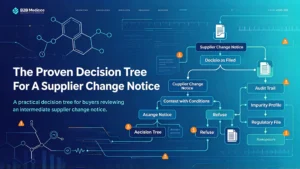
A buyer-side decision tree for handling an intermediate supplier change notice — what to accept, contest, or reject, and how to log the call.
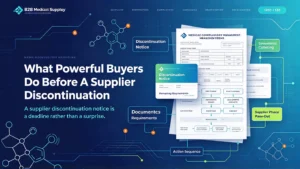
A supplier discontinuation is a deadline, not just bad news. The questions to ask in writing, the last-time-buy calculation, and the files to collect in time.

Manufacturer and supplier of pharmaceutical APIs and intermediates. Contact us for technical support and sourcing solutions.