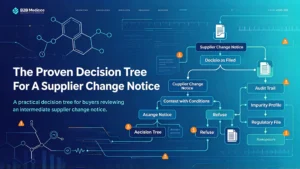
The Proven Decision Tree For A Supplier Change Notice
A buyer-side decision tree for handling an intermediate supplier change notice — what to accept, contest, or reject, and how to log the call.
Table of Contents
On January 30, 2025, the FDA approved suzetrigine (brand name Journavx, development code VX-548) for moderate-to-severe acute pain in adults. That sounds routine until you realize what it represents: the first drug with a genuinely new mechanism of action for pain to reach the market since celecoxib in 1998.
Vertex Pharmaceuticals built this molecule as a selective NaV1.8 sodium channel inhibitor. The target sits on peripheral pain-sensing neurons, not the central nervous system. That distinction matters — it is the reason suzetrigine carries no addiction risk, no respiratory depression, and no euphoria.
In a healthcare landscape where opioid overdoses claimed over 80,000 American lives in 2022, a non-addictive analgesic with real clinical data is not just a product. It is a public health tool.
For pharmaceutical intermediate buyers, the signal is simpler: a brand-new drug, approved less than six months ago, with no generic competition yet, and a synthesis route that is technically demanding. If you source intermediates for a company planning to develop a generic or supply manufacturers, the window to establish reliable supply chains is right now.
NaV1.8 is a voltage-gated sodium channel expressed almost exclusively on peripheral nociceptors — the nerve cells that detect painful stimuli. Suzetrigine binds to the voltage-sensing domain 2 (VSD2) of this channel and locks it in the closed state.
Pain signals never propagate. The drug does not enter the brain at meaningful levels (brain-to-plasma ratio below 0.1), which is why the CNS side effects that plague opioids simply do not apply here.
The selectivity profile is striking. Suzetrigine inhibits NaV1.8 at sub-nanomolar concentrations (IC50 of 0.68 nM on human channels) while showing over 31,000-fold selectivity against other sodium channel subtypes. It also cleared screens against 180 non-NaV targets with no significant off-target activity.
From a manufacturing standpoint, this selectivity is not just a selling point. It means the molecule has a specific, complex three-dimensional structure that must be reproduced exactly. Four chiral centers sit in the core tetrahydrofuran ring, and getting any of them wrong produces an inactive or potentially harmful stereoisomer.
This is the heart of what makes suzetrigine intermediates harder to source than a typical API building block.
Parameter | Detail |
Generic name | Suzetrigine |
Brand name | Journavx |
Developer | Vertex Pharmaceuticals |
CAS number | 2649467-58-1 |
Molecular formula | C₂₁H₂₀F₅N₃O₄ |
Molecular weight | 473.39 g/mol |
Drug class | Selective NaV1.8 inhibitor (non-opioid analgesic) |
Indication | Moderate-to-severe acute pain (adults) |
Dosing | 100 mg loading dose, then 50 mg every 12 hours (max 14 days) |
Key metabolic pathway | CYP3A |
Strip away the complexity and suzetrigine breaks down into two fragments:
The final assembly involves acylation and amide coupling between these two fragments. Fragment 3 is accessible through established chemistry. Fragment 2 is the bottleneck, and it is where buyers need to focus their attention.
Five distinct synthetic routes for Fragment 2 appear in published patents and literature. They differ in starting materials, step count, and — critically — in how they handle the four stereocenters.
Starts from a simple aldehyde (Compound 4) and builds the THF ring over seven steps: TMSOTf-mediated addition with 1,1,1-trifluoroacetone, cyclization, triflate formation, cross-coupling, intramolecular ring closure, hydrogenolysis, and ester hydrolysis.
The product is a racemic mixture (2-rac), meaning a downstream chiral resolution by supercritical fluid chromatography (SFC) is required. This works, but SFC resolution at scale is expensive and wastes roughly half the material.
Begins with two fragments (Compounds 11 and 12), condenses them through cyclization and hydrogenation to form Compound 14, then takes Compound 14 through four more steps: reduction, acylation, cyanation, and hydrolysis.
This route is notable because it aims for stereoselective synthesis rather than resolution, which is more efficient if the stereochemistry holds up at scale.
Starts from Compound 12 and runs six steps: lactonization, hydrolysis, asymmetric hydrogenation, decarboxylation, coupling, and stereochemical inversion.
The asymmetric hydrogenation step is the key — it introduces one chiral center enzymatically or with a chiral catalyst, which then controls the downstream stereochemistry.
This route is theoretically elegant but sensitive to catalyst performance and batch-to-batch consistency.
Also starts from Compound 24, running six steps: reduction, sulfonylation, cyanide substitution, hydrolysis, coupling, and stereochemical inversion.
Similar to Route 3 in step count but uses a different strategy for chiral center installation.
The cyanide substitution step requires careful control of reaction conditions to avoid racemization.
The longest route — eight steps starting from Compound 28: deprotection-reduction, benzylation, silyl protection-fluoroalkylation, TMS removal, ring opening, cyclization, debenzylation, and oxidation.
While the step count is high, this route offers the most flexibility for introducing the trifluoromethyl group, which is one of the trickiest structural features to install cleanly.
The route your supplier uses directly affects what you should scrutinize on the Certificate of Analysis. If the supplier runs Route 1, expect an SFC chiral purity specification — ask for the chromatogram.
If they use Route 3 or 4, probe the asymmetric hydrogenation or cyanide substitution step, because these are where racemization hides.
If they run Route 5, the fluroalkylation step introduces potential regioisomeric impurities that are easy to miss unless you are looking for them.
Three routes are published for this fragment, and all are well-established chemistry:
Route | Starting material | Steps | Notes |
1 (CN102164922A) | 4-Aminopyridine-2-carboxylic acid | 1 (esterification → amide) | 74% yield, simplest route |
2 (CN1210267C) | 4-Nitropyridine-2-carboxylic acid methyl ester | 1 (reduction + amidation) | Good for large scale |
3 (CN103958475B) | 4-Chloropyridine-2-carboxylic acid | 3 (esterification, azidation, hydrogenation) | Safer handling, avoids nitro intermediates |
Fragment 3 is rarely the sourcing bottleneck. Most intermediate suppliers can produce it. The quality concern here is residual palladium from the hydrogenation step (Routes 2 and 3), which must be controlled to ICH Q3D limits.
Three published routes complete the final molecule:
When evaluating a supplier for suzetrigine intermediates — particularly the THF core fragment — here are the checkpoints that separate reliable material from a problem waiting to happen:
Four stereocenters means four potential sites for epimerization. Request chiral HPLC or SFC data for each batch. A specification of ≥99.0% de (diastereomeric excess) per stereocenter is the minimum you should accept for development-grade material. For clinical supply, ≥99.5% is standard.
Routes 1 and 5 use TMSOTf (trimethylsilyl triflate), which is corrosive and difficult to remove completely. Route 4 involves cyanide chemistry.
Route 3 uses chiral catalysts that may contain ruthenium or rhodium. All of these leave residues that need to be quantified against ICH Q3C limits on the CoA.
The triflate intermediate in Route 1 and the azide in Route 3 of Fragment 3 are both structural alerts for genotoxicity. A supplier worth working with will have conducted impurity control studies — specifically Ames testing or in silico assessment (Derek/Nexus) on these intermediates. Ask for the assessment, not just the result.
The THF core contains a trifluoromethyl group and two fluorine substituents on the aromatic ring. Fluorinated intermediates can be thermally labile — not dangerously unstable, but prone to slow degradation if stored above 25°C for extended periods.
If your supplier ships from a region where summer container temperatures routinely exceed 50°C (common on Shanghai-to-Mumbai or Ningbo-to-Rotterdam routes), request accelerated stability data at 40°C/75% RH for at least 3 months.
Suzetrigine is a 2025 drug. No supplier has a decade of experience making these intermediates.
What you should look for instead is demonstrated capability in similar chemistries — fluorinated aromatics, stereoselective THF synthesis, or trifluoromethylation reactions.
Ask for capability statements, not just product lists. Review the supplier’s track record on supplier compliance verification — including audit history, quality system documentation, and change control procedures.
Suzetrigine is currently approved only for acute pain, with a maximum 14-day treatment window. That limits volume in the short term. But three factors are pushing demand upward:
Chronic pain expansion. Vertex is running a Phase III trial for diabetic peripheral neuropathy (NCT04991178). If suzetrigine gets a chronic pain indication, annual prescription volume could multiply tenfold or more. Intermediate demand would follow within 12-18 months of approval, as generics manufacturers ramp up.
Combination therapy. Open-label data showed that 73% of patients needed supplementary NSAIDs alongside suzetrigine. Combination formulations are a natural next step, and each combination product requires its own intermediate supply chain.
Next-generation NaV1.8 inhibitors. Vertex’s pipeline includes VX-993, a follow-on NaV1.8 inhibitor. Other companies — Biogen, Gilead, and several Chinese firms — have NaV1.8 programs in early clinical stages. These molecules share synthetic building blocks with suzetrigine, particularly the difluoromethoxyphenyl and trifluoromethyl-containing fragments.
The patent landscape tells its own story. Vertex’s compound patent (CN114945566B) and the newer process patent (CN117794921A) cover the core structure and key routes.
But process patents for alternative routes are already being filed in China (CN118772124A, filed October 2024), which signals that manufacturers are actively designing around Vertex’s original synthesis — a classic precursor to generic entry.
Suzetrigine is the rare case where a new drug’s intermediate supply chain is genuinely still being built. The THF core fragment with its four stereocenters is technically demanding, the synthesis routes are still maturing, and the competitive landscape is wide open.
For buyers, that means two things: act now to secure qualified supply, and scrutinize chiral purity and genotoxic impurity data harder than you would for a routine intermediate. The suppliers who get the stereochemistry right and document it properly are the ones worth building a long-term relationship with.
A buyer-side decision tree for handling an intermediate supplier change notice — what to accept, contest, or reject, and how to log the call.
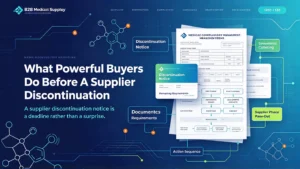
A supplier discontinuation is a deadline, not just bad news. The questions to ask in writing, the last-time-buy calculation, and the files to collect in time.
Rejected batch? What to do in the first hour, how to write the notice, who pays the costs, and the escalation path when a supplier stalls.

Manufacturer and supplier of pharmaceutical APIs and intermediates. Contact us for technical support and sourcing solutions.