You’ve found a supplier, agreed on specifications, and settled on a price. Then the next question hits: how does the material actually get from a factory in China to your warehouse or CMO?
I work at Tianming Pharma, and our team ships intermediates to buyers in North America, Europe, Latin America, and Southeast Asia every week. Over the years, we have seen shipments held at customs for a week because of a single digit wrong in an HS code.
We have watched couriers refuse to pick up a properly documented chemical because an MSDS was not on file. One buyer called us urgently after his sea freight sat in LA port for twelve days with no status update.
This guide covers what actually matters, in the order you will encounter it.
Documentation: Get This Right or Nothing Else Moves
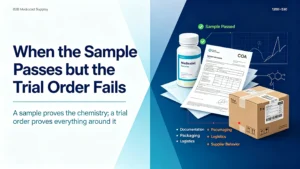
The majority of shipping delays trace back to paperwork — not product quality issues, not fraud, just documentation inconsistencies. Here is what needs to be aligned before anything leaves our facility:
Commercial Invoice. This must match the purchase order exactly: product name, quantity, unit price, total value, Incoterms, and HS code. A shipment where the invoice says “Pharmaceutical Intermediates” but the packing list says “Chemical Samples” will be flagged at customs. Every document needs to use identical terminology — avoid any variation in product descriptions.
Packing List. Itemizes gross weight, net weight, dimensions, and number of packages. The freight forwarder uses this information to book cargo space. Even a small weight discrepancy can trigger adjustment fees later.
Certificate of Analysis (CoA). Specific to pharmaceutical intermediates: each shipment requires a CoA tied to that production batch, with test results measured against the agreed specification. If you are unfamiliar with reading a CoA, we have published a separate guide on how to read a Certificate of Analysis that walks through each section.
Material Safety Data Sheet (MSDS). Required regardless of whether the product is classified as hazardous. Most carriers will not accept a chemical shipment without a valid MSDS on file.
Certificate of Origin. Not always required — relevant if your country has a free trade agreement with China or your regulator requires proof of origin. Request it before the shipment departs. Obtaining one retroactively is time-consuming and often difficult.
One practice we recommend: ask your supplier to email scans of all documents before the goods leave. Spend five minutes checking that the product name, batch number, and quantity match across all documents. That five minutes can prevent weeks of customs delays.
HS Codes
The Harmonized System code determines your import duty rate and whether the shipment triggers special permit requirements. Most pharmaceutical intermediates fall under Chapter 29 (Organic Chemicals). Common codes include:
- 2933.99 — Heterocyclic compounds with nitrogen hetero-atoms. Covers many API intermediates.
- 2942.00 — Other organic compounds. The catch-all category.
- 2922.49 — Amino-acids and esters. Relevant for amino acid derivatives and peptide-related intermediates.
The HS code is determined by chemical structure, not the trade name your supplier uses. Your supplier should provide the code, but verify it with your own customs broker. A mismatch between the code on shipping documents and your import declaration will raise questions at customs.
A note of caution: avoid using a vague “chemical sample” code to reduce duties. Customs authorities are increasingly sophisticated at detecting this, and the penalties generally exceed the duty avoided.
Packaging: Where Shortcuts Show Up
Pharmaceutical intermediates require packaging that protects the product from moisture, light, oxygen, and physical damage across international transit — not just a domestic truck delivery.
What proper intermediate packaging looks like, from inside out:
- Inner layer: Double food-grade PE bag, heat-sealed. Use heat-sealing, not twist-ties.
- Middle layer: Aluminum foil bag if the product is light-sensitive or hygroscopic.
- Outer layer: Fiber drum (typically 25 kg) or UN-approved box for smaller quantities.
- Desiccant packs inside for moisture-sensitive products.
If a supplier ships in a single plastic bag inside a cardboard box, that is not pharmaceutical-grade packaging. It might survive a short domestic route; it will not survive three weeks on a container ship crossing the Pacific, where temperature swings of 30 degrees are common.
For cold-chain products — certain peptide intermediates and temperature-sensitive compounds — validated cold chain packaging with data loggers is necessary. Confirm temperature requirements with your supplier before the shipment is prepared, not after.
Air Freight, Sea Freight, or Courier
The right choice depends on order size, urgency, and product characteristics.
Air freight: typically 3 to 7 days. Best suited for orders under 100 kg, high-value products, or situations where your CMO needs the material on a tight timeline. More expensive per kilogram, but the speed often justifies the cost — particularly for clinical trial materials where a shipping delay can push project timelines back by months.
Sea freight: 20 to 40 days. The practical choice for orders above 100 kg, full pallets, or multiple drums. Significantly less expensive per kilogram than air freight, but requires more advance planning. Sea freight also exposes products to greater temperature and humidity fluctuations, so packaging quality becomes more critical.
Courier (DHL, FedEx, UPS): 3 to 5 days. Suitable for small samples under 5 kg. One caveat: courier companies have strict policies on chemical shipments. Some will not accept pharmaceutical intermediates even with complete documentation. Verify acceptance before booking, not after the pickup fails.
A practical approach: for a first order with a new supplier, start with a small quantity via air freight or courier. Once the product and documentation process is proven, transition to sea freight for commercial-scale quantities.
Incoterms: Defining Responsibility and Cost
When you agree on a price with a supplier, the Incoterm (International Commercial Term) defines who bears each cost and at what point risk transfers from seller to buyer. Misunderstanding this on a significant order can be costly.
The terms most commonly used for pharmaceutical intermediate shipments from China:
FOB (Free on Board). The supplier is responsible for everything up to loading onto the vessel at the Chinese port of departure. After that point, the buyer pays for ocean freight, insurance, and handles import clearance. This is the standard arrangement for most sea freight orders and works well if you have a freight forwarder.
CIF (Cost, Insurance, Freight). The supplier pays freight and insurance to the destination port. The buyer handles import clearance and final delivery. One important detail: CIF insurance provides only minimal coverage. Do not assume full protection.
EXW (Ex Works). The supplier’s responsibility ends at the factory gate. The buyer manages everything from pickup onward. Recommended only for buyers with established logistics relationships and freight forwarders who can coordinate pickup in China.
DAP (Delivered at Place).The supplier delivers to the buyer’s named destination, handling all transport; the buyer handles only import clearance. The most buyer-friendly option, increasingly common for sample orders and smaller shipments.
Agree on the Incoterm before confirming the order. Both parties must be aligned. Changing terms mid-shipment creates administrative complications that are difficult to resolve.
Customs Clearance: The Buyer’s Side
We handle export clearance from China. Import clearance at the destination is the buyer’s responsibility. What you will typically need:
- Importer of Record (IOR): an entity legally authorized to import goods into your country. This can be you, your CMO, or a licensed customs broker.
- Customs Bond: required in the United States for shipments valued above $2,500. Your broker arranges this.
- FDA Prior Notice: depends on the product classification and intended use. Not every intermediate requires it, but some do — verify before shipping.
- Country-specific permits: REACH registration for Europe, TSCA compliance for the United States, or local drug authority notifications depending on your destination.
Our recommendation: engage a customs broker who has specific experience with pharmaceutical or chemical imports. A general freight forwarder may charge less, but any inexperience will be at your expense. A specialist costs marginally more and saves significantly more in avoided delays.
After the Shipment Arrives
Two steps that should not be skipped:
First, inspect the packaging before signing the delivery receipt. Open the container and examine the drums or boxes. Are there water stains, signs of crushing, or broken seals? Photograph any damage and note it on the delivery receipt before signing. Once you sign a clean receipt, proving transit damage later becomes significantly more difficult.
Second, pull a sample and re-test. Even with a reliable supplier, a product exposed to temperature fluctuations during weeks of transit can change. Run HPLC against the original CoA values.
If the numbers do not match, you at least know that something occurred during shipping, rather than discovering a yield issue months later with no explanation. (Concerned about CoA authenticity? We have also covered how to identify fake or altered Certificates of Analysis — a problem more common than many buyers realize.)
Shipping pharmaceutical intermediates from China is straightforward when handled systematically. The essentials are accurate documentation, adequate packaging, and a competent customs broker. Those three elements resolve the vast majority of potential issues.
If you are still in the supplier evaluation stage and have not yet placed an order, we have published a guide on verifying pharmaceutical intermediate supplier compliance. It covers the fundamentals and helps avoid common early-stage mistakes.
Written by the Tianming Pharma Quality & Technical Team. Updated June 2026.
We help pharmaceutical buyers navigate sourcing, quality assurance, and logistics from our manufacturing base in China. For questions about shipping your specific intermediate, contact our team. sunqian0123@gmail.com