Ultimate First Article Approval Checklist For A New Supplier
The first commercial batch from a new intermediate supplier is not a formality. Here is the checklist, the five approval outcomes, and how to log the call.
Table of Contents
Most supplier problems do not show up at the audit. They show up three months later, on the batch that was supposed to be routine, when the impurity profile moves half a point and nobody can reconstruct what the qualification decision was based on. A first article review is the last point in the process where you can still stop.
The term comes from mechanical manufacturing, where the first article proves a process can hold its tolerances on a real line rather than on a bench. In pharmaceutical intermediate sourcing the same idea applies with one important difference: the thing being verified is not geometry but evidence.
The question is not whether the material looks right. It is whether the supplier’s documentation, the physical material, the analytical numbers, and the site you are relying on all describe the same thing.
Buyers often treat this as the last checkbox before releasing a purchase order. That is the wrong order. Treat it as the first decision that either confirms or questions everything an the 30-question supplier audit and evaluating a supplier on site turned up. An audit tells you what a process is designed to do. A first article tells you what it actually did, this time, in writing.
A first article is the first batch produced under conditions representative of commercial manufacturing, reviewed against the agreed specification before the rest of the order proceeds. Three things it is not, and confusing any of them leads to a qualification that looks stronger than it is.
It is not the courtesy sample. The material that opens a relationship is usually produced under conditions chosen to make it look its best — often a laboratory batch, a hand-selected input, an unhurried shift. Useful for screening, useless as evidence of production consistency. The gap between the sample you approved and the batch you receive is where batch-to-batch consistency is either earned or lost.
It is not a repeat of the certificate of analysis. A CoA is the supplier’s own report on the supplier’s own data — a necessary document and a weak one. Reading reading a certificate of analysis properly tells you what to compare; it does not tell you whether your own laboratory, on your own method, reproduces the number. For a first article, confirmatory testing on your side is what converts a document into a decision.
It is not permanent. Approval is a status with an expiry condition, not a stamp. It expires the moment the supplier changes something material — and most suppliers will not volunteer that unless you built the obligation to. That is why the notification clause in the change-notice clause and the decision path in our guide on when the supplier changes something later are the same conversation, held at two different points in the relationship.
There is one further confusion worth naming, because it appears in more qualification files than any other: the sample you approved, the trial batch you watched, and the first commercial batch you released are three separate pieces of evidence. Collapsing them into one approval is convenient and wrong. Each answers a different question.
Sequence matters more than individual items. Most teams jump to the analytical numbers first, because numbers travel well in an email. Numbers are the last layer, not the first.
Layer one — documentation. Before the material moves, compare the supplier’s specification, the agreed acceptance criteria, the proposed test panel, and the analytical method behind each reported figure. If these are set after the batch is made, you are not reviewing a first article; you are writing a specification to fit whatever arrived. This is the sequencing problem that shows up in setting acceptance criteria before the first order.
Layer two — the physical material. Container count, seal integrity, label consistency against the paperwork, storage conditions during transit. A broken seal does not only mean the material is questionable; it means every number reported for that container describes something you cannot fully account for. Note the discrepancy before the material leaves quarantine, not after.
Layer three — the numbers, from both directions. The supplier’s report on their method, and your laboratory on yours. Where the two disagree, the interesting question is not who is wrong but whether the methods are comparable at all. A method difference that produces a repeatable offset is a documentation problem you can close with a comparability study. A method difference that produces a different impurity profile is a process problem, and it needs the supplier’s root cause, not a second opinion.
Layer four — the site and the schedule. Confirm the manufacturing location, the equipment class, and the batch size against what was evaluated. A first article produced on a different vessel than the audit described is a new qualification question, not a satisfied one. The same applies when the batch arrives on a schedule too tight to have been produced the way the process description says. Schedule pressure is a signal, not a neutral fact.
Most first article reviews turn into long arguments about isolated values. Two questions resolve the majority early, because they establish what kind of review this is.
The first: was this batch produced under conditions representative of the intended commercial supply, and if not, what is different? A development batch, an engineering batch, and a commercial batch are three different evidence categories with three different evidentiary weight. Mixing them into one approval is the most common way a qualification decision turns out to be weaker than everyone believed at the time.
The second: does the supplier’s test panel cover what your process actually needs, or only what the specification happens to list? These are frequently different documents. An intermediate can meet its stated assay and still present an unknown impurity that your downstream reaction will concentrate as the material moves through it. This is the same reasoning behind the five elements of intermediate quality control — the specification is a floor, not a description of risk.
Once those two questions are answered, five outcomes remain. Most disagreements about a first article are really disagreements about which of these was recorded, so naming the options before the meeting removes the ambiguity.
| Outcome | When it applies | What the record must contain |
|---|---|---|
| Approve as filed | Documentation, material, numbers and site all agree; nothing unresolved | Specification revision as approved, method set, batch identity, date, approver |
| Approve with conditions | Usable material, but one attribute, document or method comparison is still open | Each condition as a verifiable item with an owner and a date |
| Hold for evidence | Nothing wrong, something missing — a chromatogram, a stability point, a method description | Exactly which evidence, what question it answers, by when |
| Reject and restart | Critical difference, unrecoverable traceability gap, or non-comparable method | The finding, plus what would have prevented it |
| Limited scope | The process supports one grade, scale or route — not the full intended use | The boundary in writing, and what must change to widen it |
This is the outcome that requires the least explanation, and the one most often granted informally. It holds when documentation, material, numbers, and site all agree and nothing is unresolved.
The record still has to be complete, because “approve” without a named baseline cannot be compared against anything later. State the specification revision as approved, not “the current spec”. Name the methods, not “standard methods”. Record the batch identifier, the decision, the date, and the approver. This baseline is what every future change will be measured against, and what a reviewer will ask for when the same supplier proposes a different route in two years.
This is the most useful outcome and the most frequently documented badly. It applies when the material is usable but something is not yet closed — one attribute, one document, one method comparison, one missing figure.
Each condition needs three things: a verifiable statement, an owner, and a date. “Supplier to confirm residual solvent profile” is not a condition; it is a sentence. “Supplier to provide the residual solvent method and three batch results by the date of the second commercial order” is. Conditions without a due date become wishes, and a year later nobody remembers agreeing to them, which means the next reviewer inherits an open item that was closed in everyone’s memory but not on paper.
One discipline matters here more than it appears to. A conditional approval is still an approval, and it is tempting to release the rest of the order as though nothing was open. Resist it. Hold the material, or release it against a written boundary that says what happens if the condition fails after the material is already in your process.
Nothing is wrong and something is missing. A chromatogram, a stability point, a batch record extract, a method description, a confirmation of which vessel ran the campaign. This outcome exists to keep a conversation alive that would otherwise end badly.
Write it as neutral. A hold is not a rejection and should not read like one; suppliers respond very differently to “we need the chromatogram to close this” than to “your data is insufficient”. State exactly which evidence is needed, what question it answers, and by when. Most holds close within a week because the evidence usually already exists and was simply not packaged.
The failure mode to watch for is the hold that never closes. If two consecutive holds produce the same missing item, the real finding is that the supplier cannot supply it at all — which is a rejection with better manners, and should be recorded as one.
A critical difference, an unrecoverable traceability gap, a method that cannot be compared, or a site that does not match what was evaluated. These are the four cases where no amount of further documentation rescues the qualification.
Rejection is expensive and cheap to correct. The expensive version is approving a batch that was never qualified, discovering the gap a year later during what your incoming QC actually tests, and learning that the original record does not say what everyone assumed it said.
Two things belong in a rejection record. First, the finding, stated so precisely that the supplier cannot argue with the facts even if they dispute the conclusion. Second, what would have prevented it — was this visible in a document that was never requested, in a question nobody asked at the audit? That second question turns a rejection into a change to your own process rather than a complaint about theirs.
A fifth outcome sits outside these four and is worth naming because it is so often granted silently: approval for a limited scope. The process supports one grade, one scale, or one route, but not the full intended use. Write the boundary down — what is approved, what is not, and what has to change before the scope widens. Silent scope limits are never discovered in a meeting. They are discovered in an audit, two years later, when someone asks whether the approved material was the approved material.
The record is the deliverable. Everything else is a meeting that produced one.
Write it at the level someone can act on a year from now without asking you. That means the specification revision as approved, the method names, the batch identifier, the decision, the conditions, and who signed. Two weeks of this work saves an argument with a supplier’s quality manager who was not in the meeting — which is the version of the argument nobody enjoys and everybody has had.
Then feed the approved baseline into the ongoing file rather than filing it separately. A first article record that never touches a supplier scorecard is a document, not a control. The point of the baseline is that the next comparison — the repeat order, the changed raw material, the supplier who quietly stops offering it — has something to be measured against.
Buyers who run this well describe it as unremarkable. The first article passes, the record is filed, the supplier is released, and nothing else happens for years. That is the correct experience. The value shows up eighteen months later, when a question has to be answered quickly and the answer is already written down in a form someone else can read.
The first commercial batch from a new intermediate supplier is not a formality. Here is the checklist, the five approval outcomes, and how to log the call.
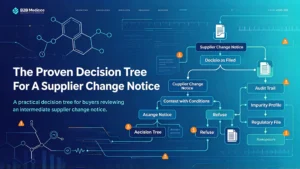
A buyer-side decision tree for handling an intermediate supplier change notice — what to accept, contest, or reject, and how to log the call.
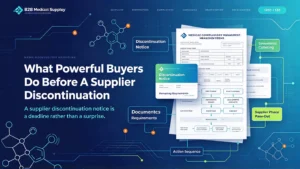
A supplier discontinuation is a deadline, not just bad news. The questions to ask in writing, the last-time-buy calculation, and the files to collect in time.

Manufacturer and supplier of pharmaceutical APIs and intermediates. Contact us for technical support and sourcing solutions.