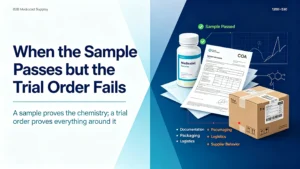
Abstract: A sample proves the chemistry; a trial order proves everything around it — documentation, packaging, logistics, and how a supplier behaves when something slips. This guide walks buyers through both, in the order that costs least and reveals most.
A formulator in Hyderabad sent us a sample request in March. Clear specification, reasonable quantity, the batch certificate attached to the inquiry. We shipped the sample from a running commercial batch; their lab confirmed every figure against their own method. Then came the trial order — two drums.
It left nine days late, the certificate inside the drum referred to a different lot than the one packed, and nobody told them the drums had changed from the steel type quoted to a fibre alternative. The material itself was fine. The order was a mess.
Buyers see this pattern constantly, and most blame the wrong thing. The sample did its job. So did the trial order — it just failed at a job the buyer never assigned it. A sample can only ever prove that the supplier can make the molecule. A trial order proves whether the organisation around the molecule works. Confusing the two is why a supplier can pass a perfect evaluation and still fail your first commercial shipment.
Why the sample proves less than buyers think
Samples are the most generous documents in this industry. When a buyer asks for a sample, a supplier has several options, and the easiest one is to reach for a kept laboratory lot — material made on a small reactor, handled carefully, possibly purified twice. It will test beautifully. It also proves nothing about the 25-kilogram batch that would eventually arrive at your plant, made by different operators, on a day when the plant was running three products at once.
The single most useful sentence in any sample request is therefore this one: send the sample from a recent commercial batch, and put the batch number on both the container and the certificate. Suppliers notice requests like this. It signals that the buyer will cross-check the paperwork, which changes what gets packed. If a supplier hesitates at that sentence — samples only from “development material”, no batch number available — that hesitation is data.
There is also a documentation layer that samples carry and buyers often skip. Ask for the batch-specific COA, the current specification, and the safety data sheet together, so the three can be checked against each other before anything is tested. A surprising number of discrepancies — limits that don’t match, methods referenced but not named — surface at this point, for free. Our guide to reading a COA covers the certificate itself; the habit that matters here is simpler: refuse to test material whose paperwork arrived incomplete.
Writing the sample request
A good sample request is short. It names the specification and revision, states the intended evaluation tests, asks for a commercial-batch sample with the batch number marked, and says what documents travel with it. Quantity is where buyers overthink — request enough for your own methods plus a retained portion, and stop there. Sample economics work differently from commercial quantities, and the MOQ conversation belongs to a later stage anyway.
One habit separates serious buyers from the rest: send identical sample requests to every shortlisted supplier. This is the natural continuation of a well-built RFQ — the same discipline of making answers comparable. When three suppliers receive the same request, differences in their responses stop being noise and start being signal. The one who asks a clarifying question about your specification is often the one who read it.
Who pays is a recurring anxiety. Policies genuinely vary — some absorb the cost, some charge it back, most ask the buyer to cover courier. Treat the courier cost as part of your qualification budget and stop negotiating over it. A supplier who argues about a courier fee during qualification has told you something about how disputes will go later.
When the sample arrives: read it like a skeptic
Check the packaging first, before the chemistry. The container type, the seal, the labelling, the lot number against the paperwork. Then compare the certificate to your specification line by line — not just the numbers, but the methods and the units. If anything looks manufactured rather than generated, the certificate verification checks take an hour and settle it.
In your own lab, test what matters to your process, not everything on the specification. Identity, assay, the two or three impurities your route is sensitive to, physical form if your formulation cares. Compare your results against their COA honestly — small method-related differences are normal and worth a question, not an accusation.
The reply to that question is itself a test; a supplier who can explain a 0.3% assay difference in terms of method conditions knows their material, and the way they answer tells you who wrote it.
Keep the retained portion sealed and labelled with the batch number and the retest date. When the first commercial batch arrives months later, that retained sample is the only honest baseline you will have.
The trial order is a rehearsal, not a bigger sample
Here is the idea buyers underuse. A trial order is small in quantity and enormous in information, because it exercises every function a commercial order will: production scheduling, QC release, documentation, export packing, freight, and the communication loop when something — something always — slips. A sample travels by courier with a lab sheet. A trial order has a purchase order, a commercial invoice, a packing list, customs paperwork, and a delivery date someone promised.
| | Sample order | Trial order | First commercial order |
|---|
| What it tests | The molecule and the lab | The whole delivery system | Whether the system holds under volume |
| Watch | Batch representativeness, COA vs spec, your own results | On-time date, document accuracy, packaging match, response to problems | Batch-to-batch trend, stability of everything the trial showed |
| Cost of getting it wrong | A wasted test cycle | A disrupted plant schedule at your end | A quality incident with regulatory consequences |
Judge a trial order on four things, none of which appeared on the sample’s COA. Did the goods leave on the confirmed date, or was the slip communicated early and honestly? Did every document — invoice, packing list, certificate, origin papers — match the shipment exactly? Did the packaging match what was quoted? And when you raised the inevitable question, how fast and how specifically did it get answered? Freight performance belongs here too; the export shipping process is where trial orders most often wobble, and a wobble handled well is worth more than a frictionless run.
That last point deserves emphasis. A trial order with one late day and a phone call that said “the drums are held in export inspection, here is the new date, and here is why” is a better qualification result than a flawless run you learned nothing from. You are not shopping for a perfect fortnight. You are shopping for how the supplier behaves in the ordinary imperfect one.
What good trial-order buyers do differently
We sit on the receiving end of these requests, so this is written with some feeling. Buyers who get clean trial orders tend to do three things. They define acceptance criteria before the trial ships, in writing, including what happens if one document mismatches.
They name one contact on each side, so problems travel a short distance. And they share an honest forecast — “this is a trial, commercial volume would be around this, timing roughly that” — which lets the supplier schedule properly instead of guessing. None of this costs money. All of it shapes how the supplier’s own team treats your file.
The trial order also generates the first real entries in whatever performance record you keep. Batch acceptance, document accuracy, on-time rate — the raw material of a supplier scorecard starts accruing here, two or three batches before anyone calls the relationship commercial.
The gate to the first commercial order
Resist the urge to convert a good trial directly into a large order. The gate between them is a short evidence review, and every item on it comes from records you already hold:
- Sample results, your lab against their COA, with the discrepancies resolved in writing.
- Trial-order documents matched against the shipment — all of them, not the ones you happened to check.
- The confirmed date versus the actual date, and how the gap (if any) was communicated.
- Retained samples from both stages, sealed, ready to compare against the first commercial lot.
- An open question list — anything the supplier said during the trial that was never substantiated.
If the list reads clean, place the commercial order and shift your attention to arrival inspection — the incoming QC routine takes over from there. If it doesn’t, you have spent a small order to learn what would have cost a production stop to learn later.
Frequently asked questions
How large should a trial order be?
Large enough to force the real process — real production scheduling, real export packing, real freight documents — and small enough that a failure costs you days rather than a quarter. For most intermediate buyers that means one to a few drums. If the order is so small it gets hand-carried through the plant, it stops being a trial.
Should the sample and the trial order come from the same supplier batch?
Not necessarily, and different batches are arguably better. Two consecutive compliant batches from routine production tell you more about consistency than one batch tested twice. Ask for the trial material’s batch certificate to reference the actual lot packed.
What if a supplier refuses to send a sample from a commercial batch?
Ask why. Sometimes the answer is innocent — the product is new to their list and only development lots exist. If so, weigh that against your need for consistency evidence. If commercial batches exist but “samples are only from development material”, treat the qualification as incomplete until you see routine production, on whatever scale you can arrange.
Can we skip the trial order if the sample was perfect?
You can, and sometimes the schedule forces it. But a perfect sample answers none of the questions a trial order does: document accuracy, on-time behaviour, packaging, problem communication. Buyers who skip the trial stage usually run it later anyway, with a full commercial order and much higher stakes attached.
The takeaway
Sample and trial order are two different experiments. The first tests whether the supplier understands the molecule. The second tests whether the supplier can be relied on — which is what you are actually buying. Keep them separate, keep the evidence, and let the trial order earn the commercial order.
We manufacture pharmaceutical intermediates for buyers across India, Bangladesh, and Pakistan, and we treat sample and trial stages as qualifications in both directions. Send us a specification and a trial plan — we will tell you honestly what we can and cannot demonstrate at that size.