Proven Checks Buyers Miss In A Batch Manufacturing Record
The first commercial batch from a new intermediate supplier is not a formality. Here is the checklist, the five approval outcomes, and how to log the call.
Back in 2019, I got a call from a procurement manager at a mid-sized European CDMO. He’d found one of our intermediates online, the price looked good, and he was ready to pull the trigger. Then he saw the line that stopped him cold: MOQ 25 kg.
He needed 500 grams. For a pilot batch.
“Can’t you just sell me a smaller amount?” Fair question.
The thing is, after 15 years on the manufacturing side of this business, I’ve fielded that exact question hundreds of times. And the answer is almost never a simple yes or no. It depends on whether we have stock, what the batch size looks like, how far along your project is, and honestly — whether we believe this is going somewhere.
MOQ isn’t just a number on a quote sheet. It shapes whether you can even access a supplier, how much capital you’ll tie up, and what kind of relationship you’re going to have. Get it right and you’ve got a partner who grows with you. Get it wrong and you’re sitting on 24 kg of material you won’t need for two years — or worse, you can’t get the material at all.
Here’s what most buyers don’t see: MOQ isn’t some number a sales manager pulled out of thin air. It comes from the reactor.
When we make an intermediate, we don’t produce it one kilogram at a time. We load starting materials into a reactor, run the reaction, work it up, purify it — and whatever comes out is the batch. If our standard setup yields about 50 kg, that’s the natural unit of production. It’s what the equipment was designed for, what the process was validated around, and what our costing model assumes.
So when someone asks for 2 kg, we’ve got two choices. Option A: run the reactor at a fraction of capacity, which means we’re burning a full production slot for a tiny output. Option B: make the full 50 kg, sell you 2 kg, and warehouse the other 48 kg, hoping someone else buys it before the retest date runs out.
Neither is great for us. That’s why the MOQ exists — not to be difficult, but because the economics of small batches are genuinely ugly. More on those economics in a minute.
Quick side note, because I see this confusion a lot: MOQ (minimum order quantity) and MPQ (minimum package quantity) are not the same thing. MPQ is about how the product is packed — say, 1 kg sealed foil bags. That means you can only order in multiples of 1 kg. MOQ is the total order minimum. A supplier might quote “MOQ 10 kg, packed in 1 kg units” — meaning you need to buy at least ten of those 1 kg bags.
This is the question I get asked most often: “What’s a normal MOQ?” The honest answer is: it depends entirely on where your project sits in the development pipeline.
At this stage, you’re screening compounds, running in vitro tests, maybe doing some early animal studies. You don’t need kilograms — you need grams, sometimes just milligrams.
Typical MOQ: Most commercial manufacturers won’t touch orders this small unless they have existing stock. Your best bet is to ask for available inventory samples — material left over from previous production runs. Many Chinese manufacturers (including us at Tianming) keep small quantities of commonly requested intermediates in stock specifically for this purpose.
What to expect: If a supplier agrees to supply gram-level quantities, expect to pay a significant premium — sometimes 5-10x the bulk price per gram. The cost isn’t in the material; it’s in the handling, documentation, and opportunity cost of using production staff for a small order.
This is the stage where MOQ conversations get real. You’ve identified a lead candidate, and you need enough material for formulation development, stability studies, and early clinical batches.
Typical MOQ: 1-5 kg for standard intermediates, potentially higher for multi-step custom synthesis.
At this scale, a manufacturer will usually run a dedicated batch. But here’s something most buyers don’t realize: the batch size might be 10-20 kg, but the supplier is willing to sell you 5 kg at a higher unit price and warehouse the rest — if you have a relationship with them and they believe in the project’s future.
Once you’re filing an ANDA or preparing for commercial launch, your volumes change dramatically.
Typical MOQ: 25-100 kg for most intermediates, though this varies widely by product complexity and market demand.
At this scale, the MOQ conversation flips. You’re no longer asking the supplier to make an exception — you’re negotiating the commercial terms for ongoing supply. The MOQ becomes less of a barrier and more of a pricing lever: larger committed volumes get you better unit pricing.
Why Suppliers Set High MOQs — And Why It’s Not Greed
I’ve heard it plenty of times. “They’re just trying to squeeze the small guys.” “It’s arbitrary.” “Why can’t they just be flexible?”
After running manufacturing operations for over a decade, I get why buyers think that. But I also know what the cost sheet looks like on the other side. And once you see it, the MOQ starts making a lot more sense.
Here’s the uncomfortable truth about small batches: a lot of your costs are fixed regardless of how much material you’re making.
Cost Factor | Why It Doesn’t Scale |
Analytical testing | A full QC panel (HPLC, GC, NMR, KF, residue on ignition, heavy metals) costs roughly the same whether the batch is 1 kg or 50 kg |
Documentation | The CoA, batch record, and compliance paperwork take the same amount of time |
Reactor cleaning | Cleaning and line clearance between batches is a fixed-time operation |
Raw material procurement | Suppliers of key starting materials have their own MOQs — you might need to buy 25 kg of a reagent to make 2 kg of product |
Yield losses | Small batches often have proportionally higher losses during workup and purification |
A manufacturer who quotes you 500/kg at 50kg MOQ might need to charge 500/kg at 50kg MOQ might need to charge 2,500/kg at 2 kg MOQ just to cover costs. That fivefold jump isn’t greed — it’s what happens when you spread the same analytical and documentation costs over 2 kg instead of 50.
Here’s something specific to pharma that general sourcing guides tend to miss. If you need material that’s GMP-grade — or even “GMP for intermediates” with proper documentation — the quality overhead doesn’t scale down.
Let me give you a real example. Say a batch comes out slightly below expected yield, or an HPLC peak shows up a little wider than usual. That triggers a deviation investigation. QC spends half a day re-running samples. QA reviews the batch record, writes up a report, maybe opens a CAPA.
On a 100 kg batch, that overhead is maybe 5−10perkilogram—noise.Ona1kgbatch?That same investigation could add 5−10per kilogram—noise. On a 1kg batch? That same investigation could add 500-1,000 per kilogram. At that point, the batch is underwater no matter what you charge.
How Experienced Buyers Actually Handle MOQ
After watching procurement teams navigate this for years — some successfully, some not — here are the approaches that actually work. Not textbook theory. Stuff I’ve seen close deals.
Before you even bring up custom production, ask one question: “Do you have any inventory from a previous campaign?”
You’d be surprised how often the answer is yes. Manufacturers run campaigns for large customers, produce a bit of overage as buffer, and end up with 5 or 10 kg sitting on the shelf. That material is fully tested, documented, and within its retest window. The supplier wants it gone — warehouse space isn’t free, and inventory that sits too long becomes a write-off.
At our facility, we keep rolling stock of maybe 50 commonly requested intermediates. A buyer who needs 500 g of something we have 8 kg of sitting there? That’s not a negotiation. That’s a “when do you need it shipped?”
If you’re sourcing Intermediate A and Intermediate B from the same supplier, don’t negotiate them separately. Put them together. “We need 2 kg of A and 3 kg of B — can you quote this as a combined order?”
Five kilograms total is a lot more attractive than two separate small orders. It fills more of a production slot, it’s one set of paperwork instead of two, and some suppliers will let the combined volume push you into a better pricing tier. Worst case, they say no and you’re back where you started.
This one works especially well in that awkward 2-5 kg range where you’re too big for samples but too small for commercial pricing.
Instead of “I need 2 kg,” try “We’re looking at 2 kg now, probably 3-4 kg in Q3, and scaling to 8-10 kg by early next year. Can we structure this as a three-batch agreement?”
From the manufacturer’s side, this changes everything. A one-off 2 kg order is a headache. Three batches over 12 months with a growth trajectory? That’s a customer worth investing in.
We can run a larger campaign batch upfront, release what you need on schedule, and hold the rest. You get manageable quantities per shipment, and we get a relationship that makes sense economically.
Sometimes the simplest path is the right one: just pay more for less. The question is how much more is fair.
Here’s what we’ve seen work across hundreds of transactions. These aren’t universal laws — every product, every supplier, every situation is different — but they’ll give you a benchmark:
Order as % of Standard Batch | Typical Premium Over Bulk Price |
50-80% of batch size | 10-20% |
20-50% of batch size | 30-50% |
5-20% of batch size | 50-100% |
Under 5% of batch size | 100-300%+ (if supplier agrees at all) |
If someone quotes you 500% premium on a half-batch order, push back. If they quote 40% premium on 10% of a batch, that’s actually reasonable — take a hard look at it.
If you’re a small or virtual biotech without a dedicated procurement team, your CDMO partner probably already has relationships with intermediate suppliers.
Many CDMOs run blanket purchase agreements or maintain shared inventory across multiple client programs. They can often pull smaller quantities at terms you couldn’t get on your own.
This is worth asking about during preclinical and Phase I. Once you hit Phase II and volumes pick up, it usually makes more sense to establish direct supplier relationships. But early on, the CDMO route can save you a lot of headaches.
Red Flags That Should Make You Pause
Most suppliers are straightforward. But I’ve been around long enough to recognize patterns that spell trouble. Here are three that come up more often than you’d think.
The “moving target” MOQ
You ask on Monday: MOQ 25 kg. Wednesday: actually, 10 kg. Friday: “we can be flexible.” If the number changes every time you talk to them, someone doesn’t know their own production constraints.
Either their inventory system is a mess, or the sales team is making promises production can’t keep. Either way, what happens when you actually need that material delivered on time?
The price that’s too good to be true
$200/kg with MOQ 1 kg for a multi-step chiral intermediate? That should set off alarms. Real pharmaceutical intermediates have real costs — starting materials, solvents, labor, QC, waste disposal. When the math doesn’t add up, what usually gets cut is quality.
We’ve had buyers come to us after purchasing “bargain” intermediates that turned out to be repackaged technical-grade powder. No CoA you can trust, no traceability, no recourse. If the deal looks impossibly good, ask for the full documentation package before you commit a cent.
The bundled “extras” you didn’t ask for
Some quotes come with impurity standards, forced degradation data, or method validation reports baked into the MOQ. That might sound helpful — until you realize you’re at preclinical stage and don’t need any of that yet. Always separate the material cost from the documentation cost.
Ask: “What’s the price for the material alone, and what does the full analytical package add?” You might be paying for a regulatory dossier you won’t use for two years.
How We Handle MOQ at Tianming
I want to be straight about how we approach this, because I think it reflects what most serious manufacturers in China actually do — even if the first quote doesn’t always show it.
Project Stage | Typical MOQ | What We Can Do |
R&D samples | 10-100 g (from inventory) | Available for purchase; pricing depends on material and documentation requirements |
Preclinical / early development | 100 g – 1 kg | Inventory first; custom batch with premium if needed |
Pilot / Phase I | 1-5 kg | Negotiable — multi-batch commitment helps a lot |
Process validation / Phase II | 5-25 kg | Standard batch pricing applies |
Commercial / ANDA | 25 kg+ | Long-term supply agreement, volume-based pricing |
Here’s what actually helps move the conversation forward — and this applies whether you’re talking to us or any other manufacturer:
MOQ isn’t some fixed rule of the universe. It’s a starting point for a conversation — one that reflects the real economics of chemical manufacturing but also leaves room for flexibility when both sides understand each other.
The buyers who get the best outcomes aren’t the ones with the biggest budgets. They’re the ones who communicate clearly, think in terms of partnership rather than transactions, and understand that a good supplier relationship is worth more than squeezing the last dollar out of every quote.
And if you’re looking at an MOQ that doesn’t match your needs right now — just ask.
Tianming Pharmaceutical Group, a China-based manufacturer of pharmaceutical intermediates and APIs with over 15 years of experience in custom synthesis and commercial-scale production. Our CDMOs worldwide across preclinical, clinical, and commercial stages. For specific MOQ inquiries, contact our sales team with your project details.
The first commercial batch from a new intermediate supplier is not a formality. Here is the checklist, the five approval outcomes, and how to log the call.
The first commercial batch from a new intermediate supplier is not a formality. Here is the checklist, the five approval outcomes, and how to log the call.
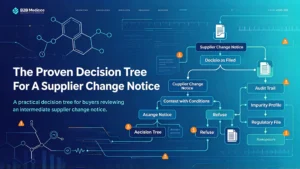
A buyer-side decision tree for handling an intermediate supplier change notice — what to accept, contest, or reject, and how to log the call.

Manufacturer and supplier of pharmaceutical APIs and intermediates. Contact us for technical support and sourcing solutions.