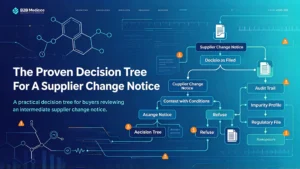
The Proven Decision Tree For A Supplier Change Notice
A buyer-side decision tree for handling an intermediate supplier change notice — what to accept, contest, or reject, and how to log the call.
Table of Contents
Every sourcing project starts the same way: you write an inquiry, send it to a few suppliers, and wait. What most buyers do not realize is that the price you get back is decided before the supplier opens their spreadsheet — by the quality of the request you sent. A vague RFQ does not just cost you a slightly higher quote; it costs you the ability to compare bids at all.
This guide is written from the supplier side of the table. We receive hundreds of RFQs a year for pharmaceutical intermediates. The requests that get fast, accurate, comparable quotes share the same habits. The requests that end in confusion, re-quoting, and “that’s more expensive than I expected” share the same five mistakes.
An RFQ is not a formality. It is the single document that determines whether the numbers you compare are numbers for the same thing. When five suppliers quote the same product name but different purity, package size, batch scale, and documentation, you are not comparing five prices — you are comparing five different products wearing the same label.
Before we name the five mistakes, one framing point. The goal of a good RFQ is not to get the lowest price. It is to get prices that mean the same thing from every supplier, so that the lowest one is actually the lowest. Every mistake below breaks that comparability, and that is what quietly inflates your landed cost — usually not because the supplier cheated, but because you asked for something that could not be quoted honestly.
The single most expensive line in any intermediate RFQ is the one that is missing: the specification. “Need 500 kg of your intermediate, quote best price” produces five different answers because five different specifications can all be called the same product.
One supplier quotes a batch at 98% assay with loose individual-impurity limits. Another quotes 99.5% with tight limits. Both are “the same product,” but they are not the same material, and they are not the same price. If your RFQ does not name the specification, each supplier quotes their own — and you compare apples to oranges.
What to include instead:
If you do not yet have a specification, say so explicitly and ask the supplier to send theirs — but understand that you have then given up the right to compare bids head-to-head. A cleaner path is to borrow the discipline of specification setting: decide what a conforming batch must look like before you shop.
Quantity in an intermediate RFQ is rarely a single number. It is usually a shape: annual demand, batch size, and order frequency. Getting these mixed up produces quotes that cannot be compared.
A quote for “1,000 kg per year” is meaningless until you say whether that is ten 100-kg batches or one 1,000-kg campaign. Those two shapes have different equipment, labor, storage, and quality-control requirements — and therefore different prices. A supplier who thinks you need one big campaign will quote a campaign price; a supplier who thinks you need ten small batches will quote a batch price. Both are honest. Neither is comparable.
This connects directly to how suppliers think about minimum order quantities. If your batch size sits below a supplier’s MOQ, the quote you get back is not the real price — it is the price of forcing the supplier outside their standard production shape.
“Purity 99%” is not a specification until you say how it is measured. Assay by HPLC, by GC, by titration, or by mass-balance can give different numbers for the same material. Two laboratories can report different results on the same sample if they run different methods.
The most common version of this mistake: the buyer writes “HPLC purity ≥ 99%” and assumes the supplier measures the same way the buyer’s own QC does. They rarely do. Different columns, different detectors, different response factors — and the “99%” you get quoted is not the “99%” you will measure on arrival.
What to include instead:
If the supplier is expected to validate their method per ICH Q2, or to report results in a way that will sit next to your COA review, put that in the RFQ. It changes both the feasibility and the price.
An RFQ that asks only for a price asks for the wrong thing. The price of an intermediate is tied to what documentation must be produced with it. A supplier who must issue a certificate of analysis per batch, keep stability or retest data, and provide batch traceability carries a different cost than one who ships material with a one-page label.
If your RFQ does not state the documentation you need, the supplier will quote the cheapest option — and you will discover, after ordering, that the COA or verification documents you assumed were included are actually a change order that adds cost and time.
State in the RFQ:
Documentation is not a compliance formality — it is a cost driver. Naming it in the RFQ keeps it in the quoted price instead of becoming a surprise later. This is the same logic that runs through pricing factors: the price reflects the scope of what is delivered, and the RFQ defines that scope.
Two identical quotes are not the same offer if one includes freight and the other does not, or if one is payable 30/70 and the other on open terms. The five mistakes end where comparability dies: on the commercial and logistics lines you forgot to specify.
Ask about, or state, the following up front:
When you list these in the RFQ, every supplier quotes the same scope, and you can build a comparison table where the lowest number is actually the lowest. When you leave them out, you are not comparing offers — you are guessing.
| Check | Ask yourself | If the answer is no |
|---|---|---|
| Specification | Does every supplier know the assay, impurity, water, and physical limits? | Decide the spec first, or you cannot compare bids |
| Quantity shape | Is annual volume, batch size, and frequency stated? | Write all three; a single number is not enough |
| Method | Is “purity” defined by a named method and basis? | Name the method, or the 99% you get is not the 99% you test |
| Documentation | Are COA, SDS, stability, and traceability named in the scope? | Add them, or expect a change order later |
| Delivery & terms | Are Incoterms, lead time, payment, and packaging specified? | Add them, or the quotes are not comparable |
There is a quieter benefit. Suppliers receive dozens of vague requests every day. A detailed, professional RFQ signals that you are a serious buyer who understands the product — and suppliers respond to serious buyers with better service, faster answers, and more candid pricing. The buyers who complain that Chinese suppliers “quote randomly” are often the buyers whose RFQs invited random quotes.
Write the RFQ the way you would want to receive it: specific, complete, and comparable. The price you get back will reflect the clarity you sent in.
The RFQ is the entry point to everything else on this site. It is where you first state the specification you will later audit, the terms you will later negotiate, and the pricing you will later compare. A clear RFQ makes every later step faster and more honest.
If you are early in the process and comparing suppliers for the first time, the second-supplier strategy and supplier audit checklist will help you decide how many quotes to collect and how to qualify who sends them. And when you are ready to evaluate the batch-to-batch consistency behind a shortlisted supplier, start by looking at whether their historical batch data matches the spec you put in your RFQ.
A buyer-side decision tree for handling an intermediate supplier change notice — what to accept, contest, or reject, and how to log the call.
A supplier discontinuation is a deadline, not just bad news. The questions to ask in writing, the last-time-buy calculation, and the files to collect in time.

Rejected batch? What to do in the first hour, how to write the notice, who pays the costs, and the escalation path when a supplier stalls.

Manufacturer and supplier of pharmaceutical APIs and intermediates. Contact us for technical support and sourcing solutions.