Proven Checks Buyers Miss In A Batch Manufacturing Record
The first commercial batch from a new intermediate supplier is not a formality. Here is the checklist, the five approval outcomes, and how to log the call.
Table of Contents
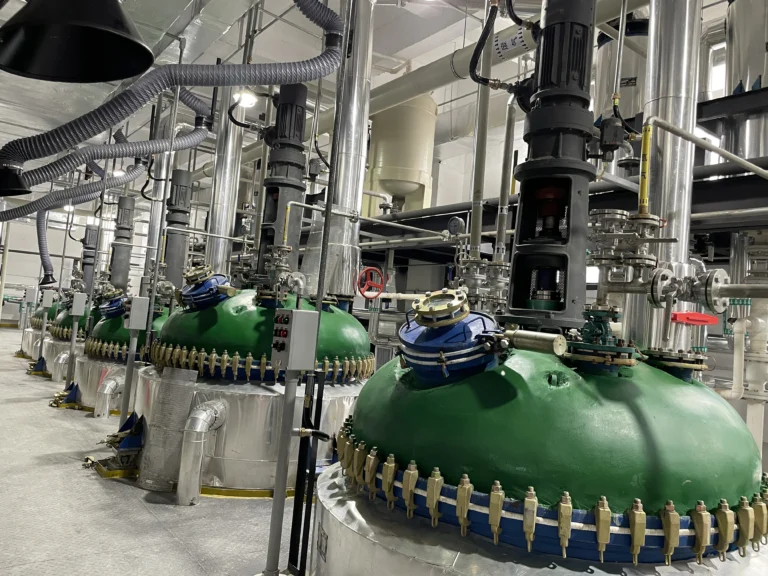
I’m Sun Yufang, and I’ve been in charge of process development at Tianming Pharmaceuticals for nearly twenty years. After working in this field for so long, I’ve come to a profound realization: the success or failure of a complex intermediate project is often not determined in the production workshop, but rather on the whiteboard in the laboratory, when the first synthesis route is drawn.
Today, I want to talk not about textbook theories, but about the practical considerations that truly impact cost, speed, and compliance in route design, based on our team’s experience delivering complex intermediate projects for our clients.
If you’re responsible for an early-stage project and are making decisions about “which route to take,” perhaps this experience can help you avoid some pitfalls.
Before we even start drawing the first reaction equation, we must first clarify: what is the ultimate goal of this project? This directly determines the philosophy of route design.
If the goal is to quickly deliver preclinical to Phase I samples, our primary task is “speed first.” In this case, we will tend to choose “classic routes” that are well-documented in the literature and do not require lengthy methodological development, even if the overall yield is lower or the steps are slightly longer.
We once used a 9-step known route to deliver the first batch of cGMP-standard key intermediates for a cancer immunotherapy project within 14 weeks, helping the client start toxicology studies on time.
If the goal is to support commercial supply, then the core design must shift to “cost and robustness first.” We will invest in upfront R&D to pursue new routes with higher atom economy, simpler purification, and avoidance of expensive reagents or high-risk steps.
For example, in a project for a diabetes drug intermediate, we optimized the key step of the original route from an alkylation requiring ultra-low temperature (-78°C) and expensive chiral auxiliaries to a one-step copper-catalyzed asymmetric conjugate addition.
Although the initial development took an extra 8 weeks, it reduced the cost per kilogram by approximately 35% and completely eliminated safety hazards in large-scale production. This is the technical logic behind our “competitive pricing”—not sacrificing quality, but reconstructing costs through deeper process innovation.
Impurity research cannot be the “rear battlefield” of the QC department; it must be the “frontline command” during route design. According to ICH M7 guidelines, a hierarchical strategy of “avoidance-control-elimination” must be followed for potentially genotoxic impurities. The best approach is to avoid their introduction during route design.
This design thinking is precisely the “proactive compliance assurance” that large pharmaceutical companies’ procurement and R&D personnel value most.
A route that only works perfectly in a round-bottom flask is a commercial disaster. Our design principle is “designed for production.”
Thermal safety is a red line. We have an internal rule that any new route must undergo reaction calorimetry analysis before scaling up to gram-scale. In a project involving an antiviral intermediate, laboratory data showed a certain condensation reaction to be “mildly exothermic.”
However, the calorimeter revealed that under adiabatic conditions, the system temperature would skyrocket by over 120°C if uncontrolled. We immediately replaced the reagent with a more active one in the route, reducing the reaction enthalpy change by 70%, allowing it to be safely scaled up in a conventional glass-lined reactor.
This real-world thermal risk assessment report became one of the most appreciated documents during the client audit.
Physical Form Management. We once took on a project where the key intermediate consistently yielded an oil in the literature, requiring column chromatography for purification, making it impossible to scale up. Through systematic screening of crystallization systems, we discovered that adding a specific ratio of anti-solvent-co-solvent pair could induce the formation of a stable crystalline form.
Ultimately, we designed a route that included an “in-situ crystallization” step, where a high-purity solid precipitated directly after the reaction, obtained by simple filtration with a yield exceeding 95%. This change reduced the post-processing time from 3 days to 4 hours.
Today’s route design must incorporate green chemistry and supply chain perspectives. We follow the “12 Principles of Green Chemistry” and refer to the ACS GCI Pharmaceutical Roundtable solvent selection guidelines, prioritizing more environmentally friendly solvents such as water, ethanol, and 2-methyltetrahydrofuran.
Ultimately, the route design of complex intermediates is a multi-objective optimization: speed, cost, safety, quality, and environmental protection. There are no standard answers; only optimal trade-offs based on a deep understanding of the process, extensive practical experience, and clear business insights.
At Tianming Pharmaceuticals, our core mission is to be our clients’ “external brain” in process development. We don’t just provide molecules; we provide industrially validated solutions and definitive project timelines. We believe that true “price advantage” stems from this scientific optimization and value creation that begins from the initial molecular design and continues throughout the entire process.
If you are looking for solutions to challenges in synthesis routes, cost control, or scale-up production for a specific molecule, please feel free to contact us.
Email: sunqian0123@gmail.com
WhatsApp: +86 17663713557
The first commercial batch from a new intermediate supplier is not a formality. Here is the checklist, the five approval outcomes, and how to log the call.
The first commercial batch from a new intermediate supplier is not a formality. Here is the checklist, the five approval outcomes, and how to log the call.
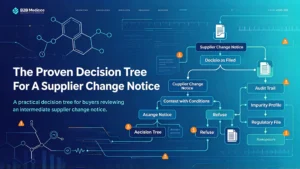
A buyer-side decision tree for handling an intermediate supplier change notice — what to accept, contest, or reject, and how to log the call.

Manufacturer and supplier of pharmaceutical APIs and intermediates. Contact us for technical support and sourcing solutions.