Proven Checks Buyers Miss In A Batch Manufacturing Record
The first commercial batch from a new intermediate supplier is not a formality. Here is the checklist, the five approval outcomes, and how to log the call.
Table of Contents
If you’ve ever been confused by the regulatory distinction between API manufacturing and intermediate production, you’re not alone. Even within the pharmaceutical industry, the line can get blurry.
But for anyone sourcing or manufacturing these materials, understanding the difference isn’t just academic—it directly affects how you operate, what documentation you need to maintain, and how regulators will treat your facility during an inspection.
So let’s break it down.
The ICH Q7 guideline—the global standard for API manufacturing—defines an intermediate as “a material produced during steps of the processing of an API that undergoes further molecular change or purification before becoming an API”. It can be isolated or not.
An active pharmaceutical ingredient (API) , by contrast, is “any substance or mixture of substances intended to be used in the manufacture of a pharmaceutical dosage form and that, when so used, becomes an active ingredient of that pharmaceutical dosage form”.
In simple terms: intermediates are the building blocks. APIs are the final active ingredients that go into the medicine you take. An ibuprofen tablet—the API is the ibuprofen itself. The intermediates are the chemical outputs from steps 1, 2, and 3 of a multi-step synthesis that eventually become that ibuprofen.
This is the single most important regulatory distinction between API and intermediate manufacturing. ICH Q7 applies in full to API manufacturing from the point where you define your “starting material.” From that point forward—through all intermediate steps to the final API—the entire process must comply with cGMP requirements.
Moreover, this GMP coverage extends to the intermediates that lie between the starting material and the final API. So once you’re in the ICH Q7 zone, the intermediates are subject to the same GMP standards as the API itself.
Here’s the nuance: the production of starting materials (the raw inputs that go into your defined beginning of the API process) is explicitly not required to follow GMP in the same way. Under ICH Q7, you define your own starting point, and you need to justify why you chose it.
A helpful way to think about it: the “starting material” is like a raw ingredient you buy from a supplier that may or may not be GMP-certified. Once that material enters your facility and you begin your defined process—typically the first synthetic step that creates a defined intermediate—that’s where GMP requirements kick in.
This is another major difference that directly affects how you do business.
For APIs, having a Drug Master File (Type II DMF) submitted to the FDA is standard practice if you’re supplying to the US market. A recent article in Pharmaceutical Technology notes that the submission requirements for DMFs (known as ASMFs in the EU) apply to both APIs and chemical intermediates.
In practice, however, many suppliers don’t file a standalone DMF for a simple early-stage intermediate. The FDA expects that “all drug substance intermediates used in the production of FDA-approved drugs meet certain quality standards and be manufactured in accordance with GMP,” and facilities may be subject to pre-approval inspections.
But the heavy lifting of a full DMF submission is typically reserved for APIs or late-stage intermediates that are close to the final molecule.
For APIs, the expectation is clear. You’re expected to have a DMF (Type II) that covers your manufacturing process, impurity control, stability data, and specifications.
For intermediates, the line is less rigid. The FDA’s DMF types explicitly include Type II for “Drug Substance, Drug Substance Intermediate”. But whether you actually need to file one depends on how advanced your intermediate is and what your customer needs for their filing.
Another quick tip: In Europe, the EMA has additional guidance on intermediates that are themselves active substances.
A 2017 EMA reflection paper clarifies that if an intermediate in your synthesis is already an active substance covered by a CEP, you may reference that CEP instead of submitting a full manufacturing process description—though you still have to document the additional steps.
From a practical compliance standpoint, here are the key pressure points that API manufacturers face that intermediate suppliers may not (or at least not to the same degree).
One of the trickiest aspects of navigating API and intermediate regulations is that different regions have different expectations. A 2025 blog article summarizes the landscape helpfully.
The FDA requires that all drug substance intermediates used in FDA-approved drugs meet quality standards and be manufactured in accordance with GMP, and facilities may face pre-approval inspections.
The FDA also accepts DMFs for both APIs and intermediates as confidential submissions that support your customer’s application.
In the EU, the system works a bit differently. The EMA emphasizes traceability of critical process steps. You must submit the synthetic route and control strategy for intermediates.
However, an important distinction exists: if the intermediate is itself an active substance covered by a European Pharmacopoeia monograph and a valid CEP, you can submit that CEP as an alternative to a full process description.
China’s NMPA has evolving GMP requirements aligned with international standards. There is no separate GMP standard specifically labeled “GMP for Intermediates”—the requirements apply across the supply chain depending on the product’s intended use.
Japan’s PMDA has strict GMP requirements based on international standards but with some unique features, particularly relating to traditional Japanese medicine (Kampo). Companies may need to comply with Japan-specific labeling and packaging regulations.
It’s not just theoretical. The FDA actively enforces GMP requirements for API manufacturing, and the violations often involve intermediates.
In October 2025, the FDA issued a warning letter to Scientific Protein Laboratories, LLC after an inspection from April to May 2025. The agency found that “equipment surfaces in contact with raw materials, intermediates and API” had grooves and scratches that could alter quality.
The facility’s APIs were deemed adulterated under the FD&C Act because their methods and controls did not conform to CGMP.
What’s notable is that the FDA’s criticism extended to how intermediates were handled—not just the final API. This underscores that once a material enters the defined API manufacturing process under ICH Q7, intermediate quality is treated as seriously as API quality.
Other recent warning letters in 2025 and 2026 have cited similar issues: systemic failures in handling impurities, inadequate OOS investigations, and equipment contamination risks. The takeaway is clear: whether you’re making APIs or the intermediates that feed into them, regulators expect robust GMP compliance.
If you’re a pharmaceutical buyer, understanding these regulatory differences should shape how you qualify your suppliers.
For API suppliers, you should expect:
But be careful: just because an intermediate supplier isn’t required to have a DMF doesn’t mean you should lower your standards. The quality of your API depends directly on the quality of the intermediates that go into it.
At Tianming Pharmaceutical, we manufacture both APIs and high-purity pharmaceutical intermediates. We operate under cGMP systems that meet ICH Q7 standards, and we maintain DMFs for our key API products.
For intermediates that fall outside the formal ICH Q7 GMP boundary, we still maintain rigorous quality control and full documentation—because we know that the quality of our customers’ final products depends on it.
If you’re sourcing APIs or intermediates and need a partner who understands where the regulatory lines are—and how to meet or exceed them—we’d welcome a conversation.
At Tianming Pharmaceutical, we supply high-purity APIs and pharmaceutical intermediates with full regulatory documentation support. For technical specifications, DMF availability, or compliance questions, contact our team. →sunqian0123@gmail.com
The first commercial batch from a new intermediate supplier is not a formality. Here is the checklist, the five approval outcomes, and how to log the call.
The first commercial batch from a new intermediate supplier is not a formality. Here is the checklist, the five approval outcomes, and how to log the call.
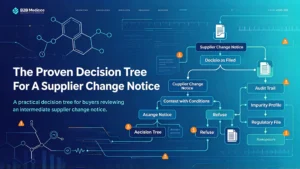
A buyer-side decision tree for handling an intermediate supplier change notice — what to accept, contest, or reject, and how to log the call.

Manufacturer and supplier of pharmaceutical APIs and intermediates. Contact us for technical support and sourcing solutions.