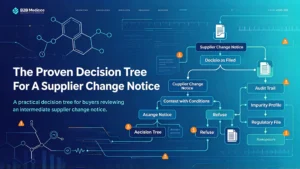
The Proven Decision Tree For A Supplier Change Notice
A buyer-side decision tree for handling an intermediate supplier change notice — what to accept, contest, or reject, and how to log the call.
If you’re trying to make sense of the drug landscape for heart failure and chronic kidney disease, you’ve probably run into finerenone. It’s a name that keeps coming up. But what exactly is it? And why are cardiologists and nephrologists talking about it as something genuinely new?
The short answer: finerenone belongs to a class called mineralocorticoid receptor antagonists (MRAs). But unlike the older ones, it’s a third-generation, non-steroidal MRA. And that one difference—steroidal vs non-steroidal—changes almost everything about how the drug works, what side effects it causes, and who can take it.
Let me walk you through what that actually means.
The renin-angiotensin-aldosterone system (RAAS) is a hormone system that regulates blood pressure and fluid balance. When it gets overactive, aldosterone (a key hormone) starts causing trouble—inflammation, fibrosis (tissue scarring), and damage to the heart and kidneys.
Mineralocorticoid receptor antagonists block the receptor that aldosterone binds to. Shut down that receptor, and you shut down a lot of the damage.
The first MRA was spironolactone, introduced in the 1950s. It’s a steroidal MRA—its chemical structure is built on steroid rings. It works, but it’s not selective.
It also binds to androgen and progesterone receptors, which is why men get gynecomastia (breast growth) and sexual side effects, and women get menstrual irregularities. About 10% to 15% of patients on spironolactone develop gynecomastia [10†L46-L48]. That’s a real problem for long term adherence.
The second-generation MRA was eplerenone. Still steroidal, still flat in structure, but more selective than spironolactone. Fewer hormonal side effects, but also less potent [9†L45-L47].
Then came finerenone.
Finerenone (BAY 94-8862) is structurally different. It’s non-steroidal—its molecular shape is bulky rather than flat [8†L8-L10]. That bulky shape makes it much more selective for the mineralocorticoid receptor.
It barely touches androgen or progesterone receptors. As a result, finerenone has no gynecomastia or sexual side effects. In the FINEARTS-HF trial, the rate of gynecomastia was essentially the same as placebo (0.2% in both groups) [19†L13-L14].
A 2025 pharmacovigilance study using FAERS data (2004-2024) found that spironolactone showed the highest incidence of sexual and congenital abnormalities.
Finerenone, by contrast, showed no significant sex hormone-related adverse events [12†L43-L46].
A comparison of the three generations shows the progression clearly:
Feature | Spironolactone (1st Gen) | Eplerenone (2nd Gen) | Finerenone (3rd Gen) |
Structural properties | Steroidal (flat) | Steroidal (flat) | Non steroidal (bulky) |
Selectivity for MR | + | +++ | ++++ |
Potency on MR (IC50) | 24 nM (+++) | 990 nM (+) | 18 nM (+++) |
Androgen receptor affinity | ++ | +/− | − |
Half-life | ~18 hours | 4 6 hours | 2 3 hours |
Active metabolites | Yes (multiple) | No | No |
BP-lowering effect | +++ | ++ | + |
A couple of things jump out from this table.
Selectivity. Finerenone has the highest selectivity for the mineralocorticoid receptor (++++). Eplerenone is next (+++). Spironolactone is the least selective (+). That’s the opposite order for androgen receptor affinity—spironolactone binds most strongly, finerenone barely at all.
Potency. Finerenone (IC50 18 nM) is about as potent as spironolactone (24 nM) at blocking the MR. Eplerenone (990 nM) is much weaker. So finerenone gives you spironolactone level potency without the hormonal baggage.
Half-life. Finerenone clears out of your body in about 2 3 hours. Spironolactone sticks around for about 18 hours. Shorter half life can make potassium levels easier to manage, though finerenone still requires monitoring.
No active metabolites. Spironolactone has several active breakdown products that linger for days. Finerenone has none. Cleaner profile.
Another difference that doesn’t make headlines but matters clinically: where the drug goes in the body. Spironolactone tends to concentrate in the kidneys.
Finerenone distributes equally to the heart and kidneys [18†L30-L32]. This balanced distribution may help explain why finerenone has shown benefits in both cardiac and renal outcomes—it’s protecting both organs simultaneously.
The drug class is interesting, but the proof is in the clinical trials.
The FIDELIO-DKD and FIGARO-DKD trials tested finerenone in over 13,000 patients with chronic kidney disease and type 2 diabetes. A pooled analysis (FIDELITY) found that finerenone reduced the risk of cardiovascular events by 14% and kidney events by 23% compared to placebo [14†L7-L13].
Then came the FINEARTS-HF trial. This Phase 3 study enrolled 6,001 patients with heart failure and left ventricular ejection fraction of 40% or higher.
Over a median follow-up of 32 months, finerenone reduced the primary endpoint—cardiovascular death or total heart failure events—by 16% (rate ratio 0.84; 95% CI 0.74 0.95; p=0.007) [17†L37-L39]. The greatest benefit was seen in patients treated soon after a recent heart failure event (within 7 days: RR 0.74) [17†L40-L42].
Based on these results, the FDA approved finerenone for heart failure with LVEF ≥40% on July 14, 2025. This made finerenone the first and only MRA approved for this large patient population [16†L4-L7]. It also remains approved for chronic kidney disease associated with type 2 diabetes (original FDA approval in July 2021) [0†L39-L41].
A 2025 network meta-analysis comparing MRAs for cardiovascular outcomes found that finerenone had the highest efficacy in heart failure patients, with a hazard ratio of 0.68 versus control, followed by spironolactone (0.72) and eplerenone (0.81) [11†L16-L18].
All MRAs can cause hyperkalemia (high potassium). Finerenone is no exception. In the FINEARTS-HF trial, hyperkalemia occurred in 9.7% of finerenone patients vs 4.2% on placebo [18†L36-L37].
In the pooled safety analysis of over 18,000 patients, hyperkalemia leading to discontinuation occurred in 1.3% of finerenone patients vs 0.5% on placebo [19†L7-L8]. Finerenone also caused more hypotension (7.6% vs 4.7%) and worsening renal function (18% vs 12%) [18†L36-L38].
However, a 2025 pharmacovigilance study comparing the three MRAs found that finerenone had a lower proportion of serious adverse events (63.34%) compared to spironolactone (80.28%) and eplerenone (87.78%) [2†L23-L25].
And crucially, finerenone does not cause the hormonal side effects that drive many patients off spironolactone.
As of 2026, finerenone is FDA approved for:
If you’re developing generics or reformulations of MRAs, finerenone represents a third-generation molecule that solves real problems with the older drugs: hormonal side effects, uneven heart-kidney protection, and hyperkalemia risk.
Its non-steroidal structure means different synthetic challenges—tighter stereochemical control, different impurity profiles, and a shorter half-life that influences formulation design.
At Tianming Pharmaceutical, we manufacture high-purity finerenone API (CAS 1050477-31-0). We’ve built our process around the specific demands of non-steroidal MRAs: rigorous impurity control, consistent crystallinity, and cGMP compliance.
As finerenone continues to gain broader clinical acceptance—particularly after the 2025 FDA approval for heart failure—having a reliable, quality-assured API supply becomes increasingly critical for pharmaceutical development programs.
If you’re working on MRA-based therapies and need a partner who understands the chemistry behind the drug class, we’d like to talk.
At Tianming Pharmaceutical, we supply high-purity finerenone API for pharmaceutical R&D. Our cGMP-grade product is manufactured under strict quality controls. For technical specifications, including impurity profiles and stability data, contact our team. → sunqian0123@gamil.com
A buyer-side decision tree for handling an intermediate supplier change notice — what to accept, contest, or reject, and how to log the call.
A supplier discontinuation is a deadline, not just bad news. The questions to ask in writing, the last-time-buy calculation, and the files to collect in time.
Rejected batch? What to do in the first hour, how to write the notice, who pays the costs, and the escalation path when a supplier stalls.

Manufacturer and supplier of pharmaceutical APIs and intermediates. Contact us for technical support and sourcing solutions.