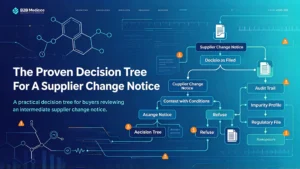
The Proven Decision Tree For A Supplier Change Notice
A buyer-side decision tree for handling an intermediate supplier change notice — what to accept, contest, or reject, and how to log the call.
If you have been tracking recent FDA approvals, you might have noticed a drug called finerenone (brand name Kerendia) quietly expanding its reach. First approved in 2021 for chronic kidney disease (CKD) in people with type 2 diabetes, it received another green light in July 2025—this time for heart failure with a left ventricular ejection fraction of 40% or higher.
That approval actually made finerenone the first and only mineralocorticoid receptor antagonist (MRA) approved for that group.
But what makes finerenone different from older MRAs like spironolactone? And why do cardiologists and nephrologists seem increasingly excited about it? The answer lies in its mechanism of action, which is fundamentally different from the drugs that came before it.
To understand finerenone, you first have to understand the renin-angiotensin-aldosterone system (RAAS). This is a hormone system that helps regulate your blood pressure and fluid balance. When it gets overactivated, it starts causing problems, particularly in the heart and kidneys.
The mineralocorticoid receptor (MR) sits at the center of that overactivation. When aldosterone (the main hormone that activates the MR) binds to it, it triggers a cascade of harmful effects: inflammation, fibrosis (tissue scarring), oxidative stress, and eventually organ damage.
Overactivation of the MR has been shown to be pathologic in heart failure and albuminuric chronic kidney disease, triggering pro-inflammatory and pro-fibrotic cellular pathways [8†L6-L14][12†L9-L12]. That is why blocking the MR has been a therapeutic target for decades.
The first drug to do this successfully was spironolactone, followed by eplerenone. Both are steroidal MRAs, meaning their chemical structure is based on steroid rings [8†L25-L26].
Spironolactone is potent, but it is not very selective. It binds to the MR, but it also binds to androgen and progesterone receptors, which is why it causes side effects like gynecomastia (breast tissue growth in men), sexual dysfunction, and menstrual irregularities [10†L43-L46].
Eplerenone is more selective than spironolactone, but it is still steroidal and less potent [8†L51-L52][11†L46-L47]. And both come with a significant risk of hyperkalemia—dangerously high potassium levels—which limits their use, especially in patients with kidney impairment [10†L47-L49].
Finerenone (BAY 94-8862) is different. It is a nonsteroidal, selective mineralocorticoid receptor antagonist [10†L10-L11].
It was originally developed using the chemical structure of a dihydropyridine channel blocker, but it was optimized to create a bulky MRA without any activity at the L-type calcium channel [12†L20-L22]. That bulky, nonsteroidal structure is the entire point.
Feature | Spironolactone (1st Gen) | Eplerenone (2nd Gen) | Finerenone (3rd Gen) |
Structural properties | Flat (steroidal) | Flat (steroidal) | Bulky (nonsteroidal) |
Selectivity to MR | + | ++ | +++ |
Potency to MR | +++ | + | +++ |
Tissue distribution | Kidney > Heart | Kidney > Heart | Kidney = Heart |
Active metabolites | Yes (multiple) | No | No |
Half life | >20 hours | 4–6 hours | 2–3 hours |
Gonadal side effects | +++ (gynecomastia, etc.) | ++ | + |
Hyperkalemia risk | +++ | ++ | + |
Source: Adapted from PMC Table 1, Endocrinology and Metabolism [22†L2-L16] |
The table above shows the key differences. Finerenone has the highest selectivity for the MR (+++), the lowest affinity for androgen receptors, the shortest half life, and no active metabolites. It also has the lowest risk of both gonadal side effects and hyperkalemia [22†L4-L14].
At the molecular level, finerenone binds specifically to the mineralocorticoid receptor and prevents the recruitment of transcriptional coactivators. This subsequently attenuates MR-mediated inflammation and fibrosis, which are the key drivers of cardiorenal disease progression [10†L18-L21].
But there is more to it than that. Finerenone acts as an inverse agonist in the absence of aldosterone, meaning it actively inhibits cofactor binding rather than just blocking aldosterone [17†L10-L13].
And in the presence of aldosterone, it is more potent and efficacious than eplerenone at blocking MR cofactor binding and inducing corepressor binding [17†L13-L16].
In animal models, finerenone has been shown to have stronger anti-inflammatory and anti-fibrotic effects than eplerenone at equinatriuretic doses [17†L18-L22][12†L22-L25].
Another critical difference is where the drug goes in the body. Spironolactone tends to concentrate in the kidneys. Finerenone, by contrast, has a balanced distribution between the heart and the kidneys [18†L2-L6][12†L40-L41].
In rodents, finerenone distributes equally to the heart and kidney, whereas spironolactone is almost undetectable in the heart [18†L2-L6]. This balanced distribution may explain why finerenone has shown benefits in both cardiac and renal outcomes.
The pharmacology is interesting, but the clinical data is what really matters. Two large Phase 3 trials—FIDELIO-DKD and FIGARO-DKD—tested finerenone in patients with CKD and type 2 diabetes who were already on maximally tolerated doses of ACE inhibitors or ARBs.
Finerenone significantly reduced the risk of both CKD progression and cardiovascular events [7†L7-L11]. A pooled analysis of both trials (FIDELITY, n=12,990) showed that finerenone reduced the risk of cardiorenal morbidity or mortality by about 16% compared to placebo over a median follow-up of 3.0 years (HR 0.84; 95% CI: 0.78 to 0.90) [13†L21-L24].
Lifetime projections suggested that a 65-year-old patient could gain an additional 1.3 years of event free survival with finerenone [13†L25-L29]. Then came the FINEARTS-HF trial.
This Phase 3 trial enrolled 6,001 patients with heart failure and LVEF ≥40% [15†L12-L14]. The primary composite endpoint was cardiovascular death or total heart failure events.
Over a median follow-up of 32 months, finerenone reduced the primary endpoint by 16% compared to placebo (rate ratio 0.84; 95% CI 0.74-0.95; p=0.007) [15†L34-L38]. This trial provided the basis for the FDA approval in July 2025 [21†L24-L28].
More recently, a real-world study using target trial emulation compared finerenone to spironolactone in patients with CKD and type 2 diabetes. Over 2,200 matched patients across 21 countries were followed for a median of 1.3 years.
Finerenone was associated with a 69% lower risk of all-cause mortality (aHR 0.31), a 53% lower risk of major kidney events (aHR 0.47), and a 26% lower risk of major cardiovascular events (aHR 0.74).
Hyperkalemia also occurred less frequently with finerenone (17.2%) than with spironolactone (26.4%) [19†L8-L12]. The senior author noted that finerenone “appears not only safer but also more effective” [4†L28-L30].
A systematic review and meta-analysis of six randomized controlled trials involving 8,527 heart failure patients found that finerenone significantly increased the risk of hyperkalemia compared to placebo (RR=2.07) and hypotension (RR=1.49) [23†L17-L20].
However, compared to eplerenone, finerenone had a lower risk of treatment-emergent adverse events (RR=0.93) and serious adverse events (RR=0.74), with similar discontinuation rates [23†L22-L24].
And compared to spironolactone in HFrEF patients, finerenone had a lower risk of hyperkalemia (RR=0.41) and treatment discontinuation (RR=0.37) [23†L26-L28]. Crucially, finerenone does not cause the gonadal side effects (gynecomastia, impotence) that plague spironolactone [22†L13-L14].
At Tianming Pharmaceutical, we manufacture high-purity finerenone API. Finerenone is a small molecule with the chemical formula C21H22N4O3 (CAS 1050477-31-0) [10†L4-L5]. Its synthesis is a complex process that requires tight control of stereochemistry and impurity profiles to meet cGMP standards.
As finerenone gains broader clinical acceptance—particularly after the 2025 FDA approval for heart failure—having a reliable, quality-assured API supply becomes increasingly critical for pharmaceutical development programs.
At Tianming Pharmaceutical, we supply high-purity finerenone API for pharmaceutical R&D. Our cGMP-grade product is manufactured under strict quality controls. For technical specifications, including impurity profiles and stability data, contact our team. sunqian0123@gmail.com
A buyer-side decision tree for handling an intermediate supplier change notice — what to accept, contest, or reject, and how to log the call.
A supplier discontinuation is a deadline, not just bad news. The questions to ask in writing, the last-time-buy calculation, and the files to collect in time.

Rejected batch? What to do in the first hour, how to write the notice, who pays the costs, and the escalation path when a supplier stalls.

Manufacturer and supplier of pharmaceutical APIs and intermediates. Contact us for technical support and sourcing solutions.