
Batch Number vs Lot Number: 7 Places Buyers Mix Them Up
Batch and lot can point at the same drums and still disagree on paper. Seven places where the two identifiers split, and the one line worth writing down before the truck leaves.
Table of Contents
Batch and lot can point at the same drums and still disagree on paper. Seven places where the two identifiers split, and the one line worth writing down before the truck leaves.
A buyer in Karachi sent me a photograph once: four drums, a certificate, a packing list. Which document was wrong, he wanted to know. None of them. The certificate read Batch No. 24J-1187. The packing list said Lot 1187. On each drum sat a small sticker: 24J1187. Same steel, same material, three different strings — and his warehouse had already quarantined the lot, because the receiving clerk had no way to prove the three belonged together.
Nine days that material sat in quarantine. The product itself was fine. What failed was a decision nobody had made: which identifier rules when the documents disagree. Meanwhile three departments traded screenshots, and the supplier’s quality manager — a patient man — kept resending the very certificate he had already sent.
Better suppliers would not have helped. One line in his own receiving procedure would have: trust this string; when the others disagree, stop and call. Nobody had written it down.
So skip the vocabulary debate. Walk the seven places where these two words open a gap in your records, and close each one before it eats a week.
Both words mean the same physical thing: one defined quantity of material from a single production cycle. ICH Q7 defines a batch as a specific quantity intended to have uniform character and quality within specified limits, and regulatory writing stays loyal to that word wherever manufacturing comes up. Lot wandered in from somewhere else — warehousing, distribution, invoicing — and stayed.
The split is administrative, never technical. Quality writes batch because the procedure says batch. The ERP prints lot because a programmer named the field that way long before anyone thought about audits. Neither side is wrong. That both sound correct is precisely the problem: two right words, drifting apart, one drum at a time.
A second layer hides underneath. Large producers sometimes divide a master batch into several packing lots, each numbered on its own. The certificate then carries two identifiers, both legitimate. A buyer told to expect one batch and one number reads that as a mistake — and files a needless complaint against a supplier who did nothing wrong.
After years of shipping intermediates into India, Bangladesh and Pakistan, I can predict one thing: buyers rarely stumble over definitions. They know both words describe a single idea. What trips them is arithmetic — three systems inside one supplier, three different strings, and one person left to reconcile them after the truck is gone.
Buy one intermediate and seven documents should carry its batch identity: the certificate of analysis, the specification sheet, the packing list, the retention sample label, the quality agreement, the batch record and — when something goes wrong later — the complaint file. Different departments create them at different moments, for different readers.
No single person watches all seven. That is the whole vulnerability. One careless hand anywhere in the chain breaks traceability, and the break never announces itself. It waits — for the downstream customer’s question, the auditor’s request, the dispute you did not see coming.
Follow the chain in motion. Quality signs the certificate at release. Logistics prints the packing list at dispatch. The warehouse labels drums at loading. Somebody fills the retention bottle at packing, maybe on the night shift. Four hands touch the identity. Only one of them looks at the certificate while writing; the rest copy whatever sits closest.
Certificates get looked at first, and often alone. Spend ten minutes on Reading the top block of a certificate: the identifier there must match the drum sticker character for character — hyphens, leading zeros, all of it. An identifier that appears nowhere on the packaging is a serious finding. It belongs with the checks that separate a genuine certificate from a copied one, not in the “typos” folder.
Specification sheets get misread more than any other document. A specification describes the product, not the batch: what any conforming lot of this material must meet. Most carry no identifier at all. File one next to the certificate and the folder looks complete while proving nothing. Specification: what should this material be. Certificate: what was this batch.
The distinction turns practical the day a result gets disputed. Which number is acceptable? The specification answers that. Which drums were tested, and do the drums on your dock come from the same cycle? Only the certificate, read with its identity intact, comes close. Argue limits when the real problem is identity, and you will lose the argument twice.
Packing lists are the most mechanical failure point. Logistics software truncates, re-codes, or shaves identifiers down to their last four digits. And the packing list is exactly where your dock works, so what happens at goods-in before storage decides whether a mismatch dies in an hour or grows for a month. A clerk staring at a truncated number against a full one will either wave the truck through or stop it. Which way he jumps depends entirely on whether you wrote a rule.
Retention samples fail quietly. Somebody fills a bottle at packing, handwrites the identifier, shelves it. If that string differs from the certificate by a single character, the bottle stops being evidence — nobody can say which lot it came from. This is not paperwork pedantry. The retained sample is what makes any future dispute arguable, and it is the material an outside laboratory will test eventually. What a third-party result can and cannot confirm rests entirely on whether that sample is provably tied to the batch.
Two habits, both free. Copy the identifier onto the label from the certificate, never from memory. Then have a second person read the bottle back against the document before it touches the shelf. A retention sample you cannot defend is worse than no sample: false confidence with a long shelf life.
Where does this go wrong in practice? Shift change. The day-shift packer writes 24J-1187; the evening relief, in a hurry, writes 24J1187. Both copied honestly. Neither copied from the certificate.
The quality agreement is the fifth place, and the only one where the fix is contractual rather than operational. Most agreements spell out testing, notification, change control — then skip the identifier entirely. A dispute arrives, and both sides realize they have been calling the same drums by different names. The clause that pins the definition is three lines of unglamorous drafting worth more than anything else in the document: name the identifier, name the format, require the same string on certificate, packaging and packing list.
Add one line while the pen is out: what happens when the mapping breaks. Say nothing, and silence gets read — fairly or not — as permission to ship a certificate under a different number and explain afterwards. Written notice before dispatch costs nothing at the table and closes the argument for good.
Batch records make the identifier load-bearing. Dispensing weights, in-process checks, deviations, the release signature — all of it filed under that one number. A record keyed to a different identifier is not evidence for the drums you received; the supplier must rebuild the link from memory. Reading the batch record that anchors the number taxes your patience, and pays it back: a file is paper, a proof is a defense.
Complaint files are where small mismatches start costing money. Once you reject a lot, the rejection file you will argue from gets assembled out of everything above — and every inconsistency inside it reads as sloppiness, not formatting. Suppliers read your file the same way. Consistent numbers earn a different class of reply than numbers that do not line up.
Asymmetry worth memorizing. A truncated packing list needs one sentence of explanation. A retention bottle whose number matches no other document needs a paragraph — delivered after you have already judged the rest of the file.
Mismatches cluster into five patterns of very different weight. Escalate all five and you train everyone to ignore you. File all five as typos, and one day a genuine traceability gap slips through wearing a typo’s clothes.
| What you see | What it usually means | What to do |
|---|---|---|
| Certificate identifier matches nothing on the drums | Split shipment, repacking, or a label reprinted after packing | Hold the lot. Photograph drums and labels. Demand the packing record before any testing. |
| Packing list shows a shorter string | Software truncation, not a second lot | Get the short-code-to-full-identifier mapping in writing; file it with the batch. |
| Two identifiers on one certificate | Master batch plus packing lot, both real | Ask which number the packaging carries, and which one the record is filed under. |
| Specification carries no number | Normal — it describes the product, not the batch | File it with the product master, away from the batch folder. |
| Retention label disagrees with the certificate | Handwriting or transcription slip | Re-identify the bottle with two people present; treat the sample as unverified until then. |
Rows one and five break traceability on their own. The middle three are administrative, cheap to close. Keep that ranking visible: teams that escalate everything end up no different from teams that escalate nothing — nobody can tell which finding actually bites. And when a mismatch does grow into a quality question, the investigation that follows a failed result comes for the identifier first. Have it ready.
Do not ask suppliers to change vocabulary. That fight wastes goodwill you will need later. Fix the identifier inside your own process, once, and let every delivery pass through it.
Which identifier does the supplier treat as authoritative for traceability? Get the answer in writing; a phone answer evaporates. Are packaging, certificate and packing list guaranteed to carry the same string? If not, what is the mapping? Which number keys the batch record — the one that must still mean something two years from now? Where does the retention label sit, and whose hand writes it? Four answers, straight into the agreement. Your next dock clerk stops making judgement calls at seven in the morning.
Before signing anything new, run one test. Take your last delivery and trace its identifier from drum sticker to certificate to retention shelf without leaving your desk. Five minutes or less, the file is healthy. Longer, and the gap already exists — the next batch inherits it.
I run this check myself when a new buyer’s file lands. Half the time the trail stops at the packing list: the drum sticker says one thing, the shipping documents say another, and nobody on either side can say where the extra digits went. Ten minutes of asking before the purchase order closes beats ten days of quarantine after it arrives.
Which word you say hardly matters. One unbroken string from drum to certificate to shelf, and everyone handling the material knowing which string that is — that is the whole game. Two vocabularies can share a supply chain for decades. One drum with two identities will not survive a single audit.
Batch and lot can point at the same drums and still disagree on paper. Seven places where the two identifiers split, and the one line worth writing down before the truck leaves.

An OOS investigation on incoming material is a decision process, not a verdict on the batch. This guide walks the buyer’s path: freeze the lot, separate laboratory error from material failure, retest within the rules, and know when a third-party result is worth paying for.
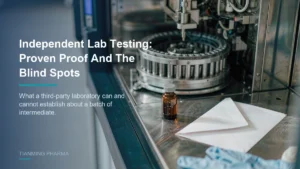
Independent lab testing settles a dispute between two results, but only if the method and the standard were agreed before the sample left the building. It cannot confirm sample integrity, and it cannot vouch for a process it never saw.

Tianming Pharmaceutical is a manufacturer of high-quality pharmaceutical intermediates and fine chemicals for research, development and industrial synthesis. We support global B2B partners with process development, custom synthesis and reliable supply, backed by consistent quality documentation.
Products are supplied as pharmaceutical intermediates for research and industrial use only. They are not for human or veterinary use and are not intended for the manufacture of finished pharmaceutical products without independent regulatory authorization.