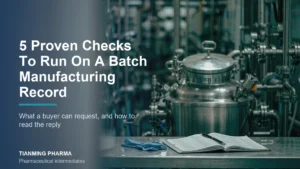
Proven Checks Buyers Miss In A Batch Manufacturing Record
The first commercial batch from a new intermediate supplier is not a formality. Here is the checklist, the five approval outcomes, and how to log the call.
Table of Contents
In the pharmaceutical industry, you often hear the saying, “The API is the core of quality.”
But if you’ve actually been involved in the process development and scale-up of complex intermediates, you’ll discover a harsher truth: the quality problems of most APIs are actually “predetermined” at the intermediate stage, and analytical methods are the first place to reveal these risks.
The development of analytical methods for intermediates is never just about issuing a certificate of conformity, nor is it simply about running an HPLC to check a purity number.
A truly mature analytical system is a tool to aid decision-making—it influences route selection, process optimization, scale-up feasibility, and even determines whether subsequent registration will be successful.
In pharmaceutical manufacturing, quality does not suddenly “appear” at the API stage.
In reality, most API quality risks are already embedded at the intermediate level, long before final crystallization or release testing begins.
At Tianming Pharmaceuticals, our experience across complex intermediates has consistently shown one thing:
analytical method development for intermediate purity and impurities is not a routine QC task—it is a strategic decision that directly impacts cost, scalability, and regulatory success.
Intermediates are often treated as “transitional materials,” and their analysis is simplified accordingly.
However, regulatory guidance such as ICH Q11 emphasizes that early understanding of impurities reduces downstream development risk.
From a manufacturing perspective, weak intermediate analytics often lead to:
Strong intermediate analytics shift impurity control upstream—where it is cheaper, faster, and more effective.
A reported purity of 99% means very little without context.
What matters is:
For this reason, we focus less on single-point purity values and more on impurity trends, batch-to-batch consistency, and impurity evolution across the route.
This approach aligns with modern CMC expectations and significantly improves audit readiness.
Reverse-phase HPLC remains the backbone of intermediate analysis, but method intent matters.
A common mistake is directly applying:
These often fail to resolve:
In our development work, column selection, gradient design, and mobile phase conditions are optimized specifically for impurity resolution, not speed.
A slightly longer run time is a small price to pay for analytical clarity.
For intermediates with complex structures, heterocycles, or high functional density, LC–MS is essential—not optional.
It enables:
From a client and auditor perspective, knowing what an impurity is is far more reassuring than simply stating it is “below limit.”
Two impurities at the same level may carry very different risks.
Key questions we always ask:
This is why analytical development at Tianming is tightly integrated with process development.
Analytics informs process decisions—not the other way around.
This integrated strategy is fully aligned with ICH Q8 and Q11 principles of process understanding.
Intermediate methods must survive real manufacturing conditions, including:
Beyond formal validation, we emphasize:
A method that only works under ideal lab conditions will eventually fail in production.
In regulated markets, data credibility is as important as analytical performance.
Our analytical systems are designed to support:
More clients now request multi-batch trend data, not just COAs—an expectation that weak analytical systems cannot support.
Strong intermediate analytics deliver tangible business value:
In many sourcing decisions, clients choose suppliers not solely on price, but on how well impurity risks are understood and communicated.
Analytical method development for intermediate purity and impurities is not a downstream obligation—it is an upstream advantage.
When done correctly, it:
At Tianming Pharmaceuticals, we view analytical development as a core part of our process intelligence, not a support function.
If you are facing challenges related to:
we are ready to support you with analytically driven, production-proven solutions.
🔹 Looking to strengthen impurity control at the intermediate stage?
Contact Tianming Pharmaceuticals to discuss analytical and process development strategies tailored to your molecule.
Email: sunqian0123@gmail.com
WhatsApp: +86 176 63713557
The first commercial batch from a new intermediate supplier is not a formality. Here is the checklist, the five approval outcomes, and how to log the call.
The first commercial batch from a new intermediate supplier is not a formality. Here is the checklist, the five approval outcomes, and how to log the call.
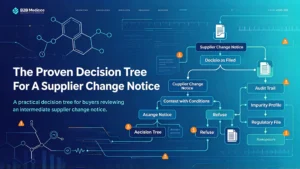
A buyer-side decision tree for handling an intermediate supplier change notice — what to accept, contest, or reject, and how to log the call.

Manufacturer and supplier of pharmaceutical APIs and intermediates. Contact us for technical support and sourcing solutions.