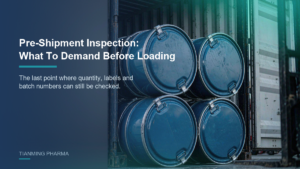
Pre-Shipment Inspection: What To Demand Before Loading
A pre-shipment inspection confirms the cargo matches the documents before they part company for a month. When to order one, what the inspector checks, and what the report must contain.
By the time an inspection becomes possible, almost every decision about the order has already been made. The material is produced, the drums are filled and labelled, the container booking exists, and the only remaining act is physical: load the cargo, close the doors, apply the seal. Between that moment and the moment the same drums arrive at your warehouse in Mumbai or Chittagong sits four weeks of ocean freight in which nobody can fix anything.
A pre-shipment inspection is the last point at which a problem can still be cheap. It is an examination of the cargo — quantity, packaging, labels, and usually a drawn sample — carried out at the factory before loading, by you, by a third-party agency, or by the manufacturer under a witness. It does not replace the certificate of analysis, and it cannot see inside a drum. What it does is confirm that the physical shipment matches the paperwork, before the paperwork and the cargo part company for a month.
This article is about the buyer side of that exercise: when the inspection earns its cost, what an inspector actually verifies, what the report must contain to be worth anything, and how the whole arrangement gets written into the order so it happens by default rather than by negotiation each time.
The definition matters more than the name suggests, because the term gets stretched across three different activities. At the narrow end, it is a visual and documentary check at the factory: drums counted against the packing list, closures and seals examined, labels compared with the invoice, loading witnessed and photographed.
In the middle sits sampling — the inspector draws sealed samples from a defined subset of drums for laboratory verification. At the widest end, the scope expands into full release testing against the specification, effectively duplicating the manufacturer’s own quality control through a second laboratory.
The three scopes cost different amounts and answer different questions, and buyers who treat “inspection” as one undifferentiated service end up either over-buying the narrow scope or under-reading the wide one. The narrow scope answers: does the physical cargo match the documents? The middle adds: does the cargo match the certificate? Only the widest scope answers: does the material meet the specification? Those are three separate questions, and it is worth deciding which one you are paying to have answered before the purchase order is amended.
Most inspection bodies — the large testing and certification groups and their regional equivalents — package these as standard scopes, and the published chemical-scope checklists from one of the inspection groups buyers most often name let a first-time buyer read exactly what happens on inspection day before committing to anything. Reading the checklist first is a better use of an hour than a sales call.
An inspection is not free, and demanding one on every order forever is the sort of rule that quietly erodes supplier goodwill without improving much. The cases where it earns its place have a shape to them, and the shape is: asymmetry between what the check costs and what a failed shipment costs.
First orders with a new supplier sit at the top of the list. Everything else in the relationship — the sample trial, the document review, the references — described a promise; the inspection is the first thing that examines the promise at scale. A first production run can differ from a sample in ways nobody intended: a substitution made during scale-up, a drum-size change, a labelling template that was never tested against a real order.
Second come resumptions after a long gap. If the last shipment was a year ago, the line has run other products in between, staff have changed, and the drum stock in the warehouse may be from a different batch of packaging. Nothing sinister needs to be involved for the file to drift; it drifts on its own.
Third are shipments where the cargo value or the downstream stakes are disproportionate — a single batch feeding a validation campaign, or material bound for a process where a rejected delivery stops a production week. Fourth, any order where the route changed: a new freight forwarder, a consolidation with other suppliers’ cargo, or transshipment through a hub the previous shipments never touched.
Between these cases, routine repeat orders from a supplier whose document trail has stayed clean can travel unexamined. That is not carelessness. It is the same logic as any control plan: apply the check where the risk sits, and record why it sits there.
The physical scope of a chemical pre-shipment inspection is less mysterious than buyers expect. Six items cover most of what happens at the factory on inspection day.
Quantity comes first: drums, bags or IBCs are counted against the packing list, and net weights are checked against what the invoice claims. Packaging integrity follows — each unit examined for dents, leaks, swollen closures, and the quiet damage that reconditioned drums carry with them. Label verification is the third: batch numbers, manufacturing dates, product names and consignee details compared line by line against the invoice and packing list, because a drum whose label disagrees with its paperwork is a customs problem before it is a quality problem.
Then the scope most buyers underrate: batch-number verification against the certificate. The batch on the drum should be the batch on the CoA, and the way the batch on the label is written is exactly the sort of detail an inspector catches — a transposed digit, a drum set from a second batch quietly mixed into the pallets, a repacked drum with a handwritten label where every other label is printed.
Where the scope includes sampling, sealed samples are drawn from a stated number of units and dispatched to the laboratory named in the scope, with the sample locations recorded. And finally, where loading supervision is included, the inspector witnesses the container loading, records the container and seal numbers, and photographs the sealed doors.
Two drums of the same material under two different batch numbers, loaded side by side, is either a consolidation the paperwork explains or a discrepancy nobody has explained yet. The inspection exists to surface that distinction while it is still a question rather than a claim.
Everything above is worth what its documentation is worth. An inspection that ends in a verbal “all fine” from the inspector, with nothing written down, leaves you with no evidence and no leverage — worse, it leaves you with the impression of a check that never happened, which is the most dangerous outcome of all because it feels like one.
A report worth paying for contains a specific set of items, and it is reasonable to demand them by name before the inspection is booked.
| Report item | What it gives you later |
|---|---|
| Inspection date, factory name and address, batches covered | Anchors the report to a production event; a report that cannot name the factory is not a report |
| Quantity statement against the packing list | The basis of any short-shipment claim |
| Photographs of representative units and their labels | Shows what the labels said on inspection day, not what someone remembers |
| Container number, seal number, sealed-door photographs | Links the cargo to the transport document; the seal number must match the bill of lading |
| Sample statement — how many drawn, from where, sent to which laboratory | Chain of custody for the result you will receive weeks later |
| Laboratory certificate, where testing is in scope | The verification layer; without it the inspection is visual only |
| Inspector’s signature and certificate or licence number | Makes the report usable in a dispute rather than decorative |
A report missing any of these is a half-inspection. The reasonable response is to send it back for completion before the cargo sails, not to accept it and hope the container holds what the photographs claim.
The limits deserve the same precision as the scope, because the failure mode in practice is over-trust. A visual inspection cannot see inside a sealed drum, so it proves nothing about assay, impurity profile, water content or anything else that lives in a chromatogram. A buyer who treats an inspection report as quality assurance has bought a packaging audit and mistaken it for a chemistry one.
The certificate remains the quality document, which is why the inspection scope that matters most is the one that links the two: sampling. When the inspector draws sealed samples and an independent laboratory verifies them against the specification, the result becomes what an independent laboratory result adds to the manufacturer’s own certificate — a second set of numbers produced by a party with nothing at stake in the shipment passing.
Without that layer, the inspection confirms identity of cargo and documents, and the quality question still rests entirely on the CoA, which is why the certificate you will compare the shipment against should be reviewed before the inspection is scoped, not after the container has left.
Retained samples belong to this same conversation. Where the scope allows it, a sample kept sealed from inspection day gives you a reference point that outlives the shipment — and it is worth understanding what a retained sample is worth at this stage, because the difference between a dispute you can prove and a dispute you can only argue is usually a sealed bottle with a documented chain of custody.
An inspection that lives in email conversations will be skipped precisely when it is needed most — the urgent order, the end-of-quarter shipment, the resupply nobody wants to delay for two factory days. The fix is contractual, and it is short.
The purchase order or quality agreement should state the trigger conditions (first order, resumption after a defined gap, cargo value threshold, route change), the scope (which of the three levels, whether sampling is included, which laboratory), who pays, and what happens on a failed inspection. The clause that puts inspection on the record costs a paragraph and converts the whole arrangement from a recurring negotiation into a standing condition of shipment.
Failed inspection handling is the part most clauses omit, and it is the part that decides whether the clause has teeth. The workable formulation is simple: no loading until discrepancies are resolved, re-inspection at the supplier’s cost where rework was needed, and a defined right to cancel where the failure repeats. None of this needs to be adversarial on paper. Suppliers who intend to ship what they promise accept these conditions routinely; resistance to them is itself information worth having before the first deposit, not after.
Sometimes the inspection finds more than a mislabelled drum. A batch drawn for sampling that comes back out of specification, a quantity mismatch that the supplier cannot explain, drums mixed across batches without documentation — these are not findings to “resolve before loading” in the loose sense.
They are grounds to stop the shipment entirely and open the conversation that the rejected batch route exists to handle: who pays for what has already been produced, what happens to the material, and whether the relationship continues on revised terms or not at all.
The economics behind the entire exercise compress into one comparison, and it is the reason inspection clauses survive contact with procurement departments. The inspection costs a known, modest fee per shipment. A failed shipment costs the cargo value, the replacement freight, the production time already planned around the material, and a season of credibility with the plant that was waiting for it.
Nobody needs a spreadsheet to see which side of that comparison the inspection belongs on; the buyer’s only real decision is which shipments to apply it to, and the answer, applied honestly, is the ones where failure would not be survivable.
For intermediates buyers across India, Bangladesh and Pakistan, the pattern that works in practice is narrow and repeatable: inspect the first order, inspect the resumption after a gap, inspect anything feeding a validation campaign, and let the document trail — certificates, reports, seals matching bills of lading — earn the routine shipments their exemption. Then, when the drums arrive, the inspection report is the first page the receiving team compares against your own incoming checks, and the two documents together close the gap between what left the factory and what entered your warehouse.
Five minutes of reading the report against the packing list, the seal number against the bill of lading, and the batch against the certificate. That is the whole discipline. It happens once, before loading, while everything is still fixable — which is the only time it is worth doing.
A pre-shipment inspection confirms the cargo matches the documents before they part company for a month. When to order one, what the inspector checks, and what the report must contain.
Residual solvents usually appear on a certificate of analysis as one word: conforms. Here is what the line covers, what it leaves out, and the sentence that turns it into numbers.
A certificate of analysis does not carry its own expiry date. Batch match, retest window and spec version decide whether it still counts — three dates, five desk checks, five minutes.

Tianming Pharmaceutical is a manufacturer of high-quality pharmaceutical intermediates and fine chemicals for research, development and industrial synthesis. We support global B2B partners with process development, custom synthesis and reliable supply, backed by consistent quality documentation.
Products are supplied as pharmaceutical intermediates for research and industrial use only. They are not for human or veterinary use and are not intended for the manufacture of finished pharmaceutical products without independent regulatory authorization.