Proven Checks Buyers Miss In A Batch Manufacturing Record
The first commercial batch from a new intermediate supplier is not a formality. Here is the checklist, the five approval outcomes, and how to log the call.
Table of Contents
A batch manufacturing record is the document trail sitting behind a certificate of analysis. These five checks tell you whether a supplier’s process is genuinely under control, or whether the numbers only look right on paper.
Everyone who buys intermediates asks for a certificate of analysis. It arrives, it lists assay and water content and the residual solvent profile, and for most buyers the paper trail ends there. Our guide to how to read a certificate of analysis covers what those numbers mean once you have them.
The trouble is that a certificate is a conclusion, not a basis. It tells you what a laboratory found in a sample drawn from a batch. It says nothing about the chain that produced that sample — which raw material lots went into the reactor, whether the critical parameters stayed inside range during the hold, whether the yield reconciled at the end.
If a supplier tested a sample properly, the certificate will look clean. If the supplier did not control the process, a good laboratory can still return a conforming result from a well-chosen draw. That gap is what the batch manufacturing record closes.
EU GMP Annex 9 §6.50 requires batch production records to be prepared for each intermediate and API. §6.52 sets out what each record must contain: dates and times, identity of major equipment, the specific batch numbers of raw materials and intermediates used, actual results for critical process parameters, sampling performed, signatures of the people who performed and checked each critical step, actual yield, and a description of packaging and labelling.
Read that list again and notice what is absent from it. Almost none of it is a specification limit. Nearly every item is a traceable fact about what actually happened. That is the difference between the two documents, and it is why one of them can be shipped with every consignment while the other is usually requested.
| Certificate of analysis | Batch manufacturing record | |
|---|---|---|
| Answers | What was found in the sample | What was done to make the batch |
| Coverage | One test point per attribute | Every significant step, weighing through packaging |
| Content | Limits and pass or fail | Actual values, lot numbers, signatures, yields |
| Availability | Every consignment | On request, usually redacted |
| What it proves | The batch meets the agreed specification | The process that made it is controlled and traceable |
Start at the top of the record and follow one raw material lot number forward. Every place it appears — the weighing step, the dissolution, the charge into the reactor — should carry the same identifier. If the number changes partway through, or if a step records only the word “material” where a lot should be, you are looking at a record written up afterwards rather than one written as it happened.
Annex 9 §6.52(c) asks for specific identification of each batch, including weights, measures and batch numbers of the raw materials and intermediates used. For an intermediate buyer this matters more than it first appears. An untraceable raw material lot means that when a question arrives eighteen months later about an impurity profile that shifted, nobody can reconstruct which input was responsible. The investigation stalls in month one.
The practical test takes ten minutes. Ask the supplier to walk one lot backwards with you — from finished batch to raw material input, without pausing. If they can do it fluently, the traceability is real. If they need to go and check, an answer may still come back eventually, but the pause is the signal.
There is a second-order version of this check that costs nothing extra. Take the lot numbers from the last three batches you received and see whether any input repeats. A recurring input across batches is not a problem by itself — some raw materials come from a single qualified source. What it tells you is which question to ask next. If the same precursor fed three consecutive batches and the assay on the fourth drifted, you now know where to look first, and the conversation starts from evidence rather than from suspicion.
An in-process control entry should read something like 58 to 61 degrees, three hours twenty minutes hold, pH recorded at 7.4. It should not read “in specification,” or “OK,” or “as per procedure.”
The distinction looks pedantic until you want to know whether a batch ran close to the edge. A supplier recording pass or fail at every control point has thrown away the information you would need to judge the process. Two batches can both conform to the same specification — one run comfortably mid-range, one run hugging a boundary for four hours. The certificates look identical. The risk profiles are not the same, and the second one is the batch where a small upstream drift becomes an out of specification result two steps later.
This is also where process understanding shows. Under §6.52(d) the record should carry actual results for critical process parameters. A manufacturer monitoring a parameter because it genuinely affects the outcome will have a number. A manufacturer monitoring a parameter only to file it will have a checkbox.
Ask what the parameter actually controls. A supplier who answers in terms of the product — that the temperature sets the rate, that the pH protects the next step from degrading — is telling you they run the process. A supplier who answers by naming the SOP number has answered your question about the paperwork, not the process. The distinction shows up later, when something drifts and you need to know whether the drift is new.
Yield is the one figure in a batch record that cannot be manufactured in isolation, because it has to close against two other numbers. The first is theoretical: the quantity the process was expected to produce from the input charge, based on the route and the assay of what went in. The second is the quantity actually recovered, after losses at filtration, drying and transfer.
Three things to check. The actual yield sits in a plausible band relative to theoretical. It sits in the same band as the previous several batches. And the loss between the two is explained somewhere in the file rather than left as a silent gap.
A supplier running consistently at 71 percent with the loss documented is running a controlled process. A supplier reporting 97 percent on one batch after a history of 88 percent has something else going on, and the record should be saying so. Nobody running a genuine process produces that swing without a cause recorded.
This is where consistency data earns its place. A single number means nothing without a baseline to read it against, and our guide to batch to batch consistency covers how to build that baseline from three or four lots before it matters. If the gap between theoretical and actual is not explained anywhere, the specification itself may be doing more work than it should be — worth revisiting alongside how you set acceptance criteria in the first place.
Annex 9 §6.52(k) requires the record to carry any deviation noted, its evaluation, and the investigation conducted or a reference to where that investigation is stored separately. §6.72 restates the point from the other direction: all deviation, investigation and out of specification reports should be reviewed as part of the batch record review before the batch is released.
What this means for a buyer is narrow and practical. You are not auditing the supplier’s deviation management system. You are establishing that the batch you are about to buy was not silently affected by something nobody wrote down.
So the check is simple. If the record shows no deviation at all across many batches, that deserves a second look rather than relief — a facility that never records a deviation may not be looking hard enough. If there is one, check that it is described, that it has an evaluation, and that the outcome is stated rather than implied. A deviation properly closed is evidence of a functioning system; the absence of deviations is not.
Where a deviation touches a quality attribute, our guide to how a deviation report should read gives you the structure to check it against. And if the impact reaches far enough that the batch may not be usable at all, that leads straight to the questions before you reject a batch rather than accepting it quietly into inventory.
§6.52(f) asks for signatures of the persons performing and directly supervising or checking each critical step. §6.51 requires the record to carry a unique batch identification number, dated and signed when issued. §6.60(h) covers the laboratory side, requiring a second person to review the original records for accuracy, completeness and compliance with established standards.
Three tells suggest a record was reconstructed after the fact. Entries in one hand across steps that should belong to different people. Dates running out of sequence, where a step is signed before the step it depends on. Corrections made by overwriting rather than by striking through once, initialling and dating.
None of these proves anything alone. A single awkward signature is an ordinary human event, and it is not a fair reason to distrust a supplier. What matters is the pattern. If two of the three appear in the same document, you have learned something real about how records are maintained there — and that belongs in the qualification file rather than in a conversation you have once and then forget.
Corrections deserve particular attention because they are the normal case, not the warning sign. A record with no corrections at all across many batches is worth a second glance for the same reason a record with no deviations is: a working process gets adjusted, and adjustments get recorded. The question is never whether a correction exists. It is whether the old value remains legible, whether it is initialled and dated, and whether the reason is stated. That is the same expectation 21 CFR 211.192 sets out for investigation records, and it is a small thing to check and an expensive thing to discover missing.
None of this requires the unredacted manufacturing instructions. Process parameters, reagent ratios and in-house operating detail are the supplier’s legitimate property, and no reasonable buyer expects to receive them. What is being requested is quality data: lot numbers, actual results, yields, signatures, the deviation record. Those are the parts describing whether your material is what the certificate says it is.
A supplier who shares a redacted batch record under a confidentiality agreement is behaving normally. A supplier who says a batch record is entirely confidential manufacturing know-how and offers nothing is telling you something different — not necessarily that the batches are bad, but that there is no quality system behind them, or that the origin of the material is unclear.
Either way, this belongs in a written agreement so that both sides know what gets shared and by when, rather than in a single email exchange. The same expectations that shape a quality agreement with a supplier also determine what lands on a scorecard once ordering starts — and the request itself belongs on your list when you are working through a first article approval, before the first commercial order rather than during a shortage. The incoming control you apply on arrival cannot reconstruct a chain that was never documented.
The regulatory framework behind these checks is set out in 21 CFR 211.192 on investigations, in the EU GMP Annex 19 on reference and retention samples, and in ICH Q7 as reproduced in the ICH quality guidelines library. These are cited here as the source of the expectation, not as a description of any particular facility.
The first commercial batch from a new intermediate supplier is not a formality. Here is the checklist, the five approval outcomes, and how to log the call.
The first commercial batch from a new intermediate supplier is not a formality. Here is the checklist, the five approval outcomes, and how to log the call.
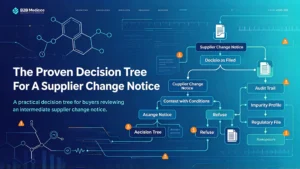
A buyer-side decision tree for handling an intermediate supplier change notice — what to accept, contest, or reject, and how to log the call.

Manufacturer and supplier of pharmaceutical APIs and intermediates. Contact us for technical support and sourcing solutions.