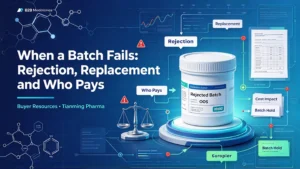
Ultimate Questions To Ask Before You Reject A Batch
Rejected batch? What to do in the first hour, how to write the notice, who pays the costs, and the escalation path when a supplier stalls.
Table of Contents
Abstract: Payment terms decide when money moves between buyer and supplier — and who carries the risk if a shipment goes wrong. This guide compares T/T, L/C, D/P and D/A for pharmaceutical intermediate purchases, with worked costs on a $60,000 order and the seven mistakes buyers make.
A buyer spends a week negotiating the unit price of a pharmaceutical intermediate, another week on MOQ, and then the procurement manager’s eyes glaze over when the commercial invoice template arrives. The line that decides who loses money if something goes wrong — the payment terms — gets signed with barely a look.
Payment terms are not a banking detail. They determine when money moves, what you receive before you pay, and who carries the risk between the day your order is confirmed and the day the drums arrive at your warehouse. In international trade, that window can stretch for months. The wrong terms can tie up your working capital, block a shipment at the port, or — in the worst case — leave you paying for goods you never receive.
This guide is written from the supplier side of the same table. It walks through the payment instruments used in intermediate trade — T/T, L/C, D/P and D/A — how each one works, what they really cost on a typical order, and the seven mistakes buyers make when they sign them. The goal is not to push one instrument over another, but to make sure the line gets negotiated as carefully as the price.
Every payment term is a point on the same spectrum: the more you pay in advance, the less the supplier worries and the more you do. Below are the structures used in pharmaceutical intermediate trade, ordered from the most supplier-favorable to the most buyer-favorable, with the risk each side carries.
Payment Structure | Buyer Risk | Supplier Risk | Typical Use |
100% T/T in advance | High — no leverage after payment | None | Custom synthesis, first order below ~$10K, urgent small lots |
30% T/T advance, 70% after shipment | Moderate — you pay on dispatch, before holding any document of title | Low — advance covers raw material cost; balance arrives on dispatch | Repeat customers with clean history |
30% T/T advance, 70% against B/L copy | Moderate-low — you pay only against documented proof of loading | Low-moderate — balance arrives only after the B/L is issued | The most common structure in China-sourced intermediates |
Documents against Payment (D/P) | Low-moderate — goods released only after payment | Moderate-high — cargo may sit if buyer refuses | Established relationships, moderate value |
Letter of Credit at sight | Low — banks guarantee payment against documents | Moderate — documents must be perfect | First orders, values above ~$50K, unfamiliar suppliers |
Confirmed LC | Low — same payment obligation as LC at sight, plus confirmation cost | Very low — a second bank adds its own undertaking to pay | High value; weak issuing-bank ratings; FX-restricted buyer countries |
Documents against Acceptance (D/A) | Low at document stage, but title transfers on acceptance | High — payment deferred until maturity | Rare in intermediates; only with strong credit history |
Open Account | Lowest | Highest | Large recurring buyers with years of history and credit lines |
Two structural points deserve emphasis. First, the middle of the table — 30/70 against B/L copy, D/P, and LC at sight — is where most intermediate trade actually happens. The extremes (100% advance, open account) are reserved for special cases. Second, the risk split is never absolute: a buyer protected on payment can still lose on quality, and a supplier protected on payment can still lose a customer relationship. Payment terms manage payment risk, not product risk.
Payment instruments carry real costs, and those costs are rarely quoted on the invoice. The figures below are typical ranges for a $60,000 intermediate order from China to South Asia — not a quote from any specific bank, but the order of magnitude you should expect.
Cost Item | T/T (30/70 split) | LC at sight | D/P collection |
Wire / transfer fees (2 transfers) | $50–120 | $25–60 (opening) | $25–60 |
LC issuing commission (0.5–1.5% of value) | — | $300–900 | — |
LC amendment / negotiation fees | — | $100–300 | — |
Collection handling fees | — | — | $100–300 |
Discrepancy fees (if any, $50–150 each) | — | $50–600 | — |
Document review time (internal, hours) | 0.5–1 | 2–4 | 1–2 |
Estimated total added cost | $50–120 | $500–1,900 | $130–360 |
Two conclusions follow. First, an LC is not free: on a $60,000 order the all-in cost commonly runs $500–1,900, which is roughly 0.8–3% of the order value. That premium buys you a bank’s promise, and it is often worth every dollar on a first order — but it should be a conscious purchase, not an assumption. Second, T/T’s real cost is not in fees: it is in the working capital you commit and the leverage you give up. A 30/70 T/T split leaves roughly $42,000 exposed until the bill of lading copy arrives, which is a cash-flow fact, not a fee.
Ask why so many suppliers in China quote “30% T/T advance, 70% against copy of B/L,” and the answer is working capital, not stubbornness.
Most pharmaceutical intermediates are made to order. Before your batch exists, the supplier must buy starting materials, reserve reactor time, and pay for intermediates and consumables — real cash outflows that begin weeks before your goods are ready.
The 30% advance is the share of that commitment the market has settled on as fair. It protects the supplier from a buyer who cancels after production has begun, which is the single most common way an order becomes a loss.
The 70% against the bill of lading copy gives the buyer the strongest practical control short of a bank instrument: the bill of lading is the document of title, and once the copy confirms the cargo is loaded in your name, any attempt by the supplier to divert the goods becomes a documented, traceable act rather than a silent one.
Strictly, the copy is evidence, not title — only the original B/L conveys the goods — so the buyer’s objective after paying is to secure the original quickly (or a telex release) before the cargo arrives. Between dispatch and payment, the copy is visibility and leverage.
The symmetry is the reason the structure survives: the advance prices the supplier’s risk of a canceled order; the B/L balance prices the buyer’s risk of paying for nothing shipped. When both sides understand the arithmetic, 30/70 against B/L is usually the fastest deal to close.
A letter of credit works because banks are ruthless about one thing: documents must match the credit exactly. Banks examine paper, not product. Under the International Chamber of Commerce’s UCP 600 rules, a presentation that does not strictly comply can be rejected — and in pharmaceutical trade, the trap is almost always the Certificate of Analysis.
Consider a credit that states: “Purity by HPLC: not less than 99.0%; batch number as per B/L; COA dated on or before shipment date.” Now the supplier’s COA arrives with an assay of 98.5%, or the COA carries the intermediate’s internal batch code while the B/L shows the commercial batch number, or the COA is dated two days after loading.
Any one of those is a discrepancy. The bank will refuse to pay, the supplier will present again or the parties will seek an amendment, and every round-trip costs time and money — while your cargo sits at the port.
The pharmaceutical-specific lesson: agree on the exact COA format before the LC is opened. The buyer and supplier should exchange a sample COA, confirm that batch numbers, assay tolerances, retest dates, and specification values are all reproducible in the document that will actually accompany the shipment, and have that sample COA attached to or described in the LC application.
Buyers who do this close LCs on the first presentation. Buyers who skip it discover that a two-character difference between a COA and an LC can stop a six-figure payment.
Two more LC facts worth knowing. First, a confirmed LC — one to which a second bank, usually in the seller’s country, adds its own undertaking to pay — protects the seller against the issuing bank’s credit risk and the buyer’s country risk (for example, foreign-exchange constraints that delay settlement).
The confirmation premium is typically carried by the seller or split, so a buyer is usually asked to accept confirmed terms only when the issuing bank’s rating is weak.
Second, discrepancies are often fixable by waiver, but every waiver is a negotiation you did not plan for. The cost table above assumes a clean presentation; a messy one multiplies the fees.
The right payment terms depend on where the relationship sits. The matrix below combines order value with supplier track record — the same logic that feeds supplier qualification and dual sourcing decisions.
Scenario | Recommended Terms | Why |
First order, under ~$20K, document audit passed | 30% T/T, 70% against B/L copy | Low cost, shared risk, enough control for a small exposure |
First order, $20K–$50K | LC at sight, or 30% T/T + 70% against B/L after site verification | Value justifies bank cost; site verification substitutes for trust |
First order, above ~$50K | LC at sight (confirmed if bank rating uncertain) | Exposure too large for an unverified supplier on open terms |
Repeat buyer, 2–3 clean orders | 30% T/T, 70% after shipment or D/P | Payment history substitutes for bank instruments |
Strategic partner, 12+ months, volume commitment | 30% T/T advance, balance open account / D/A with credit limit | Working capital efficiency for a vetted, multi-year relationship |
The pattern to notice: payment terms are a function of information. Every clean order you complete converts a unit of trust into a cheaper payment structure. The fastest way to move down the table is to make the relationship verifiable — shared audit results, batch-to-batch data, and a quality agreement — which is exactly what the audit and dual-sourcing processes are for.
Most intermediate buyers reading this are in India, Bangladesh, or Pakistan, and each market changes the payment conversation in ways a European buyer’s checklist will not tell you.
India. Import payments are governed by the Reserve Bank of India’s foreign exchange rules and must run through authorized dealer banks. In practice, Indian buyers choose between T/T and LC based on their banking relationship and the supplier’s terms. CAD (cash against documents) and D/P are common requests, but many Chinese suppliers resist them for first orders because the cargo can be refused and the shipping cost is then on the supplier.
A practical middle ground is 30% T/T advance with 70% on B/L copy, or an LC for the balance instead of the full value — a structure that keeps the bank involved at a fraction of the LC cost.
Bangladesh. Letters of credit have long been the default import mechanism, but during periods of foreign-exchange pressure, banks impose higher margins on LC openings and ration approvals.
Buyers in this situation should expect suppliers to ask for larger T/T advances on smaller, more frequent shipments — which is precisely the legitimate adaptation that keeps trade moving when LC capacity is tight. Smaller shipments also reduce the cash tied up per order, which helps both sides.
Pakistan. Importers face central bank documentation requirements, and LC terms are often dictated by SBP rules rather than commercial preference. Suppliers who have shipped to Pakistan regularly know the document set — usually including the proforma invoice, LC, and import form — and will price accordingly.
The thread through all three markets: when bank instruments are scarce or expensive, the gap is filled by T/T advances and shipment splits, not by risky open terms.
A buyer who offers 30% advance with the balance against B/L copy, on a shipment size sized to their cash position, is offering terms a supplier can live with — and that is the fastest way to get a competitive price.
Payment terms are not always either-or. Two combinations are common enough to know.
Split LC: 30% T/T advance, 70% by LC. The advance secures the production slot; the LC covers the balance and gives both sides bank-level assurance on the larger chunk. This halves the LC issuing cost relative to a full-value credit while keeping the buyer’s exposure protected — a useful structure for medium-value orders.
Open terms plus export credit insurance. Suppliers with insurance — China’s Sinosure (China Export & Credit Insurance Corporation), or comparable national export-credit schemes — can cover receivables under D/P, D/A, or even open account, converting a previously unacceptable risk into an insured one.
When a supplier has this in place, they may offer you better terms than their peers precisely because the risk is insured on their side. It costs the supplier a premium, so it is usually reflected in the price — but it is a legal, bank-sanctioned mechanism, not an evasion of any country’s rules.
If you are offered such terms, ask which insurance mechanism backs them and confirm the coverage scope in writing.
The answers tell you as much about the supplier as the price does. A supplier who answers the document-format question instantly, and who explains the advance in terms of their own raw-material commitments, is a supplier who has thought about risk from both sides of the invoice.
A supplier who deflects the questions is telling you how the negotiation will feel when a batch goes wrong.
Payment terms are the last line of defense in a transaction where everything else has already been negotiated. Read them with the same care you gave the unit price.
If you are reviewing a supplier’s commercial proposal and the payment structure does not make sense, ask before you sign — and if the supplier cannot explain it, treat that as the red flag it is.
For a full walkthrough of supplier qualification, batch consistency, and the paperwork that makes a payment structure safe, start with our supplier audit checklist and our guide to qualifying a second supplier. To compare costs before you negotiate, see how prices are actually built, what MOQ really means, and how shipping terms interact with payment terms. When you are ready to discuss terms on a specific intermediate, contact our team.
Rejected batch? What to do in the first hour, how to write the notice, who pays the costs, and the escalation path when a supplier stalls.
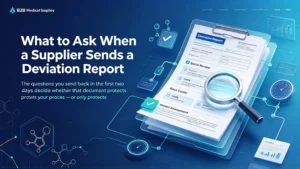
A deviation report arrives with a batch you have already paid for. The questions you send back in the first two days decide whether that document protects your process — or only protects the supplier who wrote it.
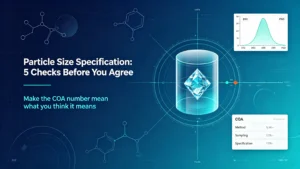
Two suppliers can quote the same intermediate with completely different particle size lines, and both may be telling the truth. Here is how to read a particle size specification before you agree to one, so the number on the COA means what you think it means.

Manufacturer and supplier of pharmaceutical APIs and intermediates. Contact us for technical support and sourcing solutions.