Ultimate First Article Approval Checklist For A New Supplier
The first commercial batch from a new intermediate supplier is not a formality. Here is the checklist, the five approval outcomes, and how to log the call.
Table of Contents
What buyers need to know about the supply chain behind a $1 billion autoimmune drug — three indications, two patent cliffs, and one molecule that keeps growing
Baricitinib is not the biggest JAK inhibitor on the market. That title belongs to upadacitinib (Rinvoq), which pulled in $8.3 billion in 2025 — nearly nine times baricitinib’s roughly $950 million.
But here is the thing buyers are noticing: baricitinib has three FDA-approved indications that no other JAK inhibitor can match in a single pill — rheumatoid arthritis, severe alopecia areata, and COVID-19. Its patent expires in Europe around 2028 and in the US around 2029.
When those dates hit, the generic manufacturing surge will require intermediates at a scale the current supply chain has not prepared for.
If you are sourcing baricitinib intermediates now, you are positioning ahead of that wave. If you wait until 2028, you will be competing with every generic manufacturer who had the same idea.
At a Glance
Baricitinib (Olumiant) — CAS1187594-09-7— is an oral JAK1/JAK2 inhibitor developed by Incyte and commercialized by Eli Lilly. It is approved in 75+ countries for rheumatoid arthritis (FDA 2018), COVID-19 (FDA 2022), and alopecia areata — the first systemic treatment ever approved for that condition (FDA June 2022). The JAK inhibitor market as a whole hit $23.6 billion in 2025, growing at roughly 19.5% annually.
Baricitinib blocks JAK1 and JAK2, two enzymes that sit just inside the cell membrane and relay inflammatory signals from cytokines like IL-6 and IL-23 into the cell nucleus.
By shutting down that relay, it suppresses the immune overdrive behind rheumatoid arthritis, alopecia areata, and severe COVID-19 inflammation. The selectivity numbers tell the story: baricitinib hits JAK1 at 5.9 nM and JAK2 at 5.7 nM — roughly 10 times more selective for those targets than for TYK2, and 100 times more than for JAK3.
That selectivity window is what makes it a drug rather than a blunt instrument.
Baricitinib comes together from three fragments. The hard part? Not any one step. It is getting all three pure enough that the final coupling does not become a purification mess.
Fragment | What It Is | Role in Final Molecule | Main Quality Concern |
Fragment A | The pyrrolopyrimidine core — the molecular skeleton that binds JAK1/JAK2 | ATP-binding pocket competition; the hinge-binding scaffold | SEM protection/deprotection completeness; residual chlorine content |
Fragment B | The linker arm connecting the core to the nitrile tail, with the azetidine ring providing conformational constraint | Joint between core and tail; azetidine restricts rotation for target fit | Chiral purity; boronic ester hydrolysis during storage; palladium residue from its own synthesis |
Fragment C | The solubilizing tail with the nitrile group | Solubility and pharmacokinetics; nitrile avoids metabolic oxidation | Nitrile stability under acidic conditions; residual sulfonating agent |
1 N-Protection of Fragment A. 4-chloro-7H-pyrrolo[2,3-d]pyrimidine is treated with sodium hydride in N,N-dimethylacetamide at -10°C, then alkylated with SEM-Cl (2-(trimethylsilyl)ethoxymethyl chloride). The SEM group masks the pyrrole nitrogen to prevent side reactions in the upcoming Suzuki coupling.
A word of warning: sodium hydride is pyrophoric. If your supplier cannot describe their inert atmosphere protocol and moisture-control measures for this step, they have probably never run it at production scale. Ask.
2 Assembly of Fragment B. 4-pyrazoleboronic acid pinacol ester reacts with 2-[1-(ethylsulfonyl)-3-azetidinylidene]acetonitrile, catalyzed by DBU in acetonitrile. This step builds the pyrazole-azetidine linker with the ethylsulfonyl group already installed. The reaction is run at room temperature and completes in about two hours — fast, but the regioselectivity at the pyrazole nitrogen needs careful HPLC monitoring.
3 Suzuki-Miyaura Coupling. This is where most problems surface. SEM-protected Fragment A and Fragment B are coupled using tetrakis(triphenylphosphine)palladium(0) — Pd(PPh₃)₄ — with potassium carbonate as base, in a refluxing mixture of n-butanol and water. The reaction typically completes in two hours, but the real work starts after: removing the palladium catalyst.
Why palladium removal matters more than yield. The ICH Q3D limit for palladium in oral drug substances is 10 ppm. A Suzuki coupling that produces 95% yield but leaves 50 ppm palladium is a failed batch — or at least it should be, unless someone downstream is cutting corners on metals testing. When you evaluate a supplier’s batch records, palladium residue is one of the first numbers to check.
4 SEM Deprotection. The final chemical step removes the SEM protecting group using lithium tetrafluoroborate (LiBF₄) in acetonitrile/water at 75°C, followed by ammonium hydroxide to adjust pH. The deprotected product is isolated by filtration, washed, and purified by column chromatography. Overall yield for the optimized route: approximately 84% from the protected intermediate.
What catches inexperienced manufacturers: incomplete SEM deprotection leaves a silylated impurity that co-elutes with the product on standard C18 HPLC columns. We have seen this firsthand — a CoA claiming 99.5% purity, but the NMR still showed the TMS singlet.
The batch was not 99.5%. It was closer to 97%, with the SEM-adduct making up the gap. If the supplier’s HPLC method does not specifically resolve that peak, the purity number means nothing.
The azetidine ring in baricitinib is not chiral itself, but the carbon attached to the nitrile group on the azetidine ring is a stereocenter in some synthetic routes. Even in achiral routes, the azetidine’s ring strain (about 25 kcal/mol) makes it susceptible to ring-opening under acidic conditions.
Impurities from ring-opened azetidine are some of the hardest to remove by recrystallization. Request the HPLC trace at 210 nm — that wavelength catches most amine and ring-opened byproducts that 254 nm detection misses.
Three metals accumulate through baricitinib’s synthesis: palladium from the Suzuki catalyst, sodium from the hydride step, and lithium from the deprotection reagent. All three must be tested by ICP-MS or ICP-OES. A supplier who only provides “heavy metals” by the USP <231> colorimetric method is not doing enough — that method is blind to palladium at pharmacologically relevant levels.
n-Butanol (used in the Suzuki step) is a Class 3 solvent with a 5,000 ppm ICH limit — generous, but it has a boiling point of 117°C and tends to stick to crystalline APIs. DMA (used in the protection step) is Class 2, limit 1,090 ppm. If the supplier’s drying protocol is “vacuum at 45°C overnight,” residual n-butanol can easily exceed 1,000 ppm even when the GC headspace report says otherwise — because the sampling temperature was set too low to volatilize it.
Push for residual solvent data at multiple sampling temperatures. This is not theoretical. We have watched buyers accept a GC report at face value, only to find their formulation step failing because n-butanol was quietly interfering with the excipient blend.
If you have been sourcing pharmaceutical intermediates for any length of time, you have seen CoAs that look perfect — and batches that do not match them. For baricitinib intermediates specifically, here is what to cross-check:
CoA Parameter | What It Should Say | What to Question |
HPLC Purity | ≥99.0% by area normalization, with method specifying column type, mobile phase gradient, and detection wavelength | “≥99.5%” without specifying detection wavelength or integration parameters — purity numbers are meaningless without the method that produced them |
Single Max Impurity | ≤0.10% individually, with each impurity ≥0.05% identified by retention time or RRT | Unidentified impurities listed as “RRT 1.32 — 0.08%” with no structural assignment — if they cannot name it, they have not characterized it |
Palladium Content | ≤10 ppm (ICH Q3D oral limit) by ICP-MS | “<10 ppm” tested by USP colorimetric method — wrong method, the result is meaningless |
Residual Solvents | List of Class 2 and Class 3 solvents with individual and total limits per ICH Q3C | “Meets ICH Q3C” with no individual solvent values — a summary statement is not a test result |
Water Content | Karl Fischer titration, typically ≤0.5% | Missing entirely — water content affects both assay value and stability |
For a deeper dive into CoA verification, our guide on how to read a Certificate of Analysis for pharmaceutical intermediates covers the full framework.
Baricitinib’s demand profile is unusual because it pulls from three unrelated patient populations simultaneously:
Indication | Approved | Patient Pool | Demand Signal |
Rheumatoid Arthritis | EU 2017 / FDA 2018 | ~17 million globally | Steady, mature — the revenue backbone. Under pressure from upadacitinib competition. |
Alopecia Areata (severe) | FDA June 2022 | ~700,000 in the US alone | Growing fast — first systemic treatment ever approved. Adolescent extension (12–17) expected FDA decision 2026 H2. No direct oral competitor in this niche yet. |
COVID-19 | FDA EUA 2020 / Full 2022 | Pandemic-dependent | Declining but strategically important — proved the anti-cytokine-storm concept. Lilly is now testing baricitinib in dengue fever (Phase 3) and type 1 diabetes. |
The alopecia areata indication is the one to watch. Baricitinib is the only oral JAK inhibitor approved for it, and the dermatology community has embraced it — prescribing grew 40% year-over-year in some US regions.
Every new alopecia patient is a repeat customer: the drug does not cure the condition, it controls it, so treatment is chronic. That means stable, long-term intermediate demand.
The core compound patent for baricitinib expires around 2028 in Europe and 2029 in the United States. Chinese API manufacturers are already filing alternative synthesis route patents — that is the clearest signal that the generic race has started.
When the patent wall comes down, the first generics to file will capture market share. Their success depends on having validated intermediate suppliers in place before the ANDA submission, not after.
What this means for intermediate buyers: the 2026–2027 window is the time to qualify suppliers. By 2028, the suppliers with validated DMF-ready processes will be booked. Everyone else will be scrambling.
For a structured approach to supplier evaluation, see our guide on verifying pharmaceutical intermediate supplier compliance.
Q: What is the CAS number for baricitinib?
Baricitinib’s CAS number is 1187594-09-7. Its molecular formula is C₁₆H₁₇N₇O₂S, with a molecular weight of 371.42 g/mol.
Q: When does the baricitinib patent expire?
The core compound patent expires around 2028 in the European Union and 2029 in the United States. Chinese generic API manufacturers are already filing alternative synthesis route patents, signaling active preparation for the post-patent market.
Q: What are the key intermediates in baricitinib synthesis?
The three key intermediates are: (1) SEM-protected 4-chloro-7H-pyrrolo[2,3-d]pyrimidine (the JAK-binding core), (2) the pyrazole-azetidine boronic ester (the linker arm), and (3) the ethylsulfonyl-azetidine-acetonitrile fragment (the solubilizing tail). These three fragments are assembled via a palladium-catalyzed Suzuki-Miyaura coupling, followed by an acidic deprotection step.
Q: What quality tests should I request for a baricitinib intermediate?
At minimum: HPLC purity with dual-wavelength detection (210 nm and 254 nm), palladium content by ICP-MS (ICH Q3D limit: ≤10 ppm), residual solvents by GC-headspace (including n-butanol and DMA), water content by Karl Fischer, and 1H NMR for structural confirmation. For intermediates containing the SEM protecting group, also request NMR evidence of complete deprotection.
Q: Why is the Suzuki coupling step the most critical?
The Suzuki coupling joins two large fragments to form the baricitinib core structure, and it requires a palladium catalyst that must be completely removed afterward. Residual palladium above 10 ppm makes the batch unsuitable for pharmaceutical use. Catalytic palladium also tends to form colloidal particles that are difficult to filter, making this step the most common source of batch failure in baricitinib manufacturing.
Q: Is baricitinib just for rheumatoid arthritis?
No. Baricitinib is FDA-approved for three indications: rheumatoid arthritis (2018), COVID-19 (2022), and alopecia areata (2022). It was the first systemic treatment ever approved for severe alopecia areata. Eli Lilly is also conducting Phase 3 trials for type 1 diabetes and dengue fever. This multi-indication profile makes baricitinib intermediate demand broader-based than single-indication drugs.
Baricitinib sits at a specific moment in its lifecycle: the revenue base is stable at roughly $1 billion per year, three approved indications are generating demand, the alopecia areata franchise is still growing, and the patent cliff is visible but two to three years away. That combination — mature demand, growing new indications, approaching generic opportunity — is rare.
Here is what actually matters. Qualify your suppliers now, before the 2028 rush. Ask about palladium removal before you ask about price. Verify the HPLC method before you trust the purity number.
And if a supplier cannot explain how they confirm SEM deprotection, keep looking. For a broader analysis of quality control in pharmaceutical intermediate sourcing, our impurity control guide covers the frameworks that apply across the entire product line.
The first commercial batch from a new intermediate supplier is not a formality. Here is the checklist, the five approval outcomes, and how to log the call.
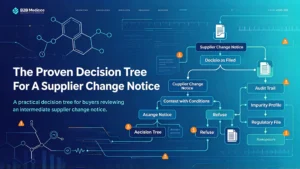
A buyer-side decision tree for handling an intermediate supplier change notice — what to accept, contest, or reject, and how to log the call.
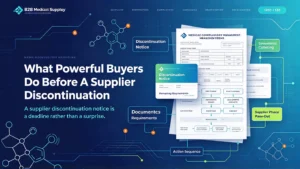
A supplier discontinuation is a deadline, not just bad news. The questions to ask in writing, the last-time-buy calculation, and the files to collect in time.

Manufacturer and supplier of pharmaceutical APIs and intermediates. Contact us for technical support and sourcing solutions.