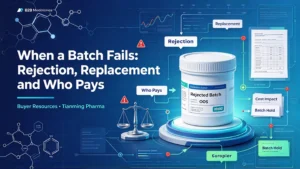
Ultimate Questions To Ask Before You Reject A Batch
Rejected batch? What to do in the first hour, how to write the notice, who pays the costs, and the escalation path when a supplier stalls.
The batch is in your warehouse, the numbers are outside specification, and your production schedule has a hole in it. The the deviation report you just read explained what went wrong; now the drums sit labelled and unopened.
In our experience supplying intermediates to buyers in India, Bangladesh and Pakistan, the outcome is usually settled before the first email is answered. The laboratory result creates the problem; the batch rejection itself is commercial. Most buyers run it badly — not for lack of leverage, but because they spend it in the wrong order.
A failing batch is not a disaster. A disorganised first hour is. The record you built on arrival is what you will argue from. The the six incoming checks gave you containers photographed as received, the batch number recorded against the delivery note, a sample retained under the specified condition, and a dated note of when the discrepancy was first seen. If they were not run properly, this is the moment that gap becomes expensive.
Three things matter in the first hour, and none is negotiation.
You do not need to prove the batch is bad. You need to prove it was bad when it left the supplier. Every batch rejection turns on that narrower claim, and the only one that survives.
The most useful document is a retained sample taken at arrival and stored correctly. It shifts the question from “is it out of specification now?” to “was it out of specification then?” — which both sides can test. Without it you are arguing about cause, and that argument cannot be won: the supplier’s counter-argument (something happened in your storage) is impossible to exclude.
| Evidence | What it proves | What it does not |
|---|---|---|
| Retained arrival sample, stored to specification | Condition of the material on arrival | Nothing, without the storage log |
| Batch number match across COA, labels and delivery note | That you tested what the supplier shipped | Nothing, if the three disagree |
| Third-party result on a split sample | An independent measurement both sides accept | Nothing, if the lab is not agreed in advance |
On the supplier’s side, we see far more disputes over method than over results. That last row is where most disputes turn. A supplier who disagrees with your in-house result is not necessarily stalling — they may believe their own data. The productive move is a split of the retained sample sent to a laboratory both sides accept, method agreed before it leaves. An a COA is not proof on its own: it reports selected results against selected limits, and says nothing about the impurity you found outside them.
If the failure touches a parameter that was never clearly fixed, the argument is not about the batch at all. It is about how the order was specified — much harder to win after delivery than before.
The first written contact decides whether you get a serious reply or a holding one. Most buyers send an emotional document; suppliers route those to a commercial contact and wait. A notice does four things.
On the response window: cross-border supply relationships commonly settle on five to ten business days for an acknowledgement and a course of action. A 24-hour deadline reads as a trap and invites a fight about reasonableness instead of about the batch. State the window and what happens if it passes, then follow it exactly.
Three outcomes, and a fourth that is a slow-motion version of the third.
| Outcome | Fits when | Watch for |
|---|---|---|
| Replacement | The material is still needed, the defect is clear, the production slot can be filled later | Replacement at the original price with no committed date. Get it in writing. |
| Credit / refund | You have sourced elsewhere, or the batch is not worth reworking | A credit note is only worth what your next order is worth. If you are switching, ask for money. |
| Conditional acceptance | The deviation is non-critical, documented, and your downstream process tolerates it | It releases the batch, not the risk. Concessions need written quality approval and a recorded downstream impact. |
The instinct to reach for a discount is the one to resist. It converts a quality decision into a commercial one and moves the problem into your process, where it resurfaces with your name on it. If a supplier offers a price reduction before the root cause is discussed, that offer says something about their confidence in the investigation.
On leverage, one thing is worth knowing: payment terms decide how much of the claim you can enforce. A buyer who has paid in full with no orders pending is negotiating with a supplier who has already been paid. A buyer holding a balance against delivery, or with a repeat order in progress, is having a different conversation.
Cost allocation is a separate question, and buyers default to absorbing it — return freight, storage, re-inspection, disposal — usually without checking. That default is almost never what the contract requires. Three things decide it, all fixed before the problem existed.
Storage while the batch sits in dispute is the item buyers forget. If your notice sets a deadline, a documented daily storage figure from the rejection date belongs in the claim. If it sets none, the storage is your own problem, indefinitely. Never quote a figure you cannot support: an inflated claim gives the supplier a reason to dispute the whole notice, not one line.
This question decides how far you push, and it is answerable from data you hold. A single rejection with a credible root cause and a closed corrective action is an incident; two in a year is a pattern. The difference is commercial: an incident is handled with the notice, a pattern at the level of the relationship. What to look at:
If the supplier attributes the failure to the process itself, the question becomes technical rather than commercial. Understanding where the impurity came from — whether it purges downstream or accumulates — is the difference between a batch you can use and one you cannot, and your technical team can reason about it from the supplier’s own data.
Silence is the most common response, and usually not malice — just a supplier with one person who can answer and no procedure telling them to. The escalation path is short, and should be followed in order.
If you decide to switch, the transition itself carries risk: supply chain risk is highest precisely while you are moving between suppliers and have neither as a proven fallback.
A rejected batch is not a quality event with a commercial consequence. It is a commercial event with a quality trigger — and buyers who treat it as the second keep most of their claim.
Everything above rests on three things decided long before the failure: the specification that defined “conforming”, the agreement that defined how a deviation is reported, and the payment structure that defines your leverage.
None can be renegotiated afterwards. What you control is the record you hold, the notice you write, and the speed of first contact — and when the claim closes, your supplier scorecard is where one incident becomes a trend line, and a trend line a sourcing decision. A rejection never scored is a rejection that will be repeated.
Rejected batch? What to do in the first hour, how to write the notice, who pays the costs, and the escalation path when a supplier stalls.
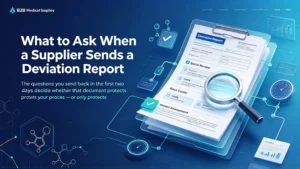
A deviation report arrives with a batch you have already paid for. The questions you send back in the first two days decide whether that document protects your process — or only protects the supplier who wrote it.

Two suppliers can quote the same intermediate with completely different particle size lines, and both may be telling the truth. Here is how to read a particle size specification before you agree to one, so the number on the COA means what you think it means.

Manufacturer and supplier of pharmaceutical APIs and intermediates. Contact us for technical support and sourcing solutions.