Abstract:A quality agreement divides quality responsibilities between you and your supplier before anything goes wrong. This guide shows intermediate buyers which clauses deserve the first read, what is worth negotiating, and what belongs somewhere else entirely.
Somewhere between the trial order and the first commercial order, a different kind of document lands in your inbox. It is long, it has legal formatting, and it asks you to agree to things you have never discussed with the supplier.
We are on the receiving end of these documents: when an account of ours moves from trial supply to scheduled commercial quantities, their quality department sends over a template — usually twenty or more pages, drafted by someone who has never spoken to either of us, with blanks where notification periods should be.
We mark what we can accept, explain what we cannot, and send it back. That exchange, more than the template itself, is where a quality agreement earns its keep. It is also where buyers most often leave value on the table, because the instinct is to skim, initial, and move on to the purchase order.
What a quality agreement actually is
A quality agreement is a written contract between a supplier and a buyer that defines which quality responsibilities belong to which party — who controls changes, who investigates deviations, who issues and signs certificates, who may audit whom, and how each party hears about problems. It covers quality obligations only. Pricing, delivery schedules, quantities, and liability limits are supposed to live in a separate commercial document.
That separation is not our preference; it is the stated position of regulators. The FDA guidance Contract Manufacturing Arrangements for Drugs: Quality Agreements, issued in November 2016, recommends that quality agreements be separate from commercial agreements such as supply or master services agreements, and explicitly states they should not cover pricing, delivery terms, or limits on liability.
On the European side, EU GMP Part I Chapter 7, which governs outsourced activities, expects a written contract that clearly defines the responsibilities of each party, including the right of the contract giver to audit. ICH Q7, Section 16, and ICH Q10, Section 2.7, extend the same logic to contract manufacture and purchased materials: the buyer’s quality system must reach into the supplier’s operation, and the written agreement is how.
One nuance worth knowing before you open the draft: the FDA guidance was written for contract manufacturing, and no dedicated FDA guidance exists for purchased APIs and intermediates. Buyers of intermediates borrow the same structure, which is why industry bodies fill the gap.
The APIC Quality Agreement Guideline and Template — the current version dates from January 2024 — is what most suppliers’ templates are ultimately descended from. If you have read one APIC-based template, you have essentially read them all. The differences that matter are in the details each party writes into the blanks.
Why the draft arrives now, and what it is really for
If your supplier relationship has followed the usual path — a structured RFQ, then a sample and a trial order — the agreement arrives exactly when informal trust is highest and everything is still reversible.
That is the point. A quality agreement is a major element of supplier qualification precisely because it is easier to define responsibilities before a problem than to invent them during one. The buyer who treats the document as paperwork to clear before the purchase order is spending their leverage at the moment they have the most of it and need it least — and will miss the clauses that only matter later.
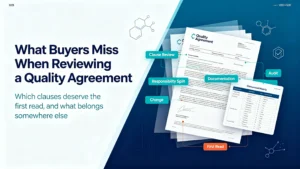
The six clauses worth reading first
Nobody reads all twenty pages with equal care, and you do not have to. These six carry most of the practical weight for an intermediate buyer.
| Clause | Why it matters to you | What buyers commonly miss |
|---|
| Scope: products, sites, activities | Names the exact material and the exact manufacturing site covered | Multi-site suppliers sometimes sign for an organisation, not a site. The site that never appears in the document is the one that may end up making your material |
| Change control and notification | Determines whether you learn about a process, site, or specification change before or after it reaches your plant | Accepting “the supplier will notify” with no period attached, or with a period shorter than your own assessment and regulatory lead times can act on |
| Specifications and certificates | Commits the supplier to the agreed specification and to batch-specific certificates issued by the quality unit | Not cross-checking this section against what your arrival inspection actually requires — the two should match line for line |
| Deviations and OOS | Sets who investigates, what you are told, and when | No time limit anywhere. “Will inform the customer of critical results” is not an obligation until a clock is attached to it |
| Audit rights | Preserves your ability to verify rather than trust | Rights that only exist on paper. If you will not travel, negotiate recognition of third-party or remote audits instead of pretending you will fly in |
| Subcontracting, storage and transfer | Keeps obligations intact when work is shared or moved, and covers storage, transport and retest documentation | Assuming your contract binds a subcontractor. It binds your supplier; the flow-down clause is what protects you, so read it |
Two of these deserve a second look. Change notification is where the real negotiating happens, because the supplier’s costs and your risks collide there directly: every month of advance notice is planning certainty for you and flexibility lost for them.
And the certificate section is where a quiet mismatch hides — buyers who have built a discipline around reading certificates should make sure the agreement obliges the supplier to provide exactly what that discipline consumes, including the retest or expiry date on every certificate.
What is worth negotiating — and what to leave alone
Arrive with your redlines prioritised, because not all clauses are equally movable. Notification periods are genuinely negotiable: the right number is not a universal figure but the time your own organisation needs to assess a change and, where required, act on it.
If your internal review takes six weeks, agreeing to two weeks of notice is signing up to find out after the fact. Site naming is negotiable. So is the audit format — mutual acceptance of remote audits, or shared industry audits, is a reasonable ask for buyers who cannot justify travel to every supplier.
Other fights are not worth having. Do not try to fold commercial terms into the quality agreement — regulators have already taken a position, and mixing the two usually means the document gets renegotiated by lawyers who were never in the room when the technical details were settled.
If pricing mechanics are on your mind, that conversation belongs in the supply agreement and its payment terms, where they can be traded against things commercial teams actually control.
Do not demand unrestricted audit rights at first signature either; a right you will not exercise soon damages credibility you may want later. And understand that some clauses are effectively fixed: suppliers inherit obligations from their own upstream agreements and cannot give you undertakings their own suppliers have not given them.
The view from the supplier’s side of the table
We see two kinds of buyers, and the difference is not seniority. The first type returns the template quickly with everything accepted and the blanks left blank, and calls us a year later asking why nobody told them the packing site changed. The second type sends back a short list: the site named, a notification period they can actually work with, a deviation clock, and a question about who signs the certificate.
That list takes an afternoon to agree, and it prevents almost every quality dispute we have seen go bad. The clauses that feel pedantic in month one are the ones holding the argument together in month eighteen — which is also the raw material a supplier scorecard measures once deliveries start.
It helps to remember what the document is not. It is not a substitute for knowing your supplier — qualification, audits, and the evaluation work that preceded it still stand on their own. It is also not where specification values get invented; the agreement references the specification you have already agreed and sets the rules for changing it.
If you are not in a position to sign one
Small-volume buyers are sometimes told a quality agreement is only available above certain volumes. If that is where you are, the responsibilities still exist — they are just distributed across other documents.
A written specification you have both countersigned, batch certificates that arrive complete and consistent, a compliance verification workflow before the relationship starts, and an arrival inspection that catches what paperwork misses together carry much of the same weight. Treat the agreement as the destination of a maturing relationship rather than the entry ticket, and revisit it when volumes justify it.
Frequently asked questions
Do intermediate buyers really need a quality agreement?
For contract manufacturing it is the regulatory expectation; for purchased materials it is a supplier qualification best practice rather than a universal legal requirement. In practice, once quantities are regular, most quality departments insist on one — and both parties benefit from having responsibilities written down before a dispute, not during one.
What is the difference between a quality agreement and a supply agreement?
A quality agreement covers quality responsibilities only: changes, deviations, certificates, audits, records. A supply agreement covers the commercial relationship: prices, quantities, delivery, payment, liability. The FDA’s 2016 guidance recommends keeping the two separate, and each document works better when it is not doing the other’s job.
How long should change notification periods be?
Long enough for your organisation to assess the change and, where necessary, act on it. There is no universal number — the mistake is accepting whatever period the template left blank, or one shorter than your own review process. Work the number out from your side first, then negotiate.
Who should sign the quality agreement?
The people accountable for quality on each side — typically the heads of the quality departments or their authorised representatives, with the document listing named contacts for daily communication. Version control matters too: the agreement should state how amendments are made, because the document will outlive the people who signed it.
The takeaway
A quality agreement is cheapest to negotiate when nothing has gone wrong yet, which is exactly when it arrives. Read the six clauses that carry the weight — scope, change notification, certificates, deviations, audits, and the flow-down of obligations — know your own numbers before you redline, and leave commercial terms where regulators say they belong. The buyers who do this do not sign better suppliers; they get more out of the suppliers they already chose.
We manufacture pharmaceutical intermediates for buyers across India, Bangladesh, and Pakistan, and we sign quality agreements as a normal part of moving from trial to commercial supply. Send us your draft or your questions — we will tell you plainly what we can commit to and what we would rather negotiate honestly than promise quietly.