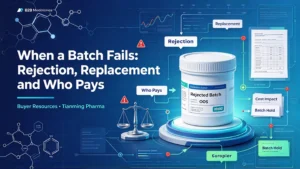
Ultimate Questions To Ask Before You Reject A Batch
Rejected batch? What to do in the first hour, how to write the notice, who pays the costs, and the escalation path when a supplier stalls.
Abstract: Relying on a single supplier for a critical API intermediate is a business continuity risk, not a cost saving. This guide explains why 2025-2026 supply chain conditions—tariff shifts, geopolitical tensions, and new shortage-prevention expectations from EMA and ICH Q9(R1)—are pushing pharmaceutical buyers in India, Bangladesh, and other generics manufacturing hubs toward dual sourcing.
It breaks down the primary-secondary supplier model, a six-step qualification checklist covering documentation, three-batch consistency, sample testing, quality agreements, and trial orders, the common pitfalls that derail second-supplier programs, and the concrete triggers for activating the backup source.
A procurement director at a generics manufacturer in Hyderabad has sourced a critical intermediate from one Chinese supplier for five years. The price is good. The batches pass incoming inspection. The relationship works — until the supplier’s plant is hit by an environmental inspection shutdown, a raw material export restriction, or a six-week freight delay at the port.
Production of the finished API stops. The cost of that stoppage, in rejected batches, re-testing, expedited freight, and delayed product launches, can exceed USD 200,000 — an order of magnitude larger than any price difference the single-source relationship ever saved.
This is not a hypothetical. An industry analysis found that 68% of pharmaceutical firms experienced at least one supply disruption in the two years before 2023, with API shortages among the most damaging categories. The same analysis quantified what dual sourcing delivers: stockout risk drops by roughly 61%, regulatory compliance readiness improves by about 34%, and unit costs can fall 12-18% once two suppliers compete for volume (pmarketresearch.com, 2026).
The lesson is not that single sourcing is always wrong. It is that single sourcing is a risk decision, not a cost decision — and for critical intermediates, the risk is no longer acceptable.
Three forces have pushed dual sourcing from a contingency plan to a strategic requirement.
EMA guidance on shortage prevention asks companies to plan for supply continuity, and ICH Q9(R1) makes risk identification and control central to lifecycle management. A qualified alternative source is treated as a tangible risk control for critical materials.
The European Commission’s Pharmaceutical Strategy frames security of supply as policy, not best practice. Buyers exporting to regulated markets are now expected to show regulators that a disruption in one source does not mean a shortage in the market (alkan-chemical.com, 2025).
US-China tariff escalation, India’s Production Linked Incentive scheme for domestic API manufacturing, and China’s 2025 tariff exemptions on certain Indian pharmaceuticals have all changed the risk profile of every sourcing corridor.
Buyers increasingly pair suppliers across geographies — for example, an Indian API manufacturer combined with an Eastern European partner, or a Chinese intermediate supplier paired with an Indian one. Diversification has shifted from a hedge to a default procurement posture (pharmatradz.com, 2025; fullavantenews.com, 2025).
The scale of single-region dependency is now well documented. The U.S.-China Economic and Security Review Commission noted in June 2025 testimony that China supplies approximately 65-70% of India’s key starting materials, intermediates, and APIs (USCC Hearing, June 2025). Every procurement team reading that number understands that “China dependency” is not an abstract concern — it is their own supply chain.
For intermediate suppliers themselves, this creates an opportunity: the buyer who needs a second source needs a supplier who can be qualified quickly, documented completely, and relied on to honor change notifications. That is the profile this checklist is built around.
Dual sourcing does not mean splitting volume 50/50 between two suppliers. That approach sacrifices scale economics on both sides and doubles management overhead. The model that works in practice is the primary-secondary structure.
Role | Volume Share | Purpose | Maintenance |
Primary supplier | 70-80% | Scale economics, routine supply, main relationship | Normal orders, annual quality review |
Secondary supplier | 20-30% | Risk buffer, competitive price tension, surge capacity | At least one small order per quarter to keep qualification warm |
Tertiary backup (optional) | 0-5% | Insurance for the most critical materials | Documented but not regularly ordered |
Model sources: CDMO operating guidance (pharmasource.global, 2025); peptide API dual-sourcing analysis (pengtingpeptide.com, 2025); Chinese supplier qualification SOP for GLP-1 peptide API exporters (chinamedglobal.com, 2025) | |||
In this model, the secondary supplier must be production-ready but does not need to run at full capacity. Keeping the qualification warm means placing a small order at least once per quarter, so that the supplier’s qualification status, documentation currency, and analytical results remain current. A supplier who has not shipped for eighteen months is, for practical purposes, a new supplier again.
Criticality segmentation helps scope the effort. A simple Tier A/B/C framework is common: Tier A materials (highly critical, long lead time) get full parallel qualification; Tier B (important but replaceable) get a warm, periodically verified qualification; Tier C (non-critical) are approved as backups with longer activation lead time (alkan-chemical.com, 2025).
Qualifying a second supplier is a deliberate process. The steps below compress the approach used in the industry — from technical screening through a trial order — into a checklist a procurement or quality team can execute.
Define your critical quality attributes before approaching any supplier. What purity, impurity limits, residual solvent ceilings, particle size distribution, and physical form does your API process require? What pharmacopeial compliance (USP, EP, BP, or Chinese Pharmacopoeia) matters for your target market?
Screen candidates against these attributes first. A supplier that cannot document batch-to-batch consistency or provide a synthetic route summary is disqualified before any audit. This screen overlaps directly with the incoming material checks described in our COA reading guide.
Ask the candidate for a full document package, then verify it against the checklist:
Documentation gaps are the single most common reason second-supplier qualifications stall. The supplier may have excellent product quality and no usable paper trail. Set document delivery deadlines into the timeline and into the Quality Agreement, because COA and SDS turnaround time directly affects your incoming inspection cycle.
Ask for three batches manufactured under the current process, and test all three against your specification, not the supplier’s. Look at the spread: if a critical impurity varies from 0.05% to 0.4% across three batches, that supplier’s process is not stable enough to be a backup source. Our batch-to-batch consistency guide explains how impurity fingerprint shifts — invisible on identical-looking COAs — cause downstream API batch failures.
Run the secondary supplier’s material through the same analytical methods you use for the primary supplier’s material, ideally in parallel. Compare impurity profiles, not just purity numbers. A 99.5% purity from two different suppliers can carry completely different impurity fingerprints, and your API process is validated against the fingerprint, not the percentage.
This step is where the “pharmacopeial equivalence trap” catches teams: two grades may both meet the monograph yet behave differently in your process because of differences in particle size, residual solvent pattern, or trace impurities. Test against your actual process window, not against the certificate (alkan-chemical.com, 2025).
The Quality Agreement is the document that makes a secondary supplier a real backup instead of a paper file. At minimum it must cover:
Negotiate the change notification clause carefully. Many suppliers, especially smaller Chinese manufacturers, interpret “change notification” loosely. A precise clause lists the categories of change explicitly: raw material supplier change, process parameter adjustment, equipment change, site change, and scale change. If the clause does not enumerate them, the backup is not truly qualified.
Place a small trial order, run it through incoming inspection, and use it in a pilot batch if volume allows. Then establish the maintenance cadence: a small order at least once per quarter, per the primary-secondary model, so the qualification stays warm.
Document the trial order results in the supplier file, and set review points — annually, or whenever the primary supplier changes anything material. A warm second supplier is a working risk control. A cold one is a false sense of security.
For buyers in India, Bangladesh, and Pakistan, the practical question is usually not whether to dual source, but whether a Chinese supplier can serve as the second source — or whether an Indian supplier should back up a Chinese primary. The answer depends on documentation discipline, and this is exactly where Chinese suppliers diverge.
What a Chinese supplier can credibly offer as a second source:
What buyers should verify carefully:
A secondary supplier does not need GMP certification to be valuable — a thoroughly documented ISO 9001 manufacturer with three-batch consistency data and a strong change control clause is often the more realistic second source. The qualification framework above is designed for exactly this profile.
Define activation triggers in advance, so that switching to the backup is a decision, not an emergency improvisation. Standard triggers used in supplier management programs (chinamedglobal.com, 2025):
Activation is a controlled ramp, not a flip of a switch. Bring the second supplier up to a larger share gradually while monitoring quality metrics — supplier-caused non-conformance rate, audit findings, complaint resolution time, and Quality Agreement compliance rate (hexiapharm.com, 2025).
If the decision instead becomes a permanent switch — the second source becomes primary — that is a different process with different costs. Our switching suppliers hidden cost guide covers bridging studies, method revalidation, and regulatory filing costs that apply in that case.
A second supplier should be evaluated on the same KPIs as the primary, with one addition: readiness. Track the reduction in sole-source exposure for Tier A materials, lead-time variability, on-time release improvement from faster document turnaround, and audit findings closure time. If the backup supplier’s document turnaround consistently misses the agreed SLA, the qualification is degrading even if no order has been placed.
The economics of the model reward patience. The 4 to 14 month onboarding cost is real, but it is amortized against a stockout risk that the analysis above puts at roughly 61% lower with dual sourcing, and against the option value of competitive pricing between suppliers. For a commercial API manufacturer, that trade is overwhelmingly favorable.
Looking for a second supplier for your API intermediates? Tianming Pharm is a Chinese manufacturer of pharmaceutical intermediates and APIs with ISO 9001 quality systems, lot-specific COAs for every batch, documented synthetic routes, and a change notification commitment built into every supply agreement. We can provide the three-batch documentation package, side-by-side comparability samples, and a trial order program that gets your second source qualified — without the usual paperwork delays. Request a qualification package.
Rejected batch? What to do in the first hour, how to write the notice, who pays the costs, and the escalation path when a supplier stalls.
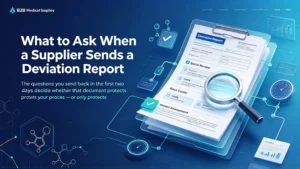
A deviation report arrives with a batch you have already paid for. The questions you send back in the first two days decide whether that document protects your process — or only protects the supplier who wrote it.
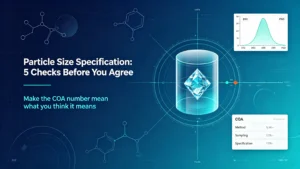
Two suppliers can quote the same intermediate with completely different particle size lines, and both may be telling the truth. Here is how to read a particle size specification before you agree to one, so the number on the COA means what you think it means.

Manufacturer and supplier of pharmaceutical APIs and intermediates. Contact us for technical support and sourcing solutions.