
Ultimate First Article Approval Checklist For A New Supplier
The first commercial batch from a new intermediate supplier is not a formality. Here is the checklist, the five approval outcomes, and how to log the call.
Table of Contents
A pharmaceutical intermediate sits between raw material and API. It has been purified, characterized, and tested — but it has not been formulated, stabilized with excipients, or sealed in a patient-ready container. That difference matters.
An API in a finished dosage form is protected by packaging, excipients, and a validated shelf life. An intermediate in a foil bag or HDPE drum is protected only by its own chemistry and whatever storage conditions the manufacturer specifies on the COA.
When those conditions are violated — by humidity in a warehouse, sunlight during a dock transfer, or heat during shipping — the intermediate degrades, and the degradation is invisible until downstream yields drop or impurities appear that were not on the original COA.
This guide covers three things:
Water is the most common degradation catalyst for pharmaceutical intermediates. It acts as a reagent — breaking ester, amide, lactam, and anhydride bonds through hydrolysis — and as a plasticizer, lowering the glass transition temperature (Tg) of amorphous solids and increasing molecular mobility, which accelerates diffusion-controlled reactions (Rumondor et al., 2009; Ahlneck & Zografi, 1990).
The practical consequence: a hygroscopic intermediate stored at 75% RH can absorb enough moisture in days to shift its assay by several percentage points — and the change will not appear on an HPLC purity trace if the degradation product is non-UV-absorbing. Only a Karl Fischer water-content test or a full assay comparison against the original COA will reveal it.
How much moisture is too much? There is no universal threshold. The acceptable water content depends on the intermediate’s chemical structure. But as a rule of thumb: if the COA specifies water content ≤ 0.5% by Karl Fischer, and your incoming inspection reads 1.2%, the material has likely already undergone measurable degradation.
ICH Q1B requires photostability evaluation for all new drug substances (ICH Q1B, 1998). For intermediates, photostability testing is not always performed — but many intermediates are just as light-sensitive as their parent APIs.
The ICH Q1B confirmatory study standard requires exposure to ≥ 1.2 million lux·hours of visible light and ≥ 200 Wh/m² of UV radiation. Any intermediate that shows significant change under these conditions must be labeled “Protect from light” — and stored in amber containers or opaque packaging.
Intermediates with the following structural features are most at risk: conjugated double bonds, aromatic rings with electron-donating substituents, enone systems, and phenols. If the COA says “Protect from light” and the material arrives in a clear plastic bag, that is a storage failure — even if the COA numbers still look acceptable.
ICH Q1A(R2) defines long-term storage conditions for stability testing at 25°C ± 2°C / 60% RH ± 5% RH for Climatic Zones I–II (ICH Q1A(R2), 2003). For intermediates assigned a retest period, the manufacturer must have data showing the material remains within specification at these conditions for the duration of the retest period.
But “room temperature” is not a universal concept. USP <659> defines controlled room temperature (CRT) as 15°C–25°C (revised in 2025 from the previous 20°C–25°C range), with a mean kinetic temperature (MKT) not exceeding 25°C (USP <659>, 2025 revision).
Brief excursions between 15°C and 30°C are permitted, and transient spikes up to 40°C are allowed for no more than 24 hours — provided the MKT stays ≤ 25°C.
For intermediates, the key question is: what happens during those excursions? Some intermediates are thermally robust. Others — particularly those with low melting points (below 80°C), thermally labile functional groups (azides, peroxides, β-lactams), or polymorphic forms — can undergo measurable change in hours, not days.
Most intermediate COAs list a storage condition. The most common phrases are:
What the COA storage field does not tell you:
During shipping, intermediates may experience temperature excursions — short periods outside the specified storage range. The tool for evaluating cumulative thermal stress is mean kinetic temperature (MKT).
MKT is a single calculated temperature that represents the cumulative thermal stress over a time period. It is weighted toward higher temperatures because degradation rates follow Arrhenius kinetics — a few hours at 35°C contribute more to degradation than many hours at 20°C (Kumar & Jha, Saudi Pharm J, 2016).
For CRT storage, USP <659> requires MKT ≤ 25°C. If the MKT of your shipment stays below 25°C, brief excursions above 30°C are generally acceptable — but only if the individual spikes do not exceed 40°C for more than 24 hours.
The problem for intermediate buyers: you usually do not have MKT data. You may have a few temperature logger readings from the shipping container, but not enough to calculate MKT. In that case, assess excursion risk by asking:
For Climatic Zones III–IV (hot, humid markets), WHO recommends long-term stability testing at 30°C/65% RH (Zone IVa) or 30°C/75% RH (Zone IVb) (WHO Technical Report Series). If your intermediate was only tested at 25°C/60% RH and you are storing it in a warehouse in Southeast Asia, the retest period may not be valid for your conditions.
Before placing an order, check the COA for these four signals:
If the COA has no storage condition, either the manufacturer did not perform stability testing, or they did not consider it important enough to state. Neither is reassuring. Ask for the stability data that supports the retest period.
“Room temperature” by itself means only “the temperature prevailing in a working environment” — which could be 30°C in a Chinese factory in July or 18°C in a German warehouse in January. The word “controlled” is what invokes the USP <659> standard (15°C–25°C, MKT ≤ 25°C). Without it, the storage expectation is undefined.
If the storage instruction says “Protect from moisture” but the COA has no Karl Fischer water content result, there is a logical gap: the manufacturer knows moisture is a risk but did not test for it. Ask whether water content was tested and whether the result was omitted or simply not performed.
The retest period on the COA was established at specific storage conditions. If your actual storage conditions are more extreme — higher temperature, higher humidity, or both — the retest period may need to be shorter. This is especially relevant for buyers in WHO Climatic Zones IVa and IVb. Ask the supplier: “Was the retest period established at 25°C/60% RH or 30°C/65% RH?” For more on retest date evaluation, see our guide on intermediate retest date vs expiry date.
Before you place an order, ask the supplier these three questions — and document the answers:
The retest period applies to the material in the packaging that was tested. If the manufacturer tested in double-sealed aluminum foil bags with desiccant, the retest period may not hold if you receive the material in a single-layer HDPE bag without desiccant.
Packaging matters for moisture-sensitive intermediates — and the difference between foil-laminate and HDPE can change water uptake by an order of magnitude.
This matters for buyers in warmer climates. A 24-month retest period at 25°C/60% RH may correspond to only 12–18 months at 30°C/65% RH, depending on the compound’s degradation kinetics.
If your storage conditions are more demanding than the study conditions, plan for shorter holding times or request stability data at your actual conditions.
If the answer is yes, ask for the summary: was significant change observed under the confirmatory conditions (≥ 1.2 million lux·h visible + ≥ 200 Wh/m² UV)? If yes, the material must be stored in light-protective packaging throughout the supply chain.
If the answer is no — photostability was not tested — consider it an unknown risk and store the material in opaque containers as a precaution.
After the intermediate arrives, run these five checks before releasing it for use:
For a broader framework on evaluating the information a COA provides — and what it omits — see our guide on how to read a COA for pharmaceutical intermediates.
And if you are also evaluating shipping risk — the conditions between the supplier’s warehouse and yours — our article on shipping pharmaceutical intermediates from China covers the logistics side of temperature and moisture control during transit.
Most intermediates do not require refrigeration. The majority are stored at controlled room temperature (15°C–25°C per USP <659>). However, a small number of temperature-sensitive intermediates — particularly those with low melting points or thermally labile functional groups — may require cool storage (8°C–15°C) or refrigeration (2°C–8°C). The COA storage field will specify this if applicable.
Per USP <659>, “dry place” means a location with average relative humidity ≤ 40% at 20°C, or equivalent water vapor pressure at other temperatures. Storage in a container that protects from moisture (sealed foil bags, HDPE drums with tight lids) also qualifies as a “dry place” regardless of ambient humidity.
USP <659> permits excursions between 15°C and 30°C for CRT-stored materials, and transient spikes up to 40°C for no more than 24 hours, provided the mean kinetic temperature (MKT) stays ≤ 25°C. For excursions beyond these limits, the impact depends on the compound’s thermal stability — which must be evaluated on a case-by-case basis using available stability data or testing.
Possibly, but not guaranteed. The retest period was established for the material in the packaging used during stability testing. Repackaging from a moisture-barrier container (foil-laminate bag) into a less protective container (HDPE bag without desiccant) may accelerate moisture uptake and reduce the effective holding time. If repackaging is necessary, use packaging with equivalent or better barrier properties, and monitor water content at regular intervals.
If the intermediate’s stability data were generated only at 25°C/60% RH (ICH Zone II conditions), the stated retest period may not be valid at 30°C/65% RH (Zone IVa) or 30°C/75% RH (Zone IVb). Request stability data at your actual conditions, or plan for a shorter retest period and more frequent monitoring. WHO TRS guidance recommends that stability studies for global distribution include Zone IV conditions.
The first commercial batch from a new intermediate supplier is not a formality. Here is the checklist, the five approval outcomes, and how to log the call.
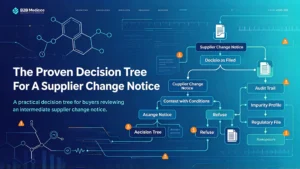
A buyer-side decision tree for handling an intermediate supplier change notice — what to accept, contest, or reject, and how to log the call.

A supplier discontinuation is a deadline, not just bad news. The questions to ask in writing, the last-time-buy calculation, and the files to collect in time.

Manufacturer and supplier of pharmaceutical APIs and intermediates. Contact us for technical support and sourcing solutions.