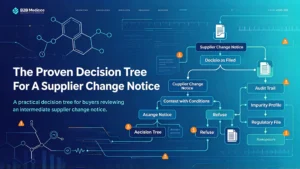
The Proven Decision Tree For A Supplier Change Notice
A buyer-side decision tree for handling an intermediate supplier change notice — what to accept, contest, or reject, and how to log the call.
Table of Contents
When the FDA signed off on resmetirom in March 2024 — Madrigal Pharmaceuticals’ Rezdiffra — it was a milestone that most of the pharmaceutical industry noticed for clinical reasons. The first approved drug for non-cirrhotic MASH (the rebranded term for what was called NASH).
But if you work in intermediate procurement, the approval probably hit you differently. It meant a new supply chain category went from near-zero to very-much-real almost overnight.
The numbers behind MASH explain why. Around 1.5 billion people carry metabolic dysfunction-associated steatotic liver disease globally. Of those, something like 6 to 8 percent progress to MASH with fibrosis. That is a staggeringly large addressable patient population.
Generic manufacturers are already jockeying for position, and intermediate demand has been climbing in ways that were predictable but still catch some buyers off guard when lead times start stretching.
This article is not a chemistry lecture. It is meant to be a practical reference for procurement people who need to understand the synthesis route, identify which intermediate makes sense for their operation, and avoid some of the quality pitfalls that have already tripped up early adopters.
Resmetirom (CAS 920509-32-6) is a selective thyroid hormone receptor-beta agonist — a THR-β agonist for short. The mechanism is straightforward in concept: activate the THR-β receptors in liver tissue, and you increase the liver’s ability to oxidize fat while simultaneously dialing down lipotoxicity and inflammation.
In practice, of course, getting a molecule to do this selectively, without triggering off-target effects through other thyroid receptors, took years of medicinal chemistry work.
The compound was first identified by Roche, then licensed to Madrigal, which ran it through the MAESTRO-NASH Phase III program. The results showed meaningful improvements in both MASH resolution and fibrosis reduction, and the FDA granted accelerated approval for patients with stage F2 to F3 fibrosis. Not a cure. But a meaningful therapeutic option where none existed before.
Why the patent timeline should be on your radar: Resmetirom’s patent landscape is still settling. Composition-of-matter patents, method-of-use claims, synthetic intermediate patents — several layers of IP protection are in play. But the direction is clear: eventually these patents will narrow or expire, and generic manufacturers will enter the market.
In our experience, intermediate demand tends to lead API demand by roughly 18 to 24 months. Procurement teams that build qualified supplier relationships now, before the rush, tend to secure better pricing and more reliable capacity allocation.
The IUPAC name for resmetirom is the kind of thing that makes powerpoint slides look terrible: 2-{3,5-dichloro-4-[(5-isopropyl-6-oxo-1,6-dihydropyridazin-3-yl)oxy]phenyl}-3,5-dioxo-2,3,4,5-tetrahydro-1,2,4-triazine-6-carbonitrile.
What matters for buyers is not memorizing that string but understanding that the molecule contains three distinct fragments — a pyridazinone moiety, a dichlorophenyl triazine core, and a carbonitrile group — each of which has to be assembled and controlled independently before converging into the final structure.
Here is how it typically comes together:
Start with a commercially available precursor that patent literature calls “Compound D.” Run a nucleophilic aromatic substitution using sodium benzene sulfinate, and you get Intermediate VII as a solid at roughly 95% yield. The phenyl sulfone group that gets bolted on here is doing double duty: it is a strong electron-withdrawing group that activates downstream chemistry, and later on, it becomes a leaving group. If someone tries to tell you the sulfone is optional or can be substituted casually, push back.
Intermediate VII carries an amine that will cause problems in later steps if left unprotected. Treat it with 3,4-dihydro-2H-pyran (DHP) to install a THP protecting group, yielding Intermediate VI.
This step is deceptively simple and frequently rushed, which is a mistake. Incomplete protection shows up as impurity peaks in downstream HPLC that are difficult to remove and easy to miss if you are not running the right method. Yields here typically hit 98% when done properly.
Here things get more interesting. Intermediate VI undergoes a Michael-type addition with 2-nitropropane, catalyzed by an organic base — DBU or potassium carbonate, depending on the manufacturer’s preference — in DMSO or DMF. The addition happens, then the nitropropane gets kicked out, and a double bond shifts position in the product.
The result is Compound V, which still carries the phenyl sulfone group. It is worth noting that the molar ratio (Compound VI to 2-nitropropane) matters more than most process documents let on; we have seen batches drift off-spec when this ratio was not tightly controlled.
Compound V meets a pyridazinone fragment. The phenyl sulfone group — installed all the way back in Step 1 — now leaves the molecule, and the pyridazinone takes its place.
The product is Compound IV, and structurally, you are now looking at the complete carbon skeleton of resmetirom. Everything after this is finishing work.
Remove the THP protecting group with hydrochloric acid, keep the temperature in the 30 to 70°C window, and you arrive at Intermediate III. Temperature discipline in this step is not a suggestion.
Go above 70°C and the triazine ring starts to degrade, producing impurities that are difficult and expensive to purge downstream. Some manufacturers under tight delivery pressure have been tempted to push this temperature to shorten reaction time. It does not end well.
Most buyers in the resmetirom space are not purchasing the finished API. They are sourcing intermediates at various stages of completion, and which stage depends on what their in-house capabilities can handle. The table below lays out the options.
Intermediate | Where it fits | Form | What to watch for |
Intermediate VII | Early-stage building block, post sulfone installation | Solid | Sulfone incorporation purity; unreacted starting material carryover |
Intermediate VI | Protected amine, ready for Michael addition | Solid | Protection completeness; leftover DHP detectable by HPLC |
Compound V | Post-addition, pre-substitution | Solid | Double bond isomer distribution; residual nitropropane |
Compound IV | Full skeleton assembled, awaiting deprotection | Solid | Phenyl sulfone removal completeness |
Intermediate III | Last stop before API conversion | Solid | Thermal degradation markers; deprotection yield |
One thing that works in buyers’ favor: All of these intermediates come out as solids in the optimized route. If you have ever dealt with oil-based intermediates — and anyone who has sourced certain peptide building blocks knows the pain — you understand why this matters.
Solids are easier to characterize, store, and verify batch-to-batch. They do not require low-temperature logistics or specialized container liners. It is a genuine practical advantage that older routes could not offer.
Two synthetic routes have been published for resmetirom intermediates, and choosing between them has real commercial consequences. This is not an academic distinction.
The earlier route, described in WO2007009913 and CN112707892, runs on silver nitrate catalysis. Some individual steps limped along at 50 to 53% yield, and certain reactions needed over 96 hours to reach completion.
Using silver also meant heavy metal waste handling, which adds cost and regulatory complexity that manufacturers inevitably pass downstream.
The newer route (CN117164568A, published 2023) took a different approach. Silver nitrate is out. Sodium benzene sulfinate and inexpensive organic bases do the heavy lifting. All intermediates come out as solids instead of oils. Reaction times drop to 1 to 5 hours per step, and yields climb to 95 to 98%.
We have seen buyers initially attracted by lower quotes from legacy-route suppliers, only to find that impurity management, batch-to-batch variation, and extended lead times ate up whatever they saved upfront.
The newer route offers four things that directly impact procurement decisions:
Ask your prospective suppliers which route they run. It is a fair question, and any credible manufacturer should be able to answer it without hesitation.
Because the resmetirom intermediate supply chain is relatively new, some of the quality issues that would be obvious for a mature compound are still catching buyers and manufacturers by surprise. Here are the ones that come up most often in our experience.
For intermediates near the end of the route — especially Intermediate III — you want to see purity at 99.0% or above. Earlier intermediates like VII and VI can tolerate 98.0%, but dropping below that starts to create a cascade of purification headaches downstream that quickly erase the cost advantage of buying intermediates instead of building everything in-house.
The triazine ring in resmetirom is not the most stable structural motif under acidic or basic conditions. Hydrolyzed triazine derivatives and over-deprotected byproducts from the final step are the two impurity families that show up most consistently.
Any supplier worth working with should be able to provide impurity profiles with defined acceptance criteria for each individual impurity, not just a single “total impurities” figure. A proper impurity control strategy is not optional here.
Compound IV and Intermediate III are both temperature-sensitive, and this sensitivity shows up during deprotection as well as during shipping and storage. We have encountered situations where freight containers sitting in summer heat caused measurable quality drift.
Verify that your supplier has stability data backing the shelf life they quote, and confirm ambient packaging is adequate for your shipping route.
Every shipment should arrive with a batch-specific CoA. If your team is not confident interpreting them, our breakdown of how to read a COA for pharmaceutical intermediates covers the critical fields. One specific thing to flag: make sure the assay method is HPLC-based. We still see suppliers using gravimetric or titration methods for resmetirom intermediates, and those techniques simply lack the specificity to distinguish between the target compound and structurally similar impurities.
This is worth emphasizing. Many manufacturers have only recently added resmetirom intermediates to their catalog. Some are very good. Others are still working through process optimization on the buyer’s dime.
A thorough supplier compliance verification — document audits, sample testing, reference checks — carries more weight here than it would for a compound like metformin or atorvastatin where the supply chain has had decades to mature.
A few converging factors are pushing resmetirom intermediate demand in one direction: up.
Post-marketing studies are already exploring resmetirom for earlier-stage MASH (F1 fibrosis) and in combination with GLP-1 drugs like semaglutide. Combination use alone could dramatically expand the patient pool and, with it, manufacturing volume.
On the regulatory front, submissions in the EU, Japan, and China are working through their respective review processes. Each approval adds another layer of demand.
The patent situation deserves attention too. Resmetirom has composition-of-matter, method-of-use, and synthetic intermediate patents layered on top of each other. As these start to narrow, generic manufacturers — especially in India and China — will need qualified intermediate suppliers lined up and ready.
And the optimized synthesis route (CN117164568A) is itself patent-protected, meaning manufacturers who control or license that intellectual property will carry a cost and quality advantage for years.
The bottom line for procurement teams: qualified supplier relationships take time to build. Sample testing, document review, negotiation — none of this happens overnight.
Starting now, while the supply chain is still forming and capacity is available, puts you in a significantly better position than trying to secure volume commitments once the generic pipeline reaches full production.
Resmetirom sits in an unusual position: a recently approved drug, a massive patient population, a supply chain that is still early in its formation, and enough manufacturing complexity that supplier selection genuinely matters.
The intermediates are well-characterized, the optimized synthesis route is efficient, and the quality expectations are specific enough that experienced buyers should have no trouble distinguishing a qualified supplier from one that is still figuring things out.
The procurement teams that will come out ahead are the ones treating this as an 18-month runway, not a transactional purchase. Understand the synthesis, nail down the quality checkpoints, qualify your suppliers properly, and lock in capacity before the market gets crowded.
In a category this new, first movers do not just save money — they define what “acceptable quality” looks like for everyone who follows.
A buyer-side decision tree for handling an intermediate supplier change notice — what to accept, contest, or reject, and how to log the call.
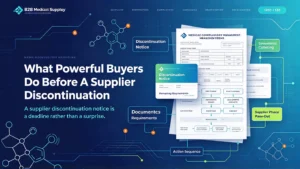
A supplier discontinuation is a deadline, not just bad news. The questions to ask in writing, the last-time-buy calculation, and the files to collect in time.
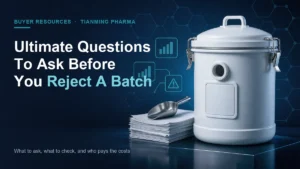
Rejected batch? What to do in the first hour, how to write the notice, who pays the costs, and the escalation path when a supplier stalls.

Manufacturer and supplier of pharmaceutical APIs and intermediates. Contact us for technical support and sourcing solutions.