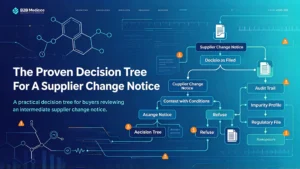
The Proven Decision Tree For A Supplier Change Notice
A buyer-side decision tree for handling an intermediate supplier change notice — what to accept, contest, or reject, and how to log the call.
If you have ever been responsible for sourcing pharmaceutical intermediates or Active Pharmaceutical Ingredients (APIs), you have undoubtedly encountered two specific acronyms: GMP and cGMP.
They are ubiquitous—appearing everywhere from supplier websites and Quality Agreements to audit reports. Most of us recognize that these terms are inextricably linked to the concept of “quality.” Today, we will provide a systematic breakdown of the differences between the two.
GMP stands for Good Manufacturing Practices. These are the basic quality regulations that pharmaceutical manufacturers follow to ensure their products are consistent, safe, and effective.
The FDA first issued its GMP regulations back in 1978, codified in 21 CFR Parts 210 and 211. GMP covers everything: your raw materials, your production facilities, how you train your staff, how you keep equipment clean, and how you document everything. The core idea behind GMP is simple: you build quality into the product from the start. You don’t just rely on testing at the end.
Here’s a practical example of how GMP shows up in everyday operations. Take a manufacturer producing an API for a cardiovascular drug. Under GMP requirements, every batch of starting material is tested for identity and purity before it ever enters the production line.
Operators follow written, validated procedures for every single step—from weighing raw materials to the final crystallization. Equipment is cleaned between batches according to a validated protocol, and those cleaning records are reviewed by the quality unit.
Every step is documented in real time, not reconstructed later from memory. If a batch deviates from specifications, a formal investigation kicks in.
So GMP is the baseline. It tells you what you need to do. But there’s a catch—and this is where cGMP comes in.
cGMP stands for Current Good Manufacturing Practices. Same acronym, one extra letter. That little “c” is actually huge.
The FDA added the “c” to emphasize that these regulations aren’t frozen in time. They evolve. Science moves forward. Technology improves. And manufacturers are expected to move with them [9†L34-L36].
Here’s how the FDA puts it: “Systems and equipment that may have been ‘top-of-the-line’ to prevent contamination, mix-ups, and errors 10 or 20 years ago may be less than adequate by today’s standards.” [9†L36-L38] That’s a pretty direct way of saying—what was acceptable in 2005 might not pass inspection in 2025.
So while GMP says “establish documented processes,” cGMP says “establish documented processes using the best current methods and technology.” It’s the difference between a static rulebook and a living, breathing system.
Let me put it in plain terms:
| GMP | cGMP |
What it means | Good Manufacturing Practices | Current Good Manufacturing Practices |
Focus | Basic quality rules and procedures | Continuous improvement using up-to-date technology |
Mindset | “Follow the rulebook” | “Use the best methods available today” |
Technology | Accepts older methods as long as they meet specs | Expects modern automation, monitoring, and control |
Documentation | Paper-based or basic electronic records | Data integrity, audit trails, real-time monitoring |
FDA expectation | Minimum standard | “Current” expectation; outdated systems risk citation |
One industry guide puts it well: “While GMP gives you the basic rules, cGMP demands that you apply them in a modern way. It’s less about a totally new rulebook and more about a new mindset.” [8†L29-L31]
So if you’re a buyer, you’re not just looking for a supplier who “follows GMP.” You want one who follows current GMP. Because if they’re still using equipment or methods from ten years ago and haven’t updated, the FDA may consider their practices outdated—even if they were perfectly fine when they were first implemented.
Is cGMP stricter than GMP?
Yes, but not in the way you might think. cGMP isn’t a completely separate set of rules. It’s the same GMP framework, but with an expectation of ongoing modernization and continuous improvement. It’s stricter because it demands that manufacturers keep pace with advances in science and technology [11†L4-L5].
Does cGMP apply to intermediates, or just finished drugs?
It applies broadly. While the FDA’s CGMP regulations for finished pharmaceuticals (21 CFR Part 211) apply directly to drug products, the same principles flow upstream.
The FDA enforces cGMP requirements on API manufacturers and, by extension, on intermediate suppliers whose activities fall under the agency’s oversight [4†L16-L18]. ICH Q7, the international guideline for API manufacturing, also aligns with cGMP principles. So when you’re sourcing intermediates for regulated markets, your supplier should be operating under current standards.
Can a supplier be GMP-certified but not cGMP-compliant?
Here’s the nuance. “GMP-certified” is often used loosely. The real question is: which standard are they certified against? Many suppliers claim GMP compliance, but true adherence requires verifiable systems aligned with international frameworks such as ICH Q7 and WHO GMP guidelines [5†L32-L34].
If a supplier is relying on an audit from five years ago and hasn’t upgraded their processes, they may be “GMP” but not truly “cGMP.”
How does cGMP affect supplier audits?
This is probably the most practical difference for you as a buyer. When you audit a supplier, you should be looking not just at their procedures, but at when those procedures were last updated.
Are they using manual logbooks, or electronic systems with audit trails? Do they have process analytical technology (PAT) for real time monitoring, or are they still pulling samples manually?
Have they kept up with evolving regulatory expectations? A thorough audit should verify whether the supplier has a robust quality management system (QMS) that actively incorporates current best practices [8†L48-L50].
Why does cGMP keep changing?
Because science and technology don’t stand still. New analytical methods allow us to detect impurities that we couldn’t see before.
New manufacturing technologies—like continuous flow processing—offer better control than batch processing.
The FDA wants manufacturers to adopt these advances when they improve quality, not to stick with outdated methods just because they’re “good enough.”
So you’re evaluating a potential supplier. What should you actually ask for?
Here’s a simple checklist:
Valid cGMP certificates: Look for certifications from recognized bodies (NMPA, FDA, WHO). Don’t just accept marketing claims—ask for evidence. Also request evidence of other certifications like ISO 9001, and verify DMF submissions if you’re targeting regulated markets like the U.S. or EU [13†L23-L29].
Third-party audit reports: If available, review reports from audits conducted by the FDA, EMA, or other regulatory authorities. These give you a much clearer picture than a supplier’s self assessment. Many top tier API suppliers are recognized as high quality due to their adherence to cGMP and strong regulatory records [14†L3-L9].
Batch-specific COAs (Certificates of Analysis): These should include purity, impurity profiles, residual solvents, and microbial limits. They should be signed off by the quality unit.
Change control and deviation records: Ask how they handle changes to their process and how they investigate quality deviations. A robust cGMP system has a formal, documented process for both.
Export experience to regulated markets: Has the supplier exported to the US, EU, or Japan before? If yes, they’ve likely navigated the full scope of cGMP expectations [15†L24-L26].
Data integrity practices: Are they using electronic systems with audit trails? Or still relying on paper logs that can be easily backdated? The FDA has been heavily focused on data integrity for years, and a lack of controls here is a major red flag.
Let’s be real. Choosing a supplier that only meets basic GMP—without the “current” part—can lead to real problems down the line:
Regulatory delays or rejections if the FDA finds their systems outdated
Contamination or quality failures from equipment that should have been upgraded
Audit findings that force you to requalify suppliers mid-project
Inability to enter regulated markets like the US or EU
On the flip side, partnering with a truly cGMP-compliant supplier gives you:
Confidence that your regulatory filings will hold up
A partner who’s already thinking about continuous improvement, not just today’s batch
Lower long-term risk of supply disruption or quality incidents
Contact our team for technical specifications, audit documentation, or to discuss your specific project requirements. sunqian0123@gmail.com
A buyer-side decision tree for handling an intermediate supplier change notice — what to accept, contest, or reject, and how to log the call.
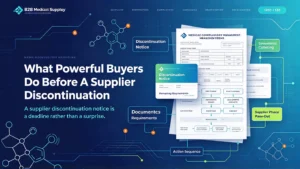
A supplier discontinuation is a deadline, not just bad news. The questions to ask in writing, the last-time-buy calculation, and the files to collect in time.
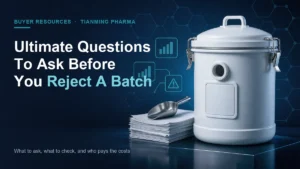
Rejected batch? What to do in the first hour, how to write the notice, who pays the costs, and the escalation path when a supplier stalls.

Manufacturer and supplier of pharmaceutical APIs and intermediates. Contact us for technical support and sourcing solutions.