Proven Checks Buyers Miss In A Batch Manufacturing Record
The first commercial batch from a new intermediate supplier is not a formality. Here is the checklist, the five approval outcomes, and how to log the call.
On April 1, 2026, the FDA approved Orforglipron (brand name Foundayo™) — the first once-daily oral small-molecule GLP-1 receptor agonist ever to reach the market.
It is a conventional synthetic small molecule, manufactured through traditional chemical synthesis rather than solid-phase peptide synthesis (SPPS).
That distinction matters enormously for the supply chain — and for the companies now racing to secure intermediates.
The numbers that drove the approval are worth a close look. In the ATTAIN-1 trial — a 72-week, double-blind, placebo-controlled study enrolling 3,127 adults with obesity — Orforglipron 36 mg delivered a mean weight loss of 12.4% (27.3 lbs) versus 0.9% with placebo [1].
Among the subset with prediabetes at baseline, 91% of Orforglipron-treated participants returned to near-normal glycemia, compared to just 42% in the placebo arm [1].
In ACHIEVE-3, the head-to-head trial against oral semaglutide (Rybelsus) in 1,698 adults with type 2 diabetes, Orforglipron 36 mg reduced HbA1c by 2.2 percentage points — a 57% greater reduction than semaglutide 14 mg — and delivered 73.6% more weight loss (9.2% vs 5.3%) [2]. These are not incremental improvements. They signal a structural shift in the oral GLP-1 category.
Morgan Stanley projects peak annual sales of 25to25to40 billion for Orforglipron. For context, that would place it among the top three pharmaceutical products of all time.
Every kilogram of that drug starts with intermediates. And the window to establish supply relationships is open right now.
Most of the GLP-1 supply chain conversation has centered on peptides — semaglutide, tirzepatide, liraglutide. Those molecules are built through SPPS, a stepwise assembly of amino acid building blocks that, while demanding, follows a well-understood logic.
Orforglipron breaks from that entirely.
As a fully synthetic small molecule (C₄₈H₄₈F₂N₁₀O₅, MW 883.0), its synthesis involves traditional multi-step organic chemistry: heterocycle construction, regioselective functionalization, chiral center installation, and cross-coupling reactions [3].
It contains three chiral centers and an elaborate architecture built around an indazole ring, a pyrazolo[4,3-c]pyridine core, and a substituted indole-carboxylic acid moiety. Each fragment is a synthetic challenge in its own right. Stringing them together into the full API — with the required stereochemical fidelity and impurity profile — demands capabilities that go well beyond what a typical generic API facility maintains.
This is not a molecule where you can buy three key starting materials off the shelf and do a one-step coupling. The supply chain is deeper, more fragmented, and currently very thin.
Three intermediates sit at the heart of this synthesis:
This is the most structurally complex of the Orforglipron intermediates. Chemical name: (S)-1-(4-fluoro-2-methyl-2H-indazol-5-yl)-3-(2-(4-fluoro-3,5-dimethylphenyl)-4-methyl-4,5,6,7-tetrahydro-2H-pyrazolo[4,3-c]pyridin-3-yl)-1H-imidazol-2(3H)-one. Molecular formula C₂₆H₂₅F₂N₇O, MW 489.53.
The molecule brings together an indazole, a tetrahydropyrazolopyridine, and an imidazolone — three heterocyclic systems — into a single framework with defined stereochemistry at the pyrazolopyridine 4-position.
The synthesis of this intermediate alone can involve 8 to 12 synthetic steps, depending on the route, with multiple column purifications and chiral resolution stages [4].
For a buyer, the critical quality parameters here are:
Chemical name: 5-[(S)-2,2-Dimethyltetrahydro-2H-pyran-4-yl]-1-[(1S,2S)-2-methyl-1-(5-oxo-4,5-dihydro-1,2,4-oxadiazol-3-yl)cyclopropyl]-1H-indole-2-carboxylic acid.
This fragment carries two of the molecule’s three chiral centers — the cyclopropyl-oxadiazolone and the tetrahydropyran substituent.
The oxadiazolone ring is particularly sensitive to hydrolytic conditions, which means the synthetic route must avoid aqueous acidic or basic workups at late stages. Suppliers with experience in moisture-sensitive heterocycle chemistry have a measurable advantage here.
The final API is formed by coupling intermediates 1 and 2, typically through an amide bond formation between the indole-carboxylic acid and a deprotected amine on the pyrazolopyridine scaffold.
The coupling itself may appear straightforward — but the purification of the final API to ICH-compliant purity (> 99.5% by HPLC, individual impurities ≤ 0.10%) is where many suppliers stumble.
The molecular weight (883) and the number of fluorine atoms (2) make the impurity profile unusually complex, with structurally similar byproducts that co-elute on standard reverse-phase columns.
Orforglipron’s composition-of-matter patent (WO2018056453, filed by Chugai Pharmaceutical and licensed to Eli Lilly in 2018) is expected to provide exclusivity into the mid-to-late 2030s in major markets [5]. That sounds like a distant horizon, but it is not.
Generic drug development for a molecule of this complexity takes 5 to 8 years from first intermediate sourcing to ANDA submission — and that clock starts ticking the moment a company commits to a development program.
The companies that will file the first ANDAs for Orforglipron generics are already assembling their intermediate supply chains today. They are not waiting for the patent to expire. They are qualifying suppliers, locking in DMF support, and running stability studies on development batches.
What does this mean for intermediate buyers?
First, the suppliers who can deliver development-scale quantities (100 g to 5 kg) with full analytical data packages right now are the ones who will own the commercial-scale business when volumes ramp to hundreds of kilograms. The relationship window begins in the development phase, not the commercial phase.
Second, the number of suppliers who genuinely can synthesize these intermediates — not just claim to — is small. The indazole-pyrazolopyridine core requires a skill set (heterocyclic synthesis, chiral resolution, palladium catalysis) that is not evenly distributed across the global CRO and API manufacturing base. Buyers should expect to evaluate no more than 5 to 8 credible suppliers globally for CAS 2212022-56-3 at the current stage of market development.
Third, early qualification has a compounding advantage. A supplier who begins working with a buyer at the 100-gram scale, iterates on impurity control, and builds the analytical methods alongside the development program will have an insurmountable lead over a supplier who enters at the commercial scale with no prior relationship. The regulatory file at ANDA submission will reference that early work. Switching suppliers post-filing is expensive, slow, and risky.
This is not a general supplier evaluation checklist. Those exist elsewhere. The following points are specific to Orforglipron intermediates and the regulatory scrutiny they will face:
A certificate of analysis showing > 99% ee is table stakes. What matters is whether the supplier can explain how that chiral purity is achieved — whether through asymmetric synthesis (a chiral catalyst or auxiliary controlling the stereochemical outcome at the bond-forming step) or through post-synthetic resolution (chiral HPLC or diastereomeric salt formation).
The former is preferable for scale-up economics; the latter is acceptable but introduces a yield penalty that will matter at commercial volumes.
Ask for the chiral HPLC chromatograms, not just the COA. Ask what happens to the enantiomeric excess when the reaction is run at 10x scale. If the supplier cannot answer that second question with batch data, they have not run it at 10x scale.
All credible synthetic routes to the indazole-pyrazolopyridine intermediate involve at least one — and often two — palladium-catalyzed cross-coupling steps (Suzuki, Buchwald-Hartwig, or both). Residual palladium is a Class 1 elemental impurity under ICH Q3D, with a permitted daily exposure of 100 μg/day for oral administration [6].
A supplier who simply runs the crude product through a silica plug and reports “Pd < 10 ppm by ICP-MS” on the COA is not doing enough. The buyer needs to see:
The FDA’s 2020 guidance on nitrosamine impurities applies to all chemically synthesized APIs, and Orforglipron is squarely in scope. The indazole and imidazolone fragments contain secondary and tertiary amines — both potential nitrosation sites if nitrite sources are present anywhere in the synthesis (sodium nitrite quenches, nitrite-contaminated solvents, certain reducing agents).
A serious supplier will have already conducted a nitrosamine risk assessment for their synthetic route and will share the methodology — not just the conclusion. If the conversation starts with “we’ll do the nitrosamine testing when regulatory asks for it,” the supplier is not ready for a development partnership.
Writing a Type II DMF for an intermediate with 8+ synthetic steps, multiple chiral centers, and a complex impurity profile is a significant regulatory writing exercise. It requires a team that understands:
A supplier who says “we can provide a DMF” without showing a redacted example of a previous DMF they have written for a similar-complexity intermediate is making a promise they may not be able to keep. Ask for the redacted example. Look for whether the impurity discussion section references actual batch data or reads like a template.
Orforglipron is the most significant new oral GLP-1 molecule to enter the pharmaceutical market in years — not because it is another peptide analog, but because it is not a peptide at all.
Its small-molecule nature makes it cheaper to manufacture at scale, easier to distribute (no cold chain), and simpler for patients to take (no injection, no fasting window). Those advantages will drive volume, and volume will drive intermediate demand.
The three key intermediates — the indazole-pyrazolopyridine core (CAS 2212022-56-3), the indole-carboxylic acid fragment (CAS 2212021-83-3), and the final API (CAS 2212020-52-3) — each present distinct synthetic challenges that limit the number of qualified global suppliers.
Early engagement with suppliers who can demonstrate chiral control, palladium removal, nitrosamine awareness, and process documentation capability is the single most consequential supply chain decision an ANDA filer will make in this program.
Tianming Pharmaceutical supplies all three Orforglipron intermediates and the final API, with development-scale quantities (grams to kilograms) available for immediate evaluation. Full analytical data packages, HPLC chromatograms, and impurity profiles are provided with every shipment.
For inquiries: sunqian0123@gmail.com | WhatsApp: +86 176 6371 3557
[1] ATTAIN-1 Phase 3 Results. New England Journal of Medicine. September 2025. Orforglipron 36 mg: −12.4% body weight vs −0.9% placebo (efficacy estimand); prediabetes subgroup: 91% vs 42% normoglycemia.
[2] ACHIEVE-3 Phase 3 Head-to-Head Results. Eli Lilly Investor Press Release. September 17, 2025. Orforglipron 36 mg vs oral semaglutide 14 mg: A1C −2.2% vs −1.4%; weight −9.2% vs −5.3%.
[3] Orforglipron (LY-3502970) — Molecular and Pharmacological Profile. New Drug Approvals. July 2025. Molecular formula C₄₈H₄₈F₂N₁₀O₅, MW 883.0, oral small-molecule non-peptide GLP-1 receptor agonist.
[4] Chugai Pharmaceutical / Eli Lilly. Patent WO2018056453 — GLP-1 receptor agonist compounds including Orforglipron and synthetic intermediates.
[5] Medicines Patent Pool. Orforglipron Patent Landscape. April 2025. Compound patents granted in 32 LMICs, pending in 18; composition-of-matter exclusivity through mid-to-late 2030s.
[6] ICH Q3D(R2) Guideline for Elemental Impurities. Palladium: Class 1, PDE 100 μg/day (oral). Effective 2022.
The first commercial batch from a new intermediate supplier is not a formality. Here is the checklist, the five approval outcomes, and how to log the call.
The first commercial batch from a new intermediate supplier is not a formality. Here is the checklist, the five approval outcomes, and how to log the call.
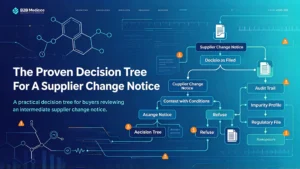
A buyer-side decision tree for handling an intermediate supplier change notice — what to accept, contest, or reject, and how to log the call.

Manufacturer and supplier of pharmaceutical APIs and intermediates. Contact us for technical support and sourcing solutions.