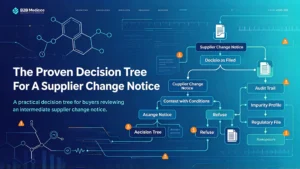
The Proven Decision Tree For A Supplier Change Notice
A buyer-side decision tree for handling an intermediate supplier change notice — what to accept, contest, or reject, and how to log the call.
Table of Contents
If you have been tracking the obesity drug pipeline over the past year, two names from Eli Lilly have probably popped up on your radar: orforglipron and retatrutide. Both are considered next-generation therapies that could reshape the metabolic disease market. But they take very different approaches.
Orforglipron is the world’s second oral GLP-1 pill for weight management, approved by the FDA in April 2026. Retatrutide, by contrast, is still investigational—a once-weekly injection that activates not just GLP-1, but two additional metabolic hormones. So how do they compare, and what should you know if you are developing or sourcing intermediates for either compound?
Orforglipron is a small-molecule, non-peptide GLP-1 receptor agonist. Unlike injectable GLP-1 drugs such as semaglutide, orforglipron is taken as a daily pill without food or water restrictions. Because it is a small molecule and not a peptide, orforglipron has more straightforward manufacturing processes and does not require cold-chain logistics.
Retatrutide (LY3437943) is a much more complex molecule—a peptide that functions as a triple hormone receptor agonist. It simultaneously activates the GLP-1 receptor, the GIP receptor and the glucagon receptor.
While GLP-1 suppresses appetite and slows gastric emptying, GIP enhances insulin secretion and possibly changes how the body uses fat, and glucagon increases energy expenditure and promotes fat breakdown.
Orforglipron — FDA approved based on the Phase 3 ATTAIN-1 trial, which enrolled 3,127 adults with obesity. After 72 weeks, patients on the highest dose (36 mg) achieved an average weight reduction of 12.4% (about 27 lbs) compared to 0.9% on placebo.
Among those in the 36 mg group, 59.6% lost at least 10% of their body weight, and 39.6% lost at least 15%. Cardiovascular risk markers also improved, including reductions in non-HDL cholesterol, triglycerides and systolic blood pressure.
Retatrutide — Latest Phase 3 data (the TRIUMPH-4 trial in adults with obesity and knee osteoarthritis) showed even more dramatic numbers. At 68 weeks, patients on retatrutide 12 mg lost an average of 28.7% of their body weight—equivalent to 71.2 lbs (32.3 kg) from a baseline weight of around 248 lbs. Nearly 40% of participants on 12 mg lost 30% or more of their body weight, and nearly 24% lost 35% or more.
A network meta-analysis published in Circulation compared 11 agents for weight loss. At 1 to 1.5 years, retatrutide was ranked highest (SUCRA 0.99) and outperformed all currently marketed agents, achieving 3.2% greater weight loss than tirzepatide. Orforglipron ranked third at 6 months (MD: −10.6%, SUCRA 0.75).
This is where the two drugs differ most obviously.
Orforglipron: Once-daily pill, taken any time of day without food or water restrictions. Patients do not need to plan their day around a weekly injection or worry about cold storage.
Retatrutide: Once-weekly subcutaneous injection, still administered by the patient at home. It uses a peptide synthesis process that is more complicated and capital-intensive at the manufacturing level.
Orforglipron may therefore be better suited for patients who prefer oral administration and want to avoid regular injections. It may also be a more practical choice for long-term maintenance therapy.
No direct Phase 3 head-to-head trial between orforglipron and retatrutide has been completed. However, the ATTAIN-MAINTAIN trial gave some indirect clues about orforglipron’s role in chronic management.
Patients who switched from tirzepatide to orforglipron maintained their previously achieved weight loss with an average difference of only 5.0 kg at 52 weeks. For patients switching from semaglutide, the difference was just 0.9 kg. This suggests orforglipron could serve as an effective weight maintenance therapy after initial intensive weight loss.
Both drugs follow the typical GLP-1 adverse event pattern—mostly gastrointestinal.
For orforglipron, the most common adverse events in ATTAIN-1 were nausea (up to 35.9%), constipation (up to 29.8%) and vomiting (up to 24.0%). Approximately 10% of patients on the 36 mg dose discontinued due to side effects, compared to 2.6% on placebo. No hepatic safety signal was observed.
For retatrutide, specific GI frequency data from TRIUMPH-4 are not yet fully published, but the profile is expected to be similar to other GLP-1 agents.
One notable behavioral reaction: a small number of participants were reportedly reluctant to continue the study because the weight loss felt “too extreme,” though such reports are anecdotal and not a formal safety signal.
Orforglipron (Foundayo): FDA approved on April 1, 2026, for chronic weight management in adults with obesity or overweight with at least one weight-related condition. Approval was issued 50 days after filing, marking the fastest new molecular entity approval since 2002.
Retatrutide: Still investigational; Eli Lilly expects to submit regulatory filings following ongoing Phase 3 trials. The asset is not expected to launch before 2028.
For pharmaceutical developers and API suppliers, the difference between these two molecules is profound.
Orforglipron is a small molecule. Its synthesis uses standard chemical manufacturing processes, which are well understood, scalable and relatively economical. This low manufacturing complexity means reliable supply can be built without highly specialized peptide infrastructure.
Retatrutide is a 39-amino-acid peptide. Its production requires solid-phase peptide synthesis (SPPS), which is expensive, slower to scale and more sensitive to impurity generation. Cold-chain logistics and careful stability management are also required.
If you are developing an oral, small-molecule GLP-1 pipeline, orforglipron-class intermediates present a more accessible manufacturing challenge. If you are developing peptide-based therapies, retatrutide represents a higher technical barrier but also the potential for best-in-class efficacy.
That question probably misses the point. Eli Lilly is developing these two drugs for different parts of the obesity treatment journey.
Orforglipron is positioned as a convenient, scalable oral option—ideal for early intervention, long-term adherence and maintenance. Retatrutide is aimed at patients who need maximum weight reduction, including those with severe obesity or obesity-related complications such as osteoarthritis.
As a Clarivate report put it, these drugs “exemplify the next generation of metabolic therapies: oral formulations that promise improved adherence, triple-hormone mechanisms that deliver superior weight loss”. Both may find a place in the clinic, and both may be used sequentially in the same patient.
At Tianming Pharmaceutical, we manufacture high-purity intermediates and APIs for next-generation metabolic therapies. We have active development programs for both small-molecule oral GLP-1 assets (such as orforglipron) and peptide-based candidates (including retatrutide).
Our cGMP facilities are equipped for both traditional chemical synthesis and advanced peptide manufacturing. If you are developing GLP-1 or triple-agonist therapies and need a partner with both technical depth and scalable capacity, we would welcome the opportunity to discuss your program.
At Tianming Pharmaceutical, we supply high-purity orforglipron intermediates and other GLP-1 class APIs. Our cGMP facilities support both small-molecule and peptide-based metabolic programs. For technical specifications, including impurity profiles, stability data and regulatory support options, contact our team. sunqian0123@gamil.com
A buyer-side decision tree for handling an intermediate supplier change notice — what to accept, contest, or reject, and how to log the call.
A supplier discontinuation is a deadline, not just bad news. The questions to ask in writing, the last-time-buy calculation, and the files to collect in time.
Rejected batch? What to do in the first hour, how to write the notice, who pays the costs, and the escalation path when a supplier stalls.

Manufacturer and supplier of pharmaceutical APIs and intermediates. Contact us for technical support and sourcing solutions.