
Proven Checks Buyers Miss In A Batch Manufacturing Record
The first commercial batch from a new intermediate supplier is not a formality. Here is the checklist, the five approval outcomes, and how to log the call.
Table of Contents

Ensuring consistent quality in pharmaceutical intermediates is not only a regulatory requirement — it is the foundation of reliable API production, process efficiency, and patient safety. As a manufacturer, we see first-hand that buyers with strong technical backgrounds will always ask two questions before anything else: How do you control your intermediate quality? and What standards do you comply with?
This article provides a clear, factual, and experience-based overview of the pharmaceutical intermediate quality standards required today. The content is aligned with widely recognized frameworks such as ICH guidelines, WHO standards, GMP principles, and regional regulatory expectations. Based on our personal experience, no assumptions — only what can be verified.
Pharmaceutical intermediates sit between raw materials and APIs. Their quality determines:
According to ICH Q11, intermediates directly influence critical quality attributes (CQAs) of the final API, which is why regulatory agencies increasingly expect manufacturers to implement documented and auditable control strategies.
Below are the non-negotiable, globally recognized quality standards followed by the industry:
Although ICH Q7 applies directly to APIs, Sections 2 and 3 clearly specify that intermediate manufacturing steps must follow GMP principles once they reach the “defined intermediate” stage.
Key expectations include:
ICH Q7 is recognized by the FDA, EMA, PMDA, NMPA, and other major regulators.
ICH Q11 goes deeper into process development and impurity control, making it essential for intermediate manufacturers.
It emphasizes:
For intermediates used in patented or high-value APIs, sponsors typically require full ICH Q11 documentation support.
Intermediates must comply with impurity control frameworks that ultimately support API safety.
Compliance is not optional. Many procurement audits specifically review whether the intermediate manufacturer tests:
This ensures downstream synthesis does not accumulate impurities beyond acceptable thresholds.
Most reputable intermediate manufacturers follow:
While some countries do not legally require full GMP for intermediates, global buyers almost always expect GMP-aligned systems, especially for:
Based on audits, supplier qualification feedback, and regulatory standards, the following QC elements are universally required:
Specifications typically include:
These parameters must match internal quality standards and customer-agreed specifications.
Regulators expect validated methods under:
Validation must cover accuracy, precision, specificity, and linearity.
Every batch must:
Change control includes:
For international clients, change control transparency is a major indicator of supplier reliability.
Intermediates typically require:
For export intermediates, clients often request full stability documentation.
Based on global procurement standards, a reliable supplier should provide:
These criteria help buyers avoid supply chain risks, especially when preparing for ANDA/NDA submissions.
Pharmaceutical intermediate quality standards are grounded in global ICH guidelines, GMP frameworks, impurity control protocols, and analytical science principles. Manufacturers who meet these standards not only ensure the reliability of their products but also support the success of downstream API synthesis and regulatory compliance.
As a producer serving global pharmaceutical partners, we follow these standards rigorously and provide complete documentation support to help clients maintain quality, efficiency, and regulatory confidence.
If you need high-quality intermediates supported by GMP-aligned manufacturing and full QA documentation—we are ready to collaborate.
Email: sunqian0123@gmail.com
WhatsApp: +8617663713557
The first commercial batch from a new intermediate supplier is not a formality. Here is the checklist, the five approval outcomes, and how to log the call.
The first commercial batch from a new intermediate supplier is not a formality. Here is the checklist, the five approval outcomes, and how to log the call.
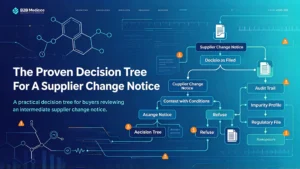
A buyer-side decision tree for handling an intermediate supplier change notice — what to accept, contest, or reject, and how to log the call.

Manufacturer and supplier of pharmaceutical APIs and intermediates. Contact us for technical support and sourcing solutions.