
Proven Checks Buyers Miss In A Batch Manufacturing Record
The first commercial batch from a new intermediate supplier is not a formality. Here is the checklist, the five approval outcomes, and how to log the call.
Table of Contents
Abstract: Selecting a pharmaceutical intermediates supplier goes beyond comparing prices. This five-step evaluation framework covers quality systems, documentation review, on-site audits, and technical alignment to help procurement teams make informed, risk-aware decisions.
In pharmaceutical procurement, the intermediates you source directly shape the quality of your final product. A supplier who looks competitive on paper can still introduce variability, delays, or compliance gaps that surface only after production begins.
This guide breaks the evaluation process into five practical steps — written for procurement professionals and sourcing teams who need a structured way to compare suppliers, not just on price, but on the fundamentals that determine long-term reliability.
Before screening suppliers, align internally on what “qualified” means for your specific project.
A qualified supplier is one whose quality management system, production capability, and documentation practices meet recognized pharmaceutical industry standards. This is broader than any single certificate — it covers personnel training, equipment maintenance, raw material control, process consistency, and record-keeping.
The key distinction: a supplier may produce intermediates that meet your specifications without necessarily holding every regulatory certification in your industry. What matters is whether their quality system can consistently deliver to your required standard — and whether they can prove it with documentation.
Start by requesting core documentation:
Red flag: Suppliers who are vague about their quality system, unwilling to share COA samples, or whose documentation does not match their listed product range.
Having documentation is a starting point. The real question is whether the system functions in practice. Through questionnaires or preliminary technical discussions, assess:
For strategic or long-term partnerships, an on-site audit is irreplaceable. No document substitutes for firsthand observation.
Audit Area | What to Check | Why It Matters |
Facility layout | Logical flow, contamination control zones | Prevents cross-contamination |
Equipment condition | Maintenance logs, calibration records | Reflects process reliability |
Batch records | Accurate, timely, complete entries | Proves traceability |
Personnel | Talk to production and QA managers directly | Depth of knowledge > certificates |
Cleanliness | General organization and housekeeping | Mirrors company culture and discipline |
Even a strong supplier must align with your specific needs:
Evaluating a pharmaceutical intermediates supplier is a systematic process. It moves from checking documents to assessing systems, from reading words to observing operations, and from reviewing files to walking the production floor.
A structured five-step evaluation — qualification review, quality system assessment, on-site audit, technical fit, and partnership potential — helps procurement teams move beyond price comparison and build a supplier base that holds up under real production conditions.
The goal is not to find a supplier who checks every box on a list. It is to find one whose quality system, technical capability, and operational discipline are strong enough to trust with your supply chain.
About Tianming Pharm
Tianming Pharm manufactures pharmaceutical intermediates for clients across multiple markets. We focus on process consistency, analytical control, and transparent documentation. If you are evaluating suppliers for an upcoming project, contact us to discuss your requirements.
The first commercial batch from a new intermediate supplier is not a formality. Here is the checklist, the five approval outcomes, and how to log the call.
The first commercial batch from a new intermediate supplier is not a formality. Here is the checklist, the five approval outcomes, and how to log the call.
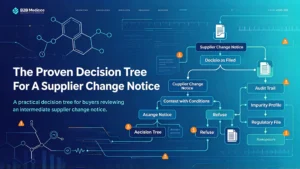
A buyer-side decision tree for handling an intermediate supplier change notice — what to accept, contest, or reject, and how to log the call.

Manufacturer and supplier of pharmaceutical APIs and intermediates. Contact us for technical support and sourcing solutions.