Proven Checks Buyers Miss In A Batch Manufacturing Record
The first commercial batch from a new intermediate supplier is not a formality. Here is the checklist, the five approval outcomes, and how to log the call.
Table of Contents
If you’ve been following weight loss news over the past few years, you’ve probably heard about GLP-1 drugs like semaglutide (Wegovy, Ozempic) and tirzepatide (Zepbound, Mounjaro). They’ve been called game-changers, and for good reason—they’re the first class of medications that consistently help people lose 15% to 20% of their body weight.
But how exactly do they work? What does the latest research say? And what should you know if you’re considering them?
I’m a pharmaceutical chemist who’s spent years working on the synthesis of GLP-1 intermediates—the chemical building blocks that go into these drugs. I’ve watched this field evolve from a niche area into one of the most significant therapeutic breakthroughs in modern medicine. Let me walk you through what the science actually says.
GLP-1 stands for glucagon-like peptide-1, a natural hormone your gut produces when you eat. Under normal circumstances, GLP-1 does a few important things:
The problem? Natural GLP-1 breaks down within minutes. GLP-1 receptor agonists (GLP-1 RAs) are synthetic versions designed to last much longer—anywhere from 12 hours to a full week, depending on the drug.
Here’s what’s happening inside your body when you take one of these medications:
The result is consistent, predictable weight loss—but only as long as you keep taking the medication. Stop it, and the appetite suppression stops too.
Let’s look at what actual clinical trials have found. I’ve pulled data from recent phase 3 trials and systematic reviews published in peer-reviewed journals.
Drug | Type | Dosing | Average Weight Loss (without diabetes) | Key Trial |
Liraglutide (Saxenda) | GLP-1 agonist | Daily injection | ~3.4 kg more than placebo (about 5-8% total) | SCALE trial |
Semaglutide (Wegovy) | GLP-1 agonist | Weekly injection | 14.9% at 68 weeks | STEP trials |
Tirzepatide (Zepbound) | GIP/GLP-1 dual agonist | Weekly injection | 20.9% at 72 weeks | SURMOUNT trials |
Oral semaglutide (Wegovy pill) | GLP-1 agonist | Daily oral | 16.6% at 64 weeks | OASIS 4 trial |
A few things worth noting from the data:
Tirzepatide is currently the most effective. A systematic review of 22 randomized controlled trials published in 2025 found that tirzepatide 15 mg produced the largest weight loss—20.9% of body weight at 72 weeks—in people without diabetes . That’s about 50 pounds for someone starting at 240 lbs.
The oral version of semaglutide works almost as well as the injection. In the OASIS 4 trial, once-daily oral semaglutide 25 mg produced a mean weight loss of 16.6%—very similar to the 14.9% seen with the weekly injection . The FDA approved this oral formulation for weight management in December 2025 .
Higher doses are coming. The FDA recently approved a higher-dose version of Wegovy (7.2 mg injection) called Wegovy HD, based on data showing additional weight reduction compared to lower doses .
You might have heard about orforglipron—a non-peptide, small-molecule GLP-1 agonist that’s taken as a daily pill. Unlike semaglutide (which is a peptide, like a small protein), orforglipron is a true small molecule.
The phase 3 ATTAIN-1 trial, published in the New England Journal of Medicine in 2025, looked at orforglipron in 3,127 adults with obesity but without diabetes. Results at 72 weeks:
Notably, among participants on the highest dose, 55% lost at least 10% of their body weight, 36% lost at least 15%, and 18% lost at least 20% .
Why does this matter? Oral small molecules like orforglipron may be easier to manufacture and distribute than peptide-based drugs, which require cold chain logistics. For patients, the convenience of a simple daily pill—no injection, no refrigeration—could make treatment more accessible .
Clinical trials show what’s possible under ideal conditions. Real-world data shows what actually happens when real people take these medications.
A 2025 review in Diabetes, Obesity and Metabolism looked at real-world evidence for GLP-1 weight-loss drugs and found some important differences :
Weight loss is often lower in real life. The observed weight reduction in clinical practice tends to be lower than in randomized controlled trials—but outcomes approach trial results when you look at patients who are highly adherent to their medication .
Discontinuation rates are high. Between 20% and 50% of patients stop taking GLP-1 drugs within the first year. The main reasons: side effects (especially nausea) and cost .
Many patients use lower doses than studied. Real-world data shows many patients never titrate up to the doses that produced the best results in trials—which likely contributes to lower-than-expected weight loss .
The takeaway? These drugs work extremely well when taken consistently at therapeutic doses. But adherence is a real-world challenge.
The most common side effects are gastrointestinal—nausea, vomiting, diarrhea, constipation, abdominal pain. These occur in 14-28% of users (depending on the drug) and are typically mild to moderate .
Thyroid tumors. All GLP-1 drugs carry a boxed warning about a potential risk of thyroid C-cell tumors, based on rodent studies. They should not be used in people with a personal or family history of medullary thyroid carcinoma or MEN2 .
Suicidal thoughts. The FDA conducted a detailed evaluation of reports of suicidal thoughts in people taking GLP-1 drugs. Their conclusion (January 2024): “FDA’s preliminary evaluation has not found evidence that use of these medicines causes suicidal thoughts or actions” .
Pancreatitis. Systematic reviews have found that the risk of pancreatitis is not significantly higher than placebo .
Severe events. Real-world studies haven’t found clear increases in risks of severe events like pancreatitis, pancreatic cancer, or depression . However, the FDA notes that because the number of events is small, a small risk can’t be definitively ruled out .
Clinical guidelines generally recommend GLP-1 drugs for:
The Asia-Pacific guidelines (which account for population-specific risk profiles) recommend considering pharmacotherapy at BMI ≥ 25 .
Important: These drugs are intended to be used alongside diet and physical activity, not as a replacement for lifestyle changes.
From a manufacturing perspective, the GLP-1 boom has created unprecedented demand for high-purity intermediates. Peptide synthesis—used for injectable semaglutide and liraglutide—requires highly controlled processes to maintain purity and consistency. The newer oral small-molecule drugs like orforglipron represent a different manufacturing paradigm, but still demand rigorous quality control.
As someone who works in this space, I can tell you that the complexity of scaling up these molecules—maintaining enantiomeric purity, controlling impurity profiles, ensuring batch-to-batch consistency—is substantial. But that complexity is what makes these drugs work as intended.
GLP-1 drugs represent a genuine therapeutic advance. The latest generation—especially tirzepatide and high-dose semaglutide—can produce weight loss in the 15-20% range, which is far beyond what was possible with previous medications.
The field is evolving quickly. Oral formulations are now available. Higher doses are being approved. New small-molecule drugs are in late-stage trials. And real-world evidence is helping us understand how to use these medications more effectively—including the critical role of adherence.
If you’re considering these medications, talk to your healthcare provider about which option might be right for you based on your specific health status, preferences (injection vs. oral), and what your insurance covers. These drugs work best when used consistently and paired with lifestyle changes.
At Tianming Pharmaceutical, we specialize in the development and manufacturing of high-purity pharmaceutical intermediates, including those used in GLP-1 therapies. Our focus is on the complex chemistry behind these breakthrough drugs—ensuring that the building blocks that go into them meet the strictest quality standards.
If you’re working on GLP-1 intermediate development or looking for reliable partners in this space, we’d welcome the conversation.
Get in touch: sunqian0123@gmail.com
WhatsApp: +86 17663713557
The first commercial batch from a new intermediate supplier is not a formality. Here is the checklist, the five approval outcomes, and how to log the call.
The first commercial batch from a new intermediate supplier is not a formality. Here is the checklist, the five approval outcomes, and how to log the call.
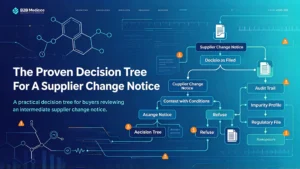
A buyer-side decision tree for handling an intermediate supplier change notice — what to accept, contest, or reject, and how to log the call.

Manufacturer and supplier of pharmaceutical APIs and intermediates. Contact us for technical support and sourcing solutions.