Ultimate First Article Approval Checklist For A New Supplier
The first commercial batch from a new intermediate supplier is not a formality. Here is the checklist, the five approval outcomes, and how to log the call.
Table of Contents
In the pharmaceutical industry, continuous manufacturing is often seen as the future trend, especially with the policy advocacy of the FDA and EMA, leading more and more innovative drug companies and large pharmaceutical companies to discuss continuous manufacturing routes.
However, in the pharmaceutical intermediate stage, a frequently overlooked practical question is: Is continuous manufacturing truly more suitable for intermediates than traditional batch manufacturing?
From practical project experience, the answer is not a simple “yes” or “no.”
In the intermediate stage, the choice of production mode is essentially a trade-off between risk management, process maturity, supply chain stability, and compliance pathways.
In the API or formulation stage, the advantages of continuous manufacturing are very clear:
However, intermediates are the opposite, possessing several essential characteristics:
Therefore, in the intermediate stage, “flexibility” is often more important than “maximum efficiency.”
Although continuous technology has received considerable attention, batch manufacturing remains the mainstream choice for most intermediate projects. This is not due to technological backwardness, but rather because it better aligns with the actual risk structure.
1️⃣ More responsive to process adjustments and route changes
This is particularly crucial in early- or mid-stage intermediate projects.
2️⃣ Higher tolerance for raw material and supply chain fluctuations
This directly relates to whether projects will stall due to non-technical reasons.
3️⃣ More mature compliance pathways and higher audit comprehension
For intermediate companies primarily engaged in exports and CDMO collaborations, this is a real advantage.
Continuous manufacturing is not unsuitable for intermediates, but its application conditions are extremely stringent.
In our project evaluations, continuous intermediate production often faces the following practical challenges:
⚠ High coupling between process scale-up and stability
⚠ More “idealistic” raw material quality requirements
⚠ Compliance and auditing experience is not yet widespread
This is why continuous production in the intermediate field remains largely a “pilot project” rather than a widespread rollout.
Based on practical experience, continuous production is only truly meaningful when the following conditions are met simultaneously:
These intermediates are often close to API precursor levels, rather than early-stage or multi-purpose intermediates.
In the intermediate stage, the choice of production model is not essentially a technological race, but rather a matter of:
From this perspective:
For pharmaceutical intermediates:
Batch production remains the most robust, replicable, and supply chain-resilient mainstream choice.
Continuous production is not a wrong direction, but rather needs to be used with the right intermediates, the right stage, and the right supply chain structure.
Truly mature manufacturing strategies are not about blindly chasing trends, but about rational judgments based on project risks, compliance paths, and long-term business goals.
If you are developing or optimizing intermediates for API programs,
contact us to discuss your route, supply requirements, and manufacturing strategy. → sunqian0123@gmail.com
WhatsApp: + 86 176 6371 3557
The first commercial batch from a new intermediate supplier is not a formality. Here is the checklist, the five approval outcomes, and how to log the call.
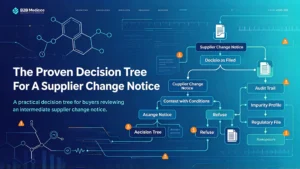
A buyer-side decision tree for handling an intermediate supplier change notice — what to accept, contest, or reject, and how to log the call.
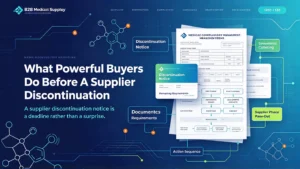
A supplier discontinuation is a deadline, not just bad news. The questions to ask in writing, the last-time-buy calculation, and the files to collect in time.

Manufacturer and supplier of pharmaceutical APIs and intermediates. Contact us for technical support and sourcing solutions.