Ultimate First Article Approval Checklist For A New Supplier
The first commercial batch from a new intermediate supplier is not a formality. Here is the checklist, the five approval outcomes, and how to log the call.
Table of Contents
In projects involving intermediates related to hydrogenation reactions, catalyst residue is a question almost every client asks, yet it’s also the most easily underestimated problem.
Many projects seem to go smoothly in the laboratory stage: the reaction is complete, the yield is good, and the HPLC main peak is clean. However, once the project enters the scale-up, continuous supply, or registration phase, catalyst residue quickly transforms from a mere “detection indicator” into a critical variable affecting compliance, cost, and project timeline.
We have repeatedly observed in actual projects that:
What truly differentiates intermediate suppliers technologically is not “whether they can reduce the metal content,” but “whether they can control it consistently, stably, and cost-effectively over the long term.”
Hydrogenation reactions are widely used in small molecule drugs for oncology, cardiovascular, and metabolic diseases. This leads to continuous attention to the following issues:
For clients, these are not “theoretical problems,” but real issues directly related to audit risks and project timelines.
We once encountered a client who discovered excessive Pd levels in the API stage, ultimately tracing it back to a seemingly “compliant” filtration operation in the early intermediate stage. Although the single-batch data was compliant, the long-term trend was unstable, forcing a rework of the entire process.
These types of problems cannot be remedied by QA; they must be addressed at the process design stage.
In our online consultations, we often hear similar questions:
“Can you help us reduce the Pd level to below 5 ppm?”
This question itself is not difficult, but what’s truly important is the underlying implementation method.
In actual industrial projects, we do not recommend simply relying on:
These methods are effective in the short term, but often lead to new problems: decreased yield, batch variability, difficulties in scaling up, and even the introduction of new impurity risks.
Our experience is:
Catalyst residue control must be integrated into the “reaction and separation synergistic design” level.
1️⃣ Catalyst Selection: Prioritizing “Post-Processing Friendly” Catalysts
During the route evaluation phase, we simultaneously assess:
In multiple projects, we prefer to choose a catalytic system with slightly lower activity but stable particles and easy filtration, rather than the “best” performing solution in the laboratory.
Because for commercial production, stability is always more important than ultimate performance.
2️⃣ Filtration and Process Sequence Design, Not “Remedial Treatment”
In mature intermediate processes, the filtration step is usually not independent, but is closely coupled with:
We have successfully reduced Pd residue by more than 40% without adding any new steps by adjusting the solvent ratio and cooling rate before filtration, while significantly improving the filtration speed.
3️⃣ Metal Scavengers: Used Only When “Necessary and Controllable”
Metal scavengers are a good tool, but not a “panacea.”
In our internal process decision-making, they are usually only used in the following situations:
And three questions must be clearly answered:
Without these three points, we would rather not use it.
From the customer’s perspective, catalyst residue control is essentially a cross-departmental issue:
Teams that have long focused on intermediate manufacturing have often repeatedly verified these combined strategies in multiple projects, forming reproducible industrial experience.
This is why more and more customers choose to introduce professional partners at the intermediate stage, rather than waiting until the API stage for “remedial treatment.”
Catalyst residue control is not a matter of metrics, but a matter of capability.
In hydrogenation intermediate projects,
Being able to reduce metal levels is a basic skill;
Being able to maintain stable low levels in the long term is the real value. In our view, a qualified intermediate supplier shouldn’t just answer “Can it meet the specifications?”, but should also answer:
If you are advancing an intermediate project involving hydrogenation steps,
and you want a more definitive solution regarding catalyst residue, process stability, or scale-up feasibility,
please feel free to contact us directly to discuss your specific molecular and technical requirements.
A truly mature process is never about “doing it once,” but about “being able to do it consistently.”
The first commercial batch from a new intermediate supplier is not a formality. Here is the checklist, the five approval outcomes, and how to log the call.
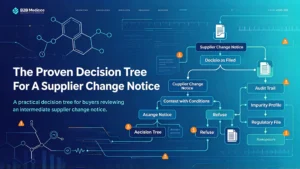
A buyer-side decision tree for handling an intermediate supplier change notice — what to accept, contest, or reject, and how to log the call.
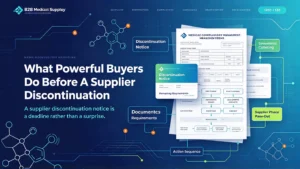
A supplier discontinuation is a deadline, not just bad news. The questions to ask in writing, the last-time-buy calculation, and the files to collect in time.

Manufacturer and supplier of pharmaceutical APIs and intermediates. Contact us for technical support and sourcing solutions.