Scaling an intermediate from grams to multi-kilogram or ton-level output is often described as a “technical transition,” but anyone who has actually managed a scale-up project knows it is rarely a linear process. Even with well-designed lab routes, the moment a reaction enters larger vessels, subtle variations in mixing, heat transfer, impurity formation, and raw-material consistency begin to surface. These issues can materially affect the feasibility, cost, and compliance profile of the final API.
This article examines the major challenges in scaling up pharmaceutical intermediates, drawing on published regulatory guidance, industrial reports, and documented case studies. The goal is to provide a realistic, evidence-based view of the scale-up process—one that reflects what actually happens in plants, not only what appears in theoretical development plans.
Why Scale-Up of Intermediates Becomes More Complex in Practice
Scaling up is rarely a simple transfer of laboratory conditions into a larger vessel. According to ICH Q11, several factors—reaction kinetics, heat transfer efficiency, impurity formation pathways, and equipment characteristics—evolve significantly when a process transitions to commercial equipment.
The FDA’s Process Validation: General Principles and Practices also points out that a considerable portion of manufacturing deviations emerge during scale transitions, emphasizing the need for rigorous process understanding early in development.
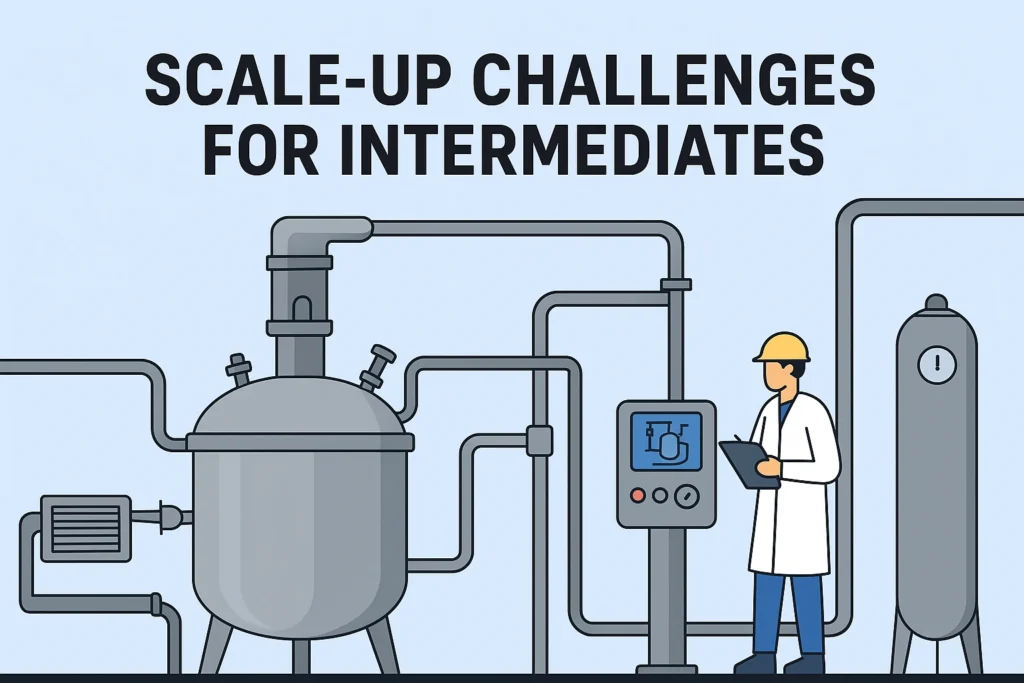
At its core, scale-up challenges arise because industrial reactors do not behave like laboratory glassware. The physical environment changes, and with it, the chemistry behaves differently.
Key Scale-Up Challenges for Pharmaceutical Intermediates
Heat Transfer Limitations and Hot-Spot Formation
One of the most common issues during scale-up stems from reduced heat transfer capability. Industrial reactors have a much lower surface-area-to-volume ratio, which can lead to:
- slower heat removal
- localized temperature variations
- altered reaction selectivity
- unanticipated impurity formation
A study published in Organic Process Research & Development reported that a large majority of reactions show different thermal behavior at scale compared to laboratory runs. For reactions with strong exothermic characteristics, this difference can be particularly significant.
Reduced Mixing Efficiency and Mass Transfer Constraints
Mixing efficiency diminishes as reactors grow larger. What appears to be excellent agitation in a 5-L flask may not provide the same effect in a 2,000-L jacketed reactor. This impacts:
- distribution and concentration of reagents
- catalyst-substrate interactions
- gas absorption rates during hydrogenation
- interfacial area in liquid–liquid systems
Processes that rely heavily on precise mixing—such as phase-transfer catalysis or heterogeneous catalysis—often require significant optimization to perform consistently at commercial scale.
Changes in Impurity Profiles During Scale-Up
Impurity behavior is rarely identical across scales. Even when small-scale synthesis produces clean profiles, commercial batches may show:
- new side reactions triggered by thermal gradients
- increased accumulation of low-level impurities
- different impurity ratios
- sensitivity to concentration or temperature fluctuations
EMA guidance on process-related impurities notes that scale changes are a frequent source of unexpected impurity formation, which can disrupt validation and delay product supply.
Variability in Raw Materials and Supply Chain Quality
Raw materials used at commercial scale often come from multiple suppliers or lots with slight but meaningful differences. Variations may include:
- solvent or reagent purity
- trace metal levels
- stabilizer or inhibitor content
- performance inconsistency in catalysts
These factors can influence yield, impurity levels, or reaction rate. As scale increases, so does the need for strict incoming QC and reliable supplier qualification programs.
Differences Between Laboratory and Industrial Equipment
The fundamental contrast between lab glassware and industrial reactors introduces additional challenges:
Laboratory Glassware Industrial Reactors
Excellent thermal responsiveness Slower heat removal
High mixing efficiency Limited turbulence
Chemically inert surfaces Potential adsorption/corrosion
High flexibility Fixed operational constraints
Laboratory Glassware | Industrial Reactors |
Excellent thermal responsiveness | Slower heat removal |
High mixing efficiency | Limited turbulence |
Chemically inert surfaces | Potential adsorption/corrosion |
High flexibility | Fixed operational constraints |
When a process is designed purely based on laboratory performance, mismatches in equipment characteristics can become a major source of scale-up failure.
Environmental, Health, and Safety (EHS) Constraints
Certain processes that are easy to handle in a controlled laboratory setting may not be feasible—or safe—on a large scale. These include:
- high-pressure hydrogenations
- cryogenic reactions
- handling of corrosive reagents
- processes involving toxic gases
If a facility lacks the necessary engineering controls or safety systems, even an optimized lab route may require redesign for commercial feasibility.
Regulatory Expectations During Scale-Up
ICH Q7 and ICH Q11 Compliance
Both guidelines emphasize the importance of:
- clearly defined critical process parameters (CPPs)
- established impurity control strategies
- thorough documentation of process changes
- completed validation prior to commercial supply
Pharmaceutical customers increasingly request:
- change-control histories
- impurity evolution studies
- equipment qualification records
- multi-batch consistency data
These expectations highlight the need for mature quality systems within intermediate-manufacturing organizations.
Practical Strategies to Enable Successful Scale-Up
Implementing Risk Assessments (FMEA and HAZOP)
ICH Q9 encourages structured risk evaluation tools. Applying them early helps identify:
- potential hot-spot risks
- reactant incompatibilities
- equipment limitations
- steps requiring tighter process controls
This approach reduces uncertainty before full-scale production begins.
Using Design of Experiments (DoE) to Define a Robust Design Space
DoE provides a quantitative understanding of how reaction parameters affect yield and impurities. It helps define:
- temperature operating ranges
- reagent addition rates
- agitation speeds
- stoichiometric balance
- sensitivity of impurity pathways
The FDA recognizes DoE as an effective method to build process understanding and improve scalability.
Strengthening Raw Material and Supplier Control
A strong supply chain involves:
- dual-sourcing strategies
- well-defined incoming specifications
- periodic supplier audits
- long-term quality agreements
These steps improve consistency, especially for complex or sensitive intermediates.
Leveraging Continuous Flow Chemistry
Continuous flow technology can address specific scale-up challenges by improving:
- heat management
- reaction safety
- process reproducibility
Studies in the Chemical Engineering Journal show that continuous flow systems can reduce temperature deviations in exothermic reactions by a substantial margin, making them an attractive option for hazardous chemistries.
Enhancing Quality Systems and Documentation
Consistent commercial production relies on:
- defined in-process controls (IPC)
- equipment calibration and verification
- structured OOS/OOT investigations
- full material traceability
These elements strengthen compliance and support long-term partnerships with global pharmaceutical companies.
Choosing the Right Intermediate Supplier
A capable intermediate manufacturer should offer:
- reactor volumes ranging from pilot to multi-ton scale
- experience in low-temperature chemistry, hydrogenation, halogenation, and flow processes
- a well-established QA/QC system aligned with international guidelines
- proven success in scaling projects for leading pharmaceutical clients
- reliable supply chain management
These capabilities help ensure that a process developed in the lab can transition smoothly into stable commercial production.
Conclusion
Scaling up intermediates is one of the most technically demanding steps in the chemical drug development cycle. Differences in heat transfer, mixing, impurity behavior, raw materials, and equipment can significantly influence process performance at scale.
By combining deep process understanding, strong quality systems, risk-based evaluation, and robust supply chain controls, manufacturers can reduce uncertainty and deliver consistent commercial-scale results.
Organizations looking for a partner with strong scale-up and commercial manufacturing capabilities can learn more at: https://www.tianmingpharm.com/
Email: sunqian0123@gmail.com
WhatsApp:+86 176 6371 3557