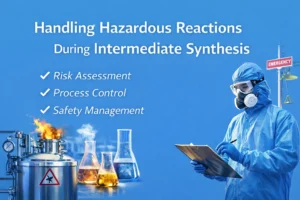
Anyone with experience in the pharmaceutical intermediate industry knows that hazardous reactions are not uncommon during the development and scale-up production of pharmaceutical intermediates.
For example, we often encounter strongly exothermic reactions, violent gas releases, the involvement of flammable solvents, and raw materials sensitive to water or air, all of which can pose safety hazards during the scale-up stage.
Accidents, once they occur, become news and social reports. In my personal experience, the issue is not whether hazardous reactions will be encountered, but whether we possess a systematic risk identification and control capability.
According to the Occupational Safety and Health Administration (OSHA)’s Process Safety Management (PSM) standard and the International Chemical Manufacturers Association (ICCA) safety guidelines, the core of managing high-risk chemical reactions lies in three points: risk assessment, process control, and emergency response plans.
For pharmaceutical intermediate companies, these requirements not only relate to employee safety but also directly affect the stable delivery of projects and compliance audit results.
Why are Intermediates always “Stuck” by Risks?
To understand this issue, we need to recognize that intermediate synthesis is typically a transitional phase between R&D and industrialization. At this stage, the process is not yet fully optimized, and some parameters are still being adjusted, such as reaction temperature, feed rate, or solvent ratio.
Reactions that appear stable at laboratory scale will experience changes in heat accumulation and mass transfer efficiency once scaled up to hundreds of liters or even tons.
According to the European Federation of Chemical Engineers (EFCE) technical document on the safety of exothermic reactions, during scale-up, heat dissipation efficiency per unit volume often decreases, while the exothermic rate increases with reactant concentration. Without proper thermal control design, this can lead to thermal runaway.
Therefore, in our experience, conducting reaction heat determination and hazard assessment in advance during intermediate synthesis is the first step in preventing accidents.
Risk Assessment: From Laboratory Data to Industrial Decisions
The foundation of hazardous reaction management is quantifiable data support.
In practice, companies typically conduct the following types of tests:
- Reaction Calorimetry
- Thermal Stability Testing (DSC/ARC),
- Decomposition
- Temperature and Pressure Assessment
- Raw Material Compatibility Testing
These tests help determine if the reaction carries a risk of self-accelerating decomposition, or whether stepwise feed, reduced concentration, or the use of a safer solvent system is necessary.
According to the safety management guidelines published by the Center for Chemical Process Safety (CCPS) of the American Institute of Chemical Engineers (AIChE), all high-energy reactions should undergo a systematic risk assessment before scale-up and be documented for subsequent audits or customer due diligence.
Process Control: Reducing Hazards, Not Avoiding Reactions
In actual production, many critical intermediate reactions are themselves “high-energy reactions,” such as nitration, hydrogenation, or strong oxidation reactions. These reactions cannot be completely avoided, but risks can be reduced through proper process design.
Common control methods include:
- Batch or staged feeding to avoid concentrated energy release;
- forced cooling system design to ensure timely heat removal;
- automatic temperature and pressure interlock systems;
- and controlling reactant concentration to avoid high-concentration operation.
In recent years, continuous flow technology has also been applied in some high-risk reactions. According to publicly available information from the FDA’s continuous manufacturing guidelines, continuous reaction systems, due to their smaller reaction volume, can reduce the scale of single accidents in certain scenarios, but this still needs to be judged in conjunction with the specific process.
Often, the Problem Lies with the Raw Materials
Dangerous reactions do not only originate from the reaction itself. Sometimes the problem lies in fluctuations in raw material purity or unstable equipment conditions.
For example:
- deviations in raw material purity may lead to increased side reactions;
- excessive solvent water content may trigger violent reactions;
- insufficient stirring efficiency may create localized hot spots.
Therefore, a stable raw material supply system and strict quality control are part of safety management. According to ICH Q7 quality requirements for API and intermediate production, a qualified supplier management system must be established for critical raw materials, and audit records must be maintained.
Emergency Management and Compliance Requirements
Even if risks have been assessed and controlled, a complete emergency response mechanism must be established.
This includes:
- Temperature anomaly alarm handling procedures;
- Backup plans for power outages or equipment failures;
- On-site emergency supplies configuration for leaks;
- Regular safety drills.
In the European and American markets, during supplier due diligence, customers typically focus on whether a company has established a PSM (Product Safety Management) system, conducted HAZOP analysis, and has incident records and rectification reports.
Safety management capabilities have become the foundation of trust in B2B cooperation.
Safety is not Just about Compliance, but also about Ensuring Supply Stability
No one can avoid the hazardous reactions in intermediate synthesis. Having worked in this industry for over a decade, I increasingly believe that safety management is not about setting rules, but about building understanding.
Past experience tells us that once production is halted due to a safety incident, it not only affects individual orders but may also impact the entire API development schedule.
From industry experience, truly mature intermediate suppliers typically possess the following characteristics:
- Conducting reaction risk assessments early in the project;
- Establishing standardized safety review processes;
- Equipment with redundancy and interlocking designs;
- Providing complete safety data support for customer registration.
Hazardous reactions are not inherently dangerous. The real risk lies in the lack of preparation and systematic management.