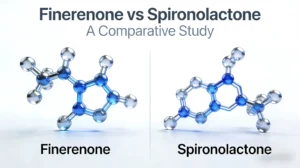
If you follow cardiorenal medicine at all, you’ve probably heard about finerenone. It’s a newer type of mineralocorticoid receptor antagonist (MRA). First approved back in 2021 for chronic kidney disease in people with type 2 diabetes.
Then, in July 2025, the FDA gave it the green light for something else—heart failure with an ejection fraction of 40% or higher. That actually made it the first MRA approved for that group.
But spironolactone has been around for decades. It’s cheap, it works, and doctors know it well. So when a newer, pricier drug like finerenone comes along, the obvious question is: is it really any better?
Let’s look at what the evidence actually says.
How They Work
Spironolactone is what you’d call a steroidal MRA. It blocks the mineralocorticoid receptor (MR), which stops aldosterone from causing damage to the heart and kidneys. But spironolactone isn’t very picky.
It also messes with androgen and progesterone receptors. That’s why it causes side effects like breast growth in men (gynecomastia), erectile issues, and irregular periods.
Finerenone is different. It’s nonsteroidal. Its bulky structure makes it much more selective for the MR. A published comparison table shows finerenone has “+++” selectivity for MR (the highest) and only “+” affinity for sex hormone receptors (the lowest). Spironolactone? Only “+” selectivity for MR and “+++” for androgen and progesterone receptors. That selectivity gap is the whole point.
Finerenone also spreads evenly to the heart and kidneys. Spironolactone tends to hang out more in the kidneys. And in animal studies, finerenone has shown stronger anti-inflammatory and anti-fibrotic effects.
What the Latest Evidence Actually Found
The Nature Communications study (November 2025) is the first real-world, head-to-head comparison between finerenone and spironolactone. The researchers used a method called target trial emulation. They looked at data from over 2,200 matched patients across 21 countries. Follow-up was about 1.3 years.
The results were pretty striking.
Outcome | Risk Reduction with Finerenone vs Spironolactone |
All-cause mortality | 69% lower |
Major adverse kidney events (MAKE) | 53% lower |
Major adverse cardiovascular events (MACE) | 26% lower |
Hyperkalemia incidence | 17.2% vs 26.4% |
The hazard ratios were: all-cause mortality aHR 0.31 (95% CI: 0.21–0.45), kidney events aHR 0.47 (95% CI: 0.33–0.67), cardiovascular events aHR 0.74 (95% CI: 0.58–0.94). The senior author, nephrologist Professor Vin-Cent Wu, said finerenone appears not only safer but also more effective at protecting both the heart and kidneys.
Before this, the FIDELIO-DKD and FIGARO-DKD trials had already shown that finerenone cut cardiovascular events by 14% and kidney events by 23% compared to placebo in CKD patients with type 2 diabetes. The pooled FIDELITY analysis (over 13,000 patients) confirmed those benefits.
Then there’s the FINEARTS-HF trial. That one looked at finerenone in heart failure patients with LVEF ≥40%. The result: a 16% relative risk reduction in cardiovascular death or total heart failure events (RR 0.84; 95% CI, 0.74–0.95; P = .007). The most common side effects were hyperkalemia (9.7% vs 4.2% for placebo), hypotension (7.6% vs 4.7%), and worsening renal function (18% vs 12%).
Safety: This Is Where the Real Difference Shows Up
Gynecomastia and sexual problems are the main reasons people stop taking spironolactone. Finerenone doesn’t cause those. That alone is a big deal for a lot of patients.
Both drugs can cause high potassium levels (hyperkalemia). But the data consistently shows finerenone causes less of it. In the Nature Communications study, hyperkalemia happened in 17.2% of finerenone patients versus 26.4% on spironolactone. That’s a meaningful difference. In FINEARTS�HF, hyperkalemia was 9.7% on finerenone vs 4.2% on placebo.
A published comparison table sums it up like this:
Side Effect Category | Spironolactone | Finerenone |
Gonadal axis-related effects | +++ | + |
Hyperkalemia | +++ | + |
Finerenone also has a much shorter half-life—about 2-3 hours in healthy people, compared to spironolactone’s 20+ hours. That might make potassium levels easier to manage.
One more thing: finerenone has no active metabolites. Spironolactone has several that stick around for days.
The Catch: No Large Head-to-Head Trial Yet
It’s worth pointing out that no large Phase 3 randomized controlled trial directly comparing finerenone and spironolactone has been completed. Experts have called for such a trial, especially in the HFpEF population.
The Nature Communications study is the best real-world evidence we have so far, but it’s not a randomized trial. The academic community agrees: more definitive evidence is still needed.
That said, the real-world data is pretty compelling. For patients with CKD and type 2 diabetes, finerenone seems to offer better outcomes with fewer hormonal side effects.
Putting the Two Side by Side
Feature | Spironolactone | Finerenone |
Class | Steroidal MRA | Nonsteroidal MRA |
MR selectivity | + | +++ |
Androgen receptor affinity | +++ | + |
Tissue distribution | Kidney > Heart | Kidney = Heart |
Half-life | >20 hours | 2–3 hours |
Active metabolites | Yes | No |
Hyperkalemia risk | High (+++) | Moderate (+) |
Gynecomastia risk | High (+++) | None |
Key trial data | RALES, EMPHASIS�HF | FIDELIO�DKD, FINEARTS�HF |
FDA-approved indications | HFrEF | CKD + T2D; HF with LVEF ≥40% |
Finerenone doesn’t replace spironolactone everywhere. For HFrEF, spironolactone is still a first-line drug with strong evidence. But for patients with CKD and type 2 diabetes, or for those with HFmrEF/HFpEF, finerenone gives you a new option with a better safety profile and once-daily dosing.
The biggest difference isn’t just efficacy. It’s the lack of hormonal side effects. For many patients, that alone might be the deciding factor.
A Quick Note on API Manufacturing
At Tianming Pharmaceutical, we manufacture high-purity finerenone API. The synthesis is complex—it requires tight control of stereochemistry and impurities, especially given its nonsteroidal structure.
As finerenone gains more clinical use—especially after the recent FDA approval for heart failure—having a reliable, quality-assured API supply becomes more and more important for drug developers.
At Tianming Pharmaceutical, we supply high-purity finerenone API for pharmaceutical R&D. For technical specs, including impurity profiles and stability data, contact our team. → sunqian0123@gmail.com