The choice between a CDMO and a direct manufacturer is a topic worth a deep dive. Anyone who’s worked in pharma supply chain knows this isn’t just another box to tick on a sourcing checklist. This decision directly dictates your production costs and your ability to pivot when the market demands it.
Today, we’re skipping the basic definitions you can find anywhere online. Instead, we’ll do a deep dive into what each model actually delivers for your business, where the hidden pitfalls are, and how to make the right call for your API strategy.
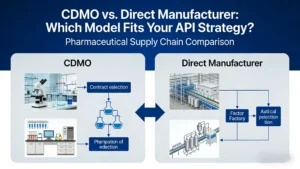
Let’s start with the basics. A direct manufacturer is exactly what it sounds like: a plant that produces according to the process you give them. You hand over your mature, optimized process, with clear quality standards and batch requirements. Their job is simple: follow the specs, deliver consistent quality, and ship on time. These companies are the workhorses of the generic and mature intermediate market. Their core competency is repeatable, reliable production.
A CDMO, however, is different. It’s not just a vendor; it’s a technical partner. They don’t just manufacture; they help you build the process from scratch, optimize the route, scale it up from lab to commercial production, handle tech transfer, prepare regulatory dossiers, and provide solutions when problems arise. Unless your API is a simple, commodity item, a good CDMO is like adding an extension of your own R&D and production team. They fill in the gaps you didn’t even know were there.
The fundamental difference between these two models boils down to three things: Who owns the risk? Who controls the process? And where is your money actually going?
When is a CDMO the Clear Right Call?
In my experience, projects get saved by CDMOs in four specific scenarios:
First, your API chemistry is genuinely difficult. We’re talking high-potency APIs (HPAPIs), high-pressure hydrogenations, or reactions requiring extremely tight impurity control. These aren’t processes you can just throw into any standard reactor.
They need specialized equipment, dedicated safety teams, and people who understand the nuances of scaling up complex chemistry. Most direct manufacturers won’t invest in this capability for one or two products. But a good CDMO? This is their core business. Their equipment, expertise, and people are constantly evolving because this is what they do.
Second, you’re still in the clinical phase, or your process isn’t finalized. Process changes are a given at this stage – improving yield, controlling a new impurity, switching a raw material.
Direct manufacturers are set up for stability, and constant changes make them uncomfortable. CDMOs, on the other hand, deal with clinical-stage projects daily. They expect changes and will adapt and troubleshoot alongside you, moving at your pace.
Third, your target market is the US or EU, where regulatory compliance is the absolute baseline. FDA inspections, EMA guidelines, REACH, ICH Q standards – this isn’t just paperwork. It dictates how you operate every reactor, document every step, and test every batch.
How many inspections do you think a typical CDMO handles in a year? They know exactly what inspectors are looking for; compliance is ingrained in their operations. If you go with a direct manufacturer, your small internal team might not have the capacity to manage all that.
Fourth, you don’t have the capital to build your own GMP facility. A decent API production line can easily cost tens of millions, and that’s before you hire the specialized teams to run it. Using a CDMO gives you immediate access to top-tier, GMP-certified infrastructure without that massive upfront investment. For many small to mid-sized pharma companies, this is the only viable path to market.
When Does a Direct Manufacturer Make More Sense?
Direct manufacturers aren’t a relic of the past. On the contrary, they are the bedrock of a stable supply chain. In some areas, they outperform CDMOs significantly.
The biggest win is for mature, high-volume APIs and intermediates with a fixed, long-optimized process. As long as demand is stable, yields are consistent, and you don’t need to tinker with anything, a direct manufacturer will beat a CDMO on cost per kilo, hands down. They don’t charge development or tech transfer fees. Their entire business model is built on economies of scale.
They’re also your best bet when supply stability is paramount. For generic APIs or standard intermediates – think paracetamol precursors or common antibiotic side chains – demand is predictable and processes don’t change. You hand them the process, and they reliably produce month after month. You don’t need to worry about unexpected deviations or process shifts. When stability is your top priority, this model is non-negotiable.
Simply put, if your chemistry is straightforward – a few standard reactions, no high-risk steps, no exotic catalysts – there’s no point paying a premium for a CDMO’s R&D expertise. A direct manufacturer will deliver the same quality product for a fraction of the cost. That’s their specialty.
So, direct manufacturers are the best fit for mature products, stable demand, simple chemistry, and when cost is your primary driver.
My Advice to Clients Stuck on the Fence
Over the years, I’ve boiled this down to two simple questions that usually provide clarity:
Question one: Is your product still evolving? Is the chemistry complex? Are the regulatory hurdles high? If the answer to any of these is yes, choose a CDMO. This is their sweet spot, and they shoulder the associated risks.
Question two: Is your product long-established? High volume? With a fixed, unchanging process? Then go with a direct manufacturer. Their strengths are stability and cost-effectiveness.
The smartest companies I’ve seen don’t just choose one; they combine both. They funnel their innovative pipeline assets – the clinical-stage products, the complex intermediates needing R&D support – to CDMOs.
And they send their mature, high-volume generics and standard intermediates that generate steady cash flow to direct manufacturers. This way, they get the best of both worlds: innovation and speed alongside cost-efficiency and stability. That’s a smart API strategy.
Final Thoughts
One final thought: price isn’t everything. A direct manufacturer might quote a rock-bottom price, but you have to ask: where are they cutting corners on safety and quality to achieve that? If something goes wrong – a production shutdown, a quality failure, a regulatory fine – the cost will dwarf whatever you initially saved. A CDMO might seem more expensive upfront, but the expertise they provide to avoid those costly mistakes is an investment, not an expense.
Ultimately, the choice between a CDMO and a direct manufacturer isn’t a simple either/or. It’s about how you execute your API strategy. A CDMO gives you flexibility, expertise, and a regulatory safety net, enabling you to move fast and innovate. A direct manufacturer provides cost control, scale, and a stable operational foundation, ensuring healthy cash flow and reliable supply.
Neither is inherently “better.” The right choice depends entirely on your product’s lifecycle stage, the complexity of your chemistry, your risk tolerance, and your company’s long-term direction.
When you align your manufacturing model with the reality of your products and your business goals, you build a supply chain that’s more than just efficient or cost-effective. You build one that’s resilient and adaptable, no matter what the market throws at it. That’s what a supply chain should be – not a constant source of stress, but a genuine competitive advantage.