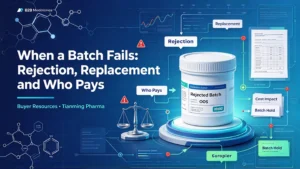
Ultimate Questions To Ask Before You Reject A Batch
Rejected batch? What to do in the first hour, how to write the notice, who pays the costs, and the escalation path when a supplier stalls.
Abstract: Choosing between custom synthesis and catalog (off-the-shelf) pharmaceutical intermediates is a decision that extends far beyond unit price.
This framework breaks down six factors that should drive the choice: specification match, lead time predictability, total cost of ownership, batch-to-batch consistency, documentation depth, and scale-up continuity.
Backed by pharmaceutical CDMO market data, ICH quality guidelines, and supply chain analysis, the guide includes a cost comparison table, decision criteria for when each approach fits, red flags to watch for, and a hybrid sourcing model that many procurement teams adopt as projects mature from research to commercial production.
A procurement manager at a generics manufacturer needs 200 kg of a substituted pyrimidine intermediate. The catalog supplier quotes $85/kg at 99.0% purity, delivery in two weeks. A custom synthesis lab quotes $120/kg but offers 99.5% purity, a tighter impurity profile, and a documented synthetic route. The catalog option looks cheaper on paper.
But the manager has been here before. The last time they chose the catalog route, three batches passed incoming inspection — and the fourth introduced an unidentified impurity at 0.3% that wasn’t on the COA. The result was a rejected API batch, a two-month investigation, and a supplier change that cost more than six months of price savings.
This scenario plays out across pharmaceutical procurement teams in India, Bangladesh, and other generics manufacturing hubs. The choice between catalog and custom synthesis intermediates is not a price comparison. It affects specification fit, regulatory filings, batch consistency, and scale-up risk — sometimes for years downstream.
A catalog intermediate is a compound the supplier already manufactures and stocks. It comes with a defined specification, a standard purity grade (commonly 98% or 99%), and an established synthetic route. The buyer orders what is available. The specification is set by the supplier.
Custom synthesis means the intermediate is manufactured to the buyer’s specification: your structure, your purity target, your impurity limits, your scale. The supplier develops or adapts a synthetic route, produces a qualification batch, and then manufactures to an agreed protocol.
The distinction matters because pharmaceutical intermediate specifications are not interchangeable. A 99.0% catalog grade and a 99.5% custom grade of the same CAS number can carry different impurity profiles, different residual solvent patterns, and different physical properties. When the downstream API synthesis is sensitive to a specific impurity — and many are — that difference determines whether a batch passes or fails.
Catalog intermediates come with supplier-defined specifications. If your API process requires tighter impurity limits than the catalog spec — for instance, a specific genotoxic impurity controlled below ICH M7 thresholds — the catalog product may not meet your needs without additional purification on your end.
Custom synthesis lets you define the specification around your process. This includes purity, specific impurity limits, residual solvent ceilings per ICH Q3C, particle size distribution, and polymorphic form. The question is straightforward: Does the catalog specification cover every critical quality attribute your process requires? If it does, catalog is viable. If it does not, custom synthesis is the only path to a compliant material.
Catalog supply is fast when material is in stock. But stockouts happen, and when they do, lead times can stretch from weeks to months. Vendor substitution — where a supplier ships material from a different batch or contract manufacturer without notifying the buyer — is a documented risk in the fine chemicals supply chain.
Custom synthesis has a longer initial lead time. Feasibility assessment, route development, and sample batch qualification typically take 4 to 12 weeks. Once the process is transferred and the supply schedule is locked in, repeat orders can follow a predictable cadence.
Procurement analysis indicates that custom programs may require 2 to 4 weeks for feasibility and sample preparation, yet can later provide more predictable release cycles over quarterly planning periods (xmcents.com, 2025).
Per-kilogram price is the most visible cost. It is rarely the most important one.
A catalog intermediate at $85/kg looks cheaper than a custom-synthesized equivalent at $120/kg. But the total cost of ownership includes incoming material testing, additional purification steps if the catalog spec falls short, batch failure costs (rejected material, re-testing, production delays), re-qualification when the supplier changes batch source, and documentation gaps that require internal resources to fill.
Market data supports this shift in buyer thinking. Custom synthesis accounted for 62.3% of the global pharmaceutical intermediate CDMO market in 2025, reaching $221.9 billion in revenue — a reflection that buyers increasingly value tailored specifications over cheaper but less controlled catalog alternatives (pmarketresearch.com, 2026 CDMO Market Report).
Catalog intermediates are manufactured in bulk. Different batches may come from different production runs, and in some cases, from different contract manufacturers. The COA may look identical batch to batch, but the impurity fingerprint can shift — a problem we examine in our batch-to-batch consistency guide.
Custom synthesis offers better batch consistency because the same route, starting materials, and process parameters are used for every batch. When the buyer controls the specification and the route, batch variation drops significantly.
This matters for API manufacturers filing regulatory dossiers — consistent intermediate quality simplifies process validation and reduces the risk of out-of-specification events downstream.
Regulatory filings require documentation, and the depth a supplier provides directly affects how much work the buyer’s regulatory team must do internally.
Catalog suppliers typically provide a COA and an SDS. Some include chromatograms. But the documentation covers what the supplier tests — not what the buyer’s filing requires.
Custom synthesis agreements can specify documentation deliverables: detailed synthetic route, impurity profiling with identified and unidentified peaks, analytical method descriptions, stability data, and change control commitments.
For buyers sourcing from China, documentation quality is a recurring challenge. The U.S.-China Economic and Security Review Commission noted in June 2025 testimony that China supplies approximately 65 to 70% of India’s key starting materials, intermediates, and APIs (USCC Hearing, June 2025). This level of dependency makes supplier documentation practices a critical due diligence area for Indian pharmaceutical manufacturers.
A catalog intermediate may be available in gram quantities today and unavailable in kilogram or multi-ton quantities tomorrow. Catalog inventories are driven by aggregate market demand, not by any single buyer’s project timeline.
Custom synthesis programs are built around the buyer’s scale-up trajectory. A typical program starts with a small sample batch (grams to hundreds of grams), progresses to a pilot batch (kilograms), and then to commercial production (tens to hundreds of kilograms). The supplier invests in process development with the understanding that the buyer’s volume will grow.
This continuity is critical for generics manufacturers developing products with pending patent expirations. Losing an intermediate supply source during scale-up can delay a product launch by 6 to 18 months — a cost that dwarfs any per-kilogram savings from a catalog purchase.
Cost Factor | Catalog Intermediate | Custom Synthesis |
Unit price (per kg) | Lower — bulk-produced, supplier-defined spec | Higher — includes R&D and process development |
Initial lead time | Days to weeks (if in stock) | 4 to 12 weeks (feasibility + qualification) |
Specification flexibility | Fixed by supplier; buyer adapts process | Built around buyer’s process requirements |
Batch consistency risk | Higher — batch source may shift without notice | Lower — same route, same parameters each batch |
Documentation package | COA + SDS (standardized) | Customizable: route, impurity profile, methods, change control |
Scale-up commitment | No guarantee — inventory driven by market demand | Contractual — supplier invests in scale-up with buyer |
Re-qualification frequency | Higher — supplier-initiated changes go unreported | Lower — change control obligations built into agreement |
Sources: pmarketresearch.com CDMO Market Report 2026; xmcents.com procurement analysis 2025; USCC Hearing June 2025 | ||
Catalog intermediates are the right choice when the specification matches your process requirements exactly, the material is for early-stage research or method development rather than commercial production, the required quantity is small (grams to low kilograms) and urgency is high, the intermediate is a well-established building block with multiple competing suppliers, or your process has demonstrated tolerance for minor specification variations.
For initial screening runs and analytical method development, catalog intermediates are often the only practical choice.
Speed matters more than specification depth at that stage, and the cost of a full custom program cannot be justified for material that may be used once and discarded.
Custom synthesis is the right choice when the intermediate is proprietary or not commercially available, your process requires tighter specifications than catalog grades offer, you need specific impurity controls for regulatory compliance, the intermediate will be used in commercial-scale API production, you need documented batch consistency for regulatory filings, or your volume trajectory requires a committed supply partner.
The decision often aligns with project stage. Early-stage research tolerates catalog variability. Late-stage development and commercial production do not.
According to IIM Marcom’s pharmaceutical intermediates industry report, custom intermediates are growing at 9.2% annually — the fastest rate among all intermediate categories — signaling that buyers are increasingly investing in custom programs as their projects mature toward commercialization (IIM Marcom, 2026 Industry Report).
In practice, many procurement teams use a hybrid model. A catalog intermediate serves initial research and method development. As the project advances toward clinical or commercial stages, the same compound transitions to custom synthesis with tighter specifications, a dedicated supply agreement, and a documentation package built for regulatory filings.
This staged approach lets teams move fast when speed matters and shift to controlled supply when consistency matters. It also spreads the cost: the premium of custom synthesis is paid only when the project has reached a stage where the investment is justified by volume and regulatory timelines.
The hybrid model aligns with how leading CDMOs structure their service offerings. Cambrex, for instance, announced a $120 million investment in October 2025 to expand API and intermediate manufacturing capacity at its Charles City, Iowa facility — capacity designed to support both catalog supply and custom synthesis programs under one roof (Cambrex Press Release, October 2025).
Catalog red flags:
Custom synthesis red flags:
These warning signs overlap with the supplier qualification framework in our switching suppliers hidden cost guide, which covers the financial impact of inadequate supplier vetting — often exceeding $200,000 when a poorly qualified supplier fails mid-project.
For a deeper look at how specifications tie into the broader quality picture, our COA reading guide breaks down what each section of a Certificate of Analysis means for procurement decisions, and our ICH Q11 starting material guide explains how the position of an intermediate in the synthesis affects regulatory requirements.
Need a custom synthesis partner for your pharmaceutical intermediates? Tianming Pharm manufactures custom and catalog intermediates for generic API manufacturers worldwide. Send us your structure, target purity, and volume requirements — we will come back with a feasibility assessment, lead time, and documentation package. Request a quote.
Rejected batch? What to do in the first hour, how to write the notice, who pays the costs, and the escalation path when a supplier stalls.
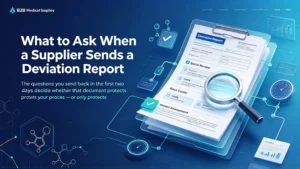
A deviation report arrives with a batch you have already paid for. The questions you send back in the first two days decide whether that document protects your process — or only protects the supplier who wrote it.
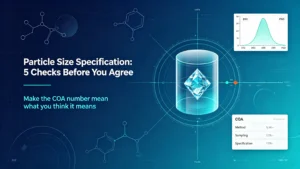
Two suppliers can quote the same intermediate with completely different particle size lines, and both may be telling the truth. Here is how to read a particle size specification before you agree to one, so the number on the COA means what you think it means.

Manufacturer and supplier of pharmaceutical APIs and intermediates. Contact us for technical support and sourcing solutions.