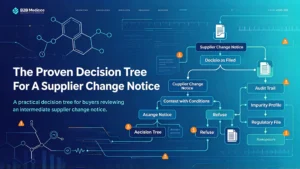
The Proven Decision Tree For A Supplier Change Notice
A buyer-side decision tree for handling an intermediate supplier change notice — what to accept, contest, or reject, and how to log the call.
Table of Contents
As a professional who has spent over a decade deeply immersed in this industry, I have witnessed significant transformations within the GLP-1 field. During its nascent stages of development, it garnered very little attention.
That changed.
If you’ve been watching the GLP-1 space at all lately, you know what I mean. Semaglutide, tirzepatide, and now orforglipron—these drugs have become almost impossible to ignore. The numbers floating around are pretty staggering.
The global market hit over $53 billion in 2024, and depending on which analyst report you’re reading, projections suggest we could be looking at $165 billion by the early 2030s. The obesity indication alone is growing faster than almost anyone predicted.
But here’s what doesn’t get nearly as much attention as it should.
Behind every vial of semaglutide, behind every orforglipron tablet, there’s a supply chain that most people never think about. And right at the foundation of that supply chain are the intermediates—the chemical building blocks that make these therapies actually possible.
So let’s talk about what’s happening in this space, because if you’re sourcing these materials, or thinking about getting into the market, there’s some stuff worth knowing.
Here’s a pattern I’ve noticed over the years. When a drug class starts hitting mainstream news—weight loss this, diabetes breakthrough that—most of the conversation focuses on the end product. How effective is it? What are the side effects? How much does it cost?
Fair questions. But they tend to skip over something crucial.
The real bottlenecks often show up way earlier in the process. Before a manufacturer can formulate a single tablet or fill a single syringe, they need the right starting materials. And for GLP-1 drugs, those starting materials come with some particular challenges.
See, these aren’t simple molecules. Depending on which drug we’re talking about, you might be dealing with complex peptide chemistry or intricate chiral synthesis. Either way, you’re looking at strict requirements around purity, stereochemistry, and impurity control. Get any of these wrong, and you’re looking at regulatory problems, production delays, or worse.
For generic manufacturers eyeing this space—and there are a lot of them—the question isn’t just “can we make this?” It’s “can we source the intermediates consistently, at quality, and at scale?”
And that question is harder to answer than it sounds.
One thing that surprises people outside the industry is how different GLP-1 drugs can be from each other in terms of how they’re made.
Take the injectable peptides—semaglutide, tirzepatide, liraglutide. These are built using solid-phase peptide synthesis, which is essentially a step-by-step assembly process where amino acids get added to a growing chain on a resin support. The intermediates here include protected amino acid derivatives, various linker molecules, and side-chain protected fragments at different stages.
It’s complicated work. A typical commercial-scale semaglutide campaign might go through 15 to 20 distinct intermediate steps. Each one has to meet specifications for chiral purity, residual solvents, metal content. One weak link in that chain and you’ve got problems.
Then there’s the newer category: oral small-molecule GLP-1 drugs. Orforglipron, which received approval in April 2026, is the first daily oral option in this class.
These use more traditional chemical synthesis routes, but they bring their own challenges—multi-step synthesis with tight stereocontrol, careful handling of reactive intermediates, and comprehensive impurity profiling that regulators are going to scrutinize closely.
Both paths require GMP-compliant manufacturing environments, strong analytical capabilities, and documentation packages that will hold up to regulatory review. Not exactly a low barrier to entry.
The pharmaceutical intermediates market in general is projected to grow from around $37 billion in 2026 to over $60 billion by 2033. GLP-1-related intermediates are contributing meaningfully to that growth.
As for where the supply actually comes from—it’s concentrated, but not exclusively, in Asia.
Chinese manufacturers have made significant investments in cGMP facilities and process development for complex chiral molecules. India brings strong regulatory expertise and a track record with DMF filings. Between the two regions, you’re looking at the majority of commercial GLP-1 intermediate production.
What does this mean for buyers? Basically, the suppliers who are winning contracts are the ones who can demonstrate three things consistently: quality that doesn’t waver, regulatory readiness (meaning they can support your filings with the right documentation), and capacity that can actually scale with demand.
Sounds obvious, but in practice, finding a supplier who can deliver on all three is harder than it looks.
I’ve sat in on a lot of supplier conversations over the years. Some of them were productive. Others felt like talking to a wall. The difference usually came down to whether the supplier understood what we were actually trying to accomplish—not just whether they could ship us material.
So here’s what I’d actually want to know, if I were evaluating GLP-1 intermediate suppliers today:
First, what’s your track record with this specific type of chemistry? Peptide work and small-molecule chiral synthesis are different skill sets. Someone who’s excellent at one might be completely out of their depth with the other. Ask for concrete examples. Ask about batch history. Ask about regulatory filings they’ve supported.
Second, can you walk me through your impurity control approach? This one’s important because impurity profiles—especially potential genotoxic impurities—are going to get close attention from FDA, EMA, whoever your regulatory path involves. A good supplier won’t just hand you a COA. They’ll explain their process understanding, their purge studies, why their specifications are set where they are.
Third, what documentation can you actually provide? DMF, CEP, technical package—what do you have ready, and what’s going to take additional work? This matters more than people realize until they’re three months into a filing timeline and realizing their supplier’s paperwork isn’t where it needs to be.
Fourth, and this is increasingly relevant given current demand: what’s your capacity situation? GLP-1 demand has outpaced supply in several segments. A supplier who’s great to work with today might not be able to scale with you if you’re launching a generic. Worth understanding their runway before you commit.
Fifth, can you point me to comparable customers who can speak to their experience? References matter. Not just for quality—though that’s obviously critical—but for delivery reliability and how they handle issues when they come up.
Here’s something that doesn’t get discussed enough in mainstream coverage of the GLP-1 boom.
These drugs are taken long-term. Often by very large patient populations. For years at a time in many cases.
Which means impurity control isn’t just a quality box to check. It’s a patient safety issue that regulators take extremely seriously.
Many GLP-1 intermediates contain functional groups that can lead to reactive metabolites if the chemistry isn’t controlled properly. Without careful process design and monitoring, these can show up as impurities in the final API—and regulators have gotten increasingly sophisticated at detecting and questioning them.
What separates a supplier who understands this from one who doesn’t? A few things, in my experience.
A supplier who can answer these questions confidently—who can walk you through their process understanding, not just their specifications—is worth considerably more than one who simply undercuts on price.
The GLP-1 market isn’t standing still. Several things are worth watching over the next few years.
Patent situations are obviously driving a lot of generic activity. Semaglutide’s composition-of-matter patent is approaching expiry discussions in major markets, and there are generic manufacturers who’ve been preparing for this.
The intermediate suppliers who can support those launches—not six months before commercial production, but now, in development—are going to be in demand.
Orforglipron’s approval opens up the oral small-molecule pathway. There are other candidates in development—danuglipron, lotiglipron, a few others. How these progress will shape intermediate demand in interesting ways.
We’re also seeing combination therapies enter development—fixed-dose combinations with GLP-1 agonists for various indications. More complex, more intermediate requirements.
And perhaps most practically: capacity. Despite significant investment, certain GLP-1 intermediates remain tight. Building supplier relationships early, before the rush, might prove strategically valuable for companies positioning in this space.
Tianming Pharmaceutical has been building capabilities in both peptide-based and small-molecule GLP-1 intermediates. We’ve invested in custom synthesis for protected amino acids and peptide fragments, in process development with a focus on chiral purity and impurity control, and in regulatory support including DMF preparation and documentation packages.
We work with companies across development stages—from early-phase research through commercial supply. Not every supplier relationship has to start at commercial scale.
Sometimes it makes sense to build a partnership earlier, when there’s more time to understand each other’s processes and expectations.
If you’re evaluating GLP-1 intermediate suppliers, or if you’re developing a generic version of one of these drugs, we’d welcome a conversation about what you’re working on.
Our team can provide specifications, discuss sample availability, and outline the documentation we have ready to support regulatory filings. sunqian0123@gamil.com
A buyer-side decision tree for handling an intermediate supplier change notice — what to accept, contest, or reject, and how to log the call.
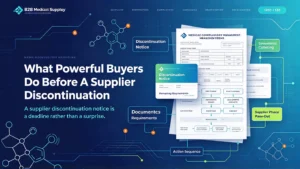
A supplier discontinuation is a deadline, not just bad news. The questions to ask in writing, the last-time-buy calculation, and the files to collect in time.
Rejected batch? What to do in the first hour, how to write the notice, who pays the costs, and the escalation path when a supplier stalls.

Manufacturer and supplier of pharmaceutical APIs and intermediates. Contact us for technical support and sourcing solutions.