
Ultimate First Article Approval Checklist For A New Supplier
The first commercial batch from a new intermediate supplier is not a formality. Here is the checklist, the five approval outcomes, and how to log the call.
So you’ve been looking into hair loss treatments lately, and you keep seeing this name pop up: clascoterone. Maybe you know it as Breezula. People are calling it the first genuinely new mechanism for male pattern baldness in over thirty years.
Meanwhile, minoxidil has been the king of topical treatments for decades. It’s cheap. It’s everywhere. And for a lot of people, it works.
So when a new drug comes along, everyone understandably wants to know: how does clascoterone actually stack up against minoxidil? Which one is better? Could they be even better used together?
Let me walk you through what the evidence actually says. Not the hype. Just the data.
This is the first thing to understand. These two drugs attack hair loss from totally opposite directions.
Minoxidil has been FDA-approved for androgenetic alopecia since 1988. It’s still the only topical API approved for both men and women with this condition. But here’s a weird thing—scientists still don’t fully agree on exactly how it works.
The current thinking is that it does several things at once. It widens blood vessels (vasodilation). It has some anti-inflammatory effects. It triggers something called the Wnt/β-catenin signaling pathway, which is involved in hair growth.
And it may have mild anti-androgen properties as well. On top of all that, minoxidil also makes the growth phase of hair follicles last longer.
About 1.4% of topical minoxidil gets absorbed through your skin. And get this—it’s actually a prodrug. Your hair follicles have to convert it into minoxidil sulfate using an enzyme called sulfotransferase.
People with higher sulfotransferase activity tend to respond better. That’s why minoxidil works really well for some people and barely at all for others.
Clascoterone takes a much more targeted approach. It’s a topical androgen receptor antagonist. In plain English: the clascoterone molecule looks a lot like DHT—the male hormone that shrinks hair follicles. So it binds to androgen receptors on your follicles instead of letting DHT bind. Block DHT from binding, and you protect the follicles from shrinking.
Because it’s designed as a “soft drug,” clascoterone gets broken down quickly in your skin and barely makes it into your bloodstream. That’s supposed to keep systemic side effects to a minimum.
So to put it simply: minoxidil tries to stimulate growth through a bunch of different channels. Clascoterone tries to shut off the main cause of follicle shrinkage in the first place.
| Feature | Minoxidil | Clascoterone |
| FDA approval status | Approved for AGA (1988) | Not yet approved—Phase 3 done |
| Mechanism | Vasodilator + multiple pathways; prolongs growth phase | Topical androgen receptor antagonist (blocks DHT locally) |
| How you use it | 5% foam/solution, usually twice daily | 5% solution, twice daily (still investigational) |
| Hair count gain | ~21 hairs/cm² vs placebo (16–48 weeks) | Not publicly released yet (absolute numbers) |
| Relative improvement vs placebo | Not typically reported this way | 539% (SCALP 1) and 168% (SCALP 2) |
| Trial size | Decades of RCT data | 1,465 patients (largest topical AGA Phase 3 program ever) |
| Systemic absorption | ~1.4% through skin | Minimal (soft drug design) |
| Key side effects | Scalp irritation, unwanted hair growth elsewhere | Mild local itching, similar to placebo |
A few notes on those numbers.
For minoxidil: in both men and women, topical minoxidil improves hair density by about 21 hairs per square centimeter compared to placebo, which only gives you about 5–9 hairs per square centimeter after 16 to 48 weeks of treatment.
For clascoterone: the SCALP-1 and SCALP-2 trials enrolled 1,465 men across the US and Europe. That makes it the largest Phase 3 program ever done for a topical hair loss treatment.
SCALP-1 showed a 539% relative improvement in hair count versus placebo. SCALP-2 showed a 168% improvement. Both hit statistical significance. Patient-reported outcomes were also positive—people actually noticed more hair growth.
Here’s the honest answer. We can’t do a real apples-to-apples comparison yet. Nobody has run a head-to-head Phase 3 trial pitting clascoterone directly against minoxidil. We just don’t have that data.
But we do have one piece of direct comparison evidence. An ex vivo study—meaning a lab study, not a human trial—compared clascoterone 5% to minoxidil 5% using scalp biopsies from five men. Both treatments increased hair cell activity and stimulated hair shaft production.
Interestingly, clascoterone also reduced IL-6—a growth-inhibiting factor—more effectively than minoxidil. That suggests it might be more potent at promoting hair growth. But it’s an ex vivo study with a very small sample. We need more data.
For now, here’s my take. If you have mild to moderate androgenetic alopecia, especially early-stage, clascoterone could be a great option—particularly if you want to avoid systemic exposure. One clinical analysis put it this way: clascoterone isn’t a replacement for treating moderate or advanced hair loss, but it could play a meaningful role in mild cases, early stages, or maintenance phases.
Minoxidil, on the other hand, has decades of real-world data behind it. You know what you’re getting. But it doesn’t work for everyone, and some people find the twice-daily application annoying.
Honestly, this is the more interesting question. Studies have shown that combination therapy for androgenetic alopecia works better than using just one drug.
And microneedling—a minimally invasive procedure that creates tiny channels in your scalp—can help deliver both 5% minoxidil and clascoterone solution more effectively to the follicles.
The logic makes sense. Minoxidil stimulates growth through multiple pathways. Clascoterone blocks DHT locally at the follicle. Together, they might be stronger than either one alone. That’s speculation for now, but it’s plausible.
A few caveats before you get too excited.
Clascoterone is not FDA-approved for hair loss yet. The Phase 3 SCALP trials wrapped up in December 2025, but there’s a mandatory 12-month safety follow-up that isn’t expected to finish until spring 2026.
Cosmo has said they won’t seek regulatory approval in the US or Europe until they have that data. Best-case scenario? Approval wouldn’t happen before 2027.
Also, we still don’t have the absolute hair count data from the Phase 3 trials—only the relative percentages. That 539% number sounds incredible, but without knowing the actual number of hairs gained, it’s hard to say what it means for someone looking in the mirror.
And the huge gap between SCALP-1 (539%) and SCALP-2 (168%) raises questions about variability based on how severe the hair loss was at the start, or differences in how the assessment was done at different sites.
Clascoterone isn’t just a hair loss treatment — it’s a pharmaceutical intermediate with specific sourcing requirements. If you’re a pharma buyer or R&D team evaluating clascoterone API suppliers, here’s what matters.
| Parameter | Detail |
|---|---|
| CAS Number | 19608-29-8 |
| Molecular Formula | C₂₄H₃₀O₄ |
| Molecular Weight | 382.49 g/mol |
| Purity (HPLC) | ≥99.0% |
| Manufacturing Standard | cGMP-compliant |
| Key Quality Concerns | Stereochemistry control, residual solvents, impurity profile |
Clascoterone’s Phase 3 safety follow-up is expected to complete in 2026, with potential FDA approval by 2027. Once approved, demand for cGMP-grade clascoterone API will spike — and suppliers with established manufacturing capacity and regulatory documentation will have a head start. If your team is in early-stage formulation development, now is the time to qualify your API source.
At Tianming Pharmaceutical, we manufacture high-purity clascoterone API (CAS 19608-29-8). The synthesis is complex—you need tight control over stereochemistry and rigorous impurity management to meet cGMP standards.
As clascoterone moves closer to potential approval for androgenetic alopecia, having a reliable, quality-assured API supply is becoming more and more important for pharmaceutical development programs in this space.
For technical specifications, including impurity profiles and stability data, Contact our API team: sunqian0123@gmail.com | WhatsApp: +86 176 6371 3557
This article was written by the Tianming Pharmaceutical team and last updated in June 2026. It is intended for informational purposes only and does not constitute medical advice.
The first commercial batch from a new intermediate supplier is not a formality. Here is the checklist, the five approval outcomes, and how to log the call.
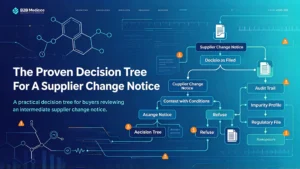
A buyer-side decision tree for handling an intermediate supplier change notice — what to accept, contest, or reject, and how to log the call.
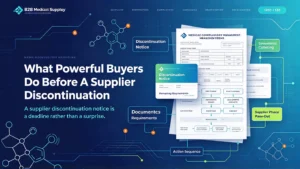
A supplier discontinuation is a deadline, not just bad news. The questions to ask in writing, the last-time-buy calculation, and the files to collect in time.

Manufacturer and supplier of pharmaceutical APIs and intermediates. Contact us for technical support and sourcing solutions.