
Ultimate First Article Approval Checklist For A New Supplier
The first commercial batch from a new intermediate supplier is not a formality. Here is the checklist, the five approval outcomes, and how to log the call.
Table of Contents
In regulatory practice, intermediates are often underestimated. Many companies focus heavily on the API itself, assuming intermediates are only a “supporting layer.” In reality, reviewers frequently trace quality risks back to intermediate stages—especially when impurity issues arise.
If your documentation at this level is weak, it rarely goes unnoticed.
This article walks through what actually matters in DMF and CEP submissions for intermediates—not just what guidelines say, but what regulators tend to question during review.
Over the past decade, both the FDA and EDQM have tightened expectations around process understanding. This shift is largely driven by real-world cases where impurity risks—particularly genotoxic impurities—originated upstream.
According to FDA inspection trends and deficiency reports, a significant portion of API-related issues can be traced back to inadequate control of intermediates. While exact percentages vary by product category, the pattern is consistent: weak intermediate control often leads to downstream risk.
This is why documentation is no longer a formality. It is part of your risk narrative.
Reviewers almost always start here. Not because it’s the first section—but because it explains everything else.
A strong process description does more than list reaction steps. It shows:
How the route was selected
Which steps are critical and why
Where impurities are likely to form
What often triggers questions is not missing data, but missing reasoning.
For example, if a purification step appears late in the process, regulators may ask:
Why is impurity control not addressed earlier?
That kind of question is avoidable—if your process description reflects actual development thinking, not just a finalized route.
It’s easy to treat raw material control as a checklist item. In practice, this section often becomes a focal point during review.
Particularly for:
Starting material designation
Reagents with known impurity risks
Multi-source supply chains
Regulators are not only looking for specifications—they are evaluating whether you understand how material variability impacts your process.
A well-prepared submission typically includes:
Justification for starting materials (aligned with ICH Q11)
Risk-based supplier qualification
Clear linkage between material quality and process performance
If this connection is missing, expect follow-up questions.
There is a tendency to overcomplicate specifications, especially for intermediates. In reality, reviewers are looking for something simpler: Are your controls appropriate for their purpose?
Typical parameters include identification, assay, and impurity levels. That part is straightforward.
Where submissions often fall short is analytical credibility.
If methods are not validated—or validation is only partially described—reviewers may question the reliability of the entire dataset.
At minimum, your analytical approach should demonstrate:
Specificity (especially for structurally similar impurities)
Precision across runs
Sensitivity aligned with impurity thresholds
Referencing ICH Q2 is expected. Demonstrating that you’ve actually applied it is what builds confidence.
If there is one section that determines how smoothly your submission proceeds, this is it.
Regulators do not assess intermediates in isolation. They assess them in context:
What impurities are introduced?
Which ones persist into the API?
How effectively are they controlled?
This requires a connected view of the process—not fragmented data.
A convincing impurity strategy usually includes:
Identification of process-related impurities
Tracking of impurity fate across steps
Scientifically justified limits
Alignment with ICH Q3A, Q3C, and Q3D is expected, but alignment alone is not enough. What matters is whether your data tells a coherent story.
Not every intermediate needs extensive stability data. However, once an intermediate is:
Stored for extended periods
Transported between sites
Used in multiple campaigns
stability becomes relevant—and regulators will expect supporting data.
In such cases, a basic but well-designed study (long-term + accelerated) is usually sufficient. The key is not volume of data, but whether it supports your proposed storage conditions and retest period.
Well-written explanations help—but batch data carries the most weight.
Regulators typically expect:
Data from at least 2–3 representative batches
Preferably at pilot or commercial scale
What they are really looking for is consistency.
If impurity levels fluctuate significantly between batches, even within limits, it may raise concerns about process robustness.
On the other hand, consistent data—supported by a clear process—can offset minor gaps elsewhere.
For intermediates, GMP expectations used to be less stringent. That is changing.
While full API-level GMP compliance may not always be required, regulators increasingly expect:
Defined quality systems
Traceable manufacturing practices
Basic compliance documentation
For CEP applications, inspections are not uncommon—especially for higher-risk products.
In other words, this section is no longer just administrative. It reflects operational credibility.
Across both DMF and CEP reviews, a few recurring issues appear:
| Observation | Typical Consequence |
|---|---|
| Impurity pathways not clearly explained | Major deficiency |
| Weak starting material justification | Extended review cycles |
| Analytical methods not validated | Data reliability concerns |
| Inconsistent batch results | Questions on process control |
What’s notable is that these are rarely due to lack of data. More often, they result from lack of clarity or weak scientific justification.
From a reviewer’s perspective, a strong submission answers three implicit questions:
Do you understand your process?
Can you control it consistently?
Can you prove it with data?
Everything else—format, structure, even depth—comes second.
This is where EEAT naturally aligns with regulatory expectations:
Experience → reflected in real batch and scale-up data
Expertise → shown through scientific reasoning
Authority → demonstrated via guideline alignment
Trust → built through consistency and transparency
Intermediates are no longer a “background” element in regulatory submissions. They are part of the quality story regulators expect you to tell—clearly and convincingly.
A well-prepared DMF or CEP does not overwhelm with information. It connects the dots:
from materials → to process → to impurities → to final API quality.
When that connection is obvious, reviews tend to move faster—and with fewer questions.
If you need any assistance or have any questions, please contact us. sunqian0123@gmail.com
The first commercial batch from a new intermediate supplier is not a formality. Here is the checklist, the five approval outcomes, and how to log the call.
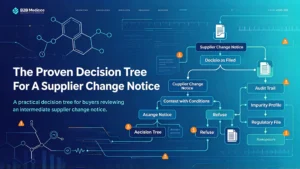
A buyer-side decision tree for handling an intermediate supplier change notice — what to accept, contest, or reject, and how to log the call.
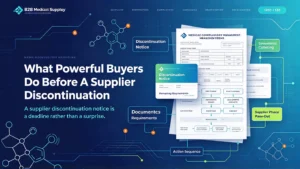
A supplier discontinuation is a deadline, not just bad news. The questions to ask in writing, the last-time-buy calculation, and the files to collect in time.

Manufacturer and supplier of pharmaceutical APIs and intermediates. Contact us for technical support and sourcing solutions.