Ultimate First Article Approval Checklist For A New Supplier
The first commercial batch from a new intermediate supplier is not a formality. Here is the checklist, the five approval outcomes, and how to log the call.
Table of Contents
In the process of pharmaceutical intermediate process development, if I were to say which step is most easily overlooked in the early stages and most often leads to problems later on, it would definitely be solvent selection.
In many projects, solvents are often treated simply as a “reaction medium” at the beginning:
—If it dissolves the reactants, allows the reaction to proceed, and has been used in the literature, it’s considered acceptable.
However, those who have truly experienced pilot-scale and large-scale production understand that the choice and recovery method of solvents often fundamentally determine whether a project can successfully move towards industrial production.
Based on our experience in actual projects, more than half of the scale-up failures, cost overruns, or compliance issues are rooted in solvent-related problems. These problems are often not due to the reaction itself being unsuccessful, but rather because “the solvent selection was not considered thoroughly enough” in the early stages.
In this article, I want to share some real-world insights on solvent selection and recovery in intermediate synthesis, based on our frontline experience.
At the active pharmaceutical ingredient (API) stage, the solvent system is usually relatively mature and fixed.
But the intermediate stage is completely different:
This means that solvent selection at the intermediate stage is actually laying the foundation for process stability for the next three to five years.
We have seen many projects like this:
Tracing the reasons, many times it’s simply because an “easy-to-use in the lab” solvent was chosen in the early stages.
This sounds very realistic, but it’s a lesson many people only learn after making mistakes. In a laboratory setting, the following solvents are very convenient to use:
However, when scaling up to large-scale production, they often present a series of challenges:
We once handled a project where the key reaction showed excellent selectivity in DMF, and the laboratory data was very promising. However, once scaled up to kilogram quantities, problems arose:
Ultimately, the client had to readjust the solvent system at the intermediate stage, delaying the overall project progress by at least two months.
This lesson is clear: in intermediate process development, solvent issues are not just chemical problems, but also engineering problems.
When we conduct route assessments internally, solvent selection is never just about “can this reaction be done,” but rather requires answering at least the following questions:
1️⃣ Can this solvent be reliably recovered in the future?
Is it suitable for conventional reduced-pressure distillation? Does it easily form azeotropes with impurities? Will impurities accumulate after multiple recovery cycles?
If a solvent is theoretically recoverable, but the actual recovery purity is unstable, it is practically unusable in industrial production.
2️⃣ Will it amplify impurity risks?
Some solvents may appear “clean” in the laboratory, but when scaled up, they may:
These risks are particularly fatal at the intermediate stage, as impurities can easily be carried into subsequent steps, causing cascading problems.
3️⃣ Is it compatible with subsequent steps?
If a solvent performs well in the current step, but:
Then the overall process efficiency will often be significantly reduced.
In actual production, the proportion of solvent costs in the raw material costs of intermediates is often underestimated. In some projects, our calculations have shown that:
Solvent procurement + processing + losses
can account for more than 30% of the cost per kilogram of intermediate.
Therefore, what’s truly important is not just “whether it can be recycled,” but rather:
Can the recycled solvent be used reliably, safely, and repeatedly?
We have adopted the following strategies in several projects:
These strategies rarely appear in academic papers, but they significantly impact the commercial viability of projects.
With the implementation of guidelines such as ICH Q3C, Q3A/Q3B, regulatory agencies are paying significantly more attention to solvent issues.
Now, when we assist clients in preparing submission documents, we are frequently asked:
This reflects a trend: solvent selection is no longer simply an internal technical decision, but has become a key area of auditing and inquiry.
A mature intermediate process team will not treat solvents as mere “background.”
Instead, they will clearly determine:
In intermediate synthesis, solvent selection and recycling are not just part of environmental requirements or cost control, but a core process decision that runs through R&D, scale-up, compliance, and the supply chain.
If you are currently working on an intermediate project, or are repeatedly adjusting for scale-up, cost, or process stability issues, you might want to reconsider:
Were the solvents chosen initially truly well-considered for the final production?
Looking for a reliable partner in solvent selection and recovery for intermediate synthesis?
We support pharma and biotech companies with process-validated solvent strategies, recovery feasibility assessment, and scalable intermediate manufacturing.
👉 Talk to our technical team to discuss your process requirements.
Email: sunqian0123@gamil.com
WhatsApp: +86 176 6371 3557
The first commercial batch from a new intermediate supplier is not a formality. Here is the checklist, the five approval outcomes, and how to log the call.
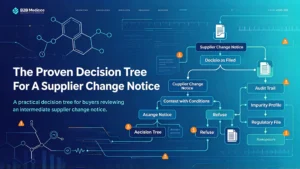
A buyer-side decision tree for handling an intermediate supplier change notice — what to accept, contest, or reject, and how to log the call.
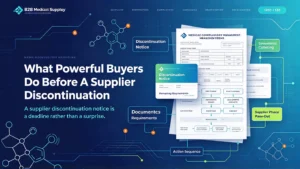
A supplier discontinuation is a deadline, not just bad news. The questions to ask in writing, the last-time-buy calculation, and the files to collect in time.

Manufacturer and supplier of pharmaceutical APIs and intermediates. Contact us for technical support and sourcing solutions.