Ultimate First Article Approval Checklist For A New Supplier
The first commercial batch from a new intermediate supplier is not a formality. Here is the checklist, the five approval outcomes, and how to log the call.
Table of Contents
Having worked in the field of intermediate manufacturing for a long time, a consensus gradually forms: what truly determines the success or failure of a project is often not the yield, but the “safety” of the process.
Many of us have probably experienced this: many accidents, production line stoppages, customer complaints, and even project terminations, don’t happen in the final API steps, but in the intermediate stages. The reason is simple—intermediate processes are often in the “most unstable and easily underestimated” position.
I would like to share some insights based on my years of practical project experience, discussing process safety issues in intermediate manufacturing that are rarely mentioned in textbooks but happen every day in reality.
From a process perspective, intermediate production often has several common characteristics:
What does this mean?
It means that many reactions are scaled up under conditions where “experience is insufficient.”And safety accidents are most likely to occur at this stage.
Based on our personal experience, we have seen too many such cases:
Reactions that were “no problem” in the laboratory often show abnormal temperature increases, rapid gas release, and system loss of control once scaled up to kilogram quantities.
It’s not that our operators are unprofessional, but the risks were already embedded in the design phase.
When many companies talk about safety, their first reaction is:
These are certainly important, but in intermediate production, they can only address the last line of defense.
What truly determines the safety limit are the following three things:
1. Is the route selection “inherently safe”?
When evaluating routes, we often ask a very practical question:
What would happen if this reaction went out of control in the worst-case scenario?
For example:
There was a project where the literature route provided by the customer required a strong alkaline alkylation at -70℃. Laboratory operations may be acceptable, but once scaling up begins, the requirements for the cooling system and operating window become extremely demanding.
We ultimately advised the client to adjust the process, even if it meant adding an extra reaction step, to achieve controllability under milder conditions.
This wasn’t about “safety for safety’s sake,” but rather to ensure the project could truly reach commercialization.
2. Have you truly understood the reaction behavior before scaling up?
A common misconception is:
“The lab process is running smoothly, scaling up is just an equipment issue.”
But the reality is, many dangerous behaviors simply don’t manifest themselves at the small-scale stage.
In intermediate projects, we place great importance on the following information:
This information is often more important than the “theoretical mechanism.”
Experience tells us:
Scaling up without understanding the thermal behavior is essentially gambling.
3. Process safety must be prioritized upfront, not addressed retrospectively
Many accident reviews include a summary of lessons learned or a post-mortem reflection:“If we had assessed this in advance, it could have been avoided.”
The most effective stage for safety design in intermediate manufacturing is only one:The route design and process development stage.
Once stable production begins, all safety measures can only be:
Many people, when thinking about process safety, immediately picture explosions and fires.
But in real projects, more common and insidious risks include:
These issues may not receive enough attention, but they are sufficient to keep a project in a state of long-term instability.
And the intermediate stage is precisely where these problems are most easily overlooked.
In recent years, we have clearly felt a shift in our clients’ focus during audits and technical discussions. They no longer just ask:
Instead, they repeatedly ask:
This fully illustrates a fact:
Process safety has transformed from an “internal management issue” into a crucial criterion for customers when choosing partners. For customers, choosing a supplier of intermediates who understands safety is essentially reducing the systemic risk of the entire project.
In intermediate manufacturing, safety is never an “additional requirement.”
It determines:
Truly mature process safety is not just a set of clauses written in documents, but is reflected in every route selection, every trade-off of conditions, and every scaling-up decision.
Finally, to summarize in one sentence: If intermediate manufacturing is a long-term project, then safety is not the brakes, but the steering wheel. With the right direction, the project can run fast and last long.
Intermediate project cooperation services: sunqian0123@gmail.com
WhatsApp: +86 176 6371 3557
The first commercial batch from a new intermediate supplier is not a formality. Here is the checklist, the five approval outcomes, and how to log the call.
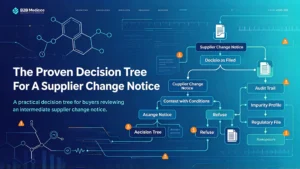
A buyer-side decision tree for handling an intermediate supplier change notice — what to accept, contest, or reject, and how to log the call.
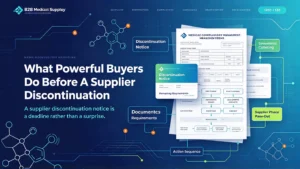
A supplier discontinuation is a deadline, not just bad news. The questions to ask in writing, the last-time-buy calculation, and the files to collect in time.

Manufacturer and supplier of pharmaceutical APIs and intermediates. Contact us for technical support and sourcing solutions.