Ultimate First Article Approval Checklist For A New Supplier
The first commercial batch from a new intermediate supplier is not a formality. Here is the checklist, the five approval outcomes, and how to log the call.
Table of Contents
After years working in the pharmaceutical industry, I’ve observed few topics with such profound, long-term implications for companies and their products as data integrity. Though seemingly intangible, it forms the bedrock of every analytical result, every process validation, and ultimately, every patient’s trust in each tablet they take.
Ensuring absolute data reliability is particularly challenging in the complex realm of intermediate manufacturing.
Over the years, while overseeing quality systems and supplier audits, I have witnessed countless instances where minor flaws in data integrity led to problems amplifying and spreading throughout the supply chain.
Today, drawing from my experience, I aim to explore the key challenges frequently faced by intermediate manufacturers and share strategies proven effective in practice. Together, we can strengthen compliance, transparency, and trust throughout the entire production lifecycle.
Pharmaceutical intermediates occupy a pivotal transitional stage between active pharmaceutical ingredients (APIs) and finished products. The quality and consistency of these intermediates directly determine whether the final drug can meet regulatory requirements and therapeutic expectations.
Inaccurate, incomplete, or even tampered analytical or production data often carries severe consequences—ranging from product recalls to patient safety risks. Regulatory bodies like the US FDA, European EMA, and UK MHRA have frequently issued warning letters in recent years, many of which involve data integrity issues.
These particularly focus on incomplete audit trails, shared login credentials, and unrecorded changes to batch records.
My experience shows: Even if your product has perfect chemical purity, without credible data, you cannot prove its quality is reliable.
Based on my experience conducting multiple audits, the following areas are particularly prone to issues:
a. Manual Recording
Despite growing automation, many intermediate manufacturers still rely on handwritten records or Excel spreadsheets. Human errors, lost pages, or even intentional omissions can occur inadvertently.
b. Shared User Accounts
For convenience, some production lines still allow multiple users to share a single system account. This prevents tracing who performed or approved specific actions—directly violating the “Attributability” principle of ALCOA+.
c. Incomplete Audit Trails
Many analytical instruments lack robust audit trail functionality, or have it but fail to perform regular reviews. This makes it difficult to detect data tampering or deletion.
d. Inadequate Backup and Archiving Systems
Data stored solely on local hard drives or insecure servers is vulnerable to damage, accidental deletion, or tampering. For smaller suppliers, the long-term, secure preservation of batch records and analytical data is particularly prone to oversight.
e. Lack of Data Governance Culture
Ultimately, most data issues stem not from technology but from mindset. If employees view record-keeping as merely “passing inspections” rather than a core quality function, compliance will remain superficial.
Global regulators are intensifying scrutiny of data management practices. FDA’s 21 CFR Part 11 and EU Annex 11 both impose explicit requirements for electronic data control, audit trails, and system validation. Concurrently, WHO and ICH Q7 guidelines repeatedly emphasize data traceability and reliability within GMP environments.
Based on my audit experience, regulators particularly scrutinize:
* Whether system access rights are appropriately assigned
* Whether raw data is preserved in its original format
* Whether audit trails are reviewed regularly and comprehensively
* Whether computerized systems are fully validated
* Whether employees receive training on data integrity
The cost of non-compliance extends beyond receiving Form 483s or warning letters—it can lead to long-term reputational damage and even removal from qualified supplier lists.
Based on my experience, every intermediate manufacturer should rigorously implement these steps:
a. Advance workshop digitization
Prioritize implementing LIMS (Laboratory Information Management Systems) or Electronic Batch Records (EBR) to minimize manual data entry and automate traceability. Even small-to-medium manufacturers should now consider cloud-based solutions with role-based access controls.
b. Strengthen Individual Accountability
Every operation must be traceable to a specific performer. Prohibit shared accounts and ensure each user logs in with a unique, encrypted, and regularly updated account.
c. Conduct Regular Data Integrity Audits
Beyond routine GMP inspections, schedule internal audits focused on data management. Randomly sample chromatographic data, audit logs, and change records to detect issues early.
d. Foster a Culture of Honesty and Responsibility
Data integrity is not merely regulatory compliance but a professional ethic. Encourage employees to proactively report deviations, fostering an environment where “mistakes are feared, not concealment.” Reward staff who identify issues before risks materialize.
e. Strengthen Supplier Management
If relying on external intermediate suppliers, verify they adhere to identical data integrity standards. This includes reviewing their validation documentation, system controls, and even conducting joint audits.
f. Prioritize Continuous, Practical Training
Organize scenario-based training sessions where employees analyze real-world data integrity failures. Help them grasp the principles behind regulations through practical examples, rather than rote memorization of clauses.
Emerging technologies are transforming data management practices:
Blockchain enables tamper-proof traceability across multiple nodes;
Artificial intelligence can automatically flag anomalous data or suspicious modifications;
Cloud-based validation tools simplify compliance documentation while enhancing data accessibility.
Yet remember: no matter how advanced the technology, it ultimately relies on the people using it. The human factor remains the cornerstone of maintaining data integrity.
In my view, data integrity in pharmaceutical intermediate manufacturing is never a bureaucratic checklist item—it is the touchstone of scientific credibility and professional ethics.
Every number we record, every signature we affix, every audit trail we leave is fundamentally a pledge to patient safety and professional conscience. Only by upholding these standards can we truly fortify product compliance and earn the enduring trust of markets and patients in pharmaceuticals.
At Tianming Pharmaceuticals, we continuously integrate a robust digital quality system with highly transparent audit processes to ensure every data point stands up to scrutiny. For I firmly believe: only authentic data truly reflects authentic quality.
Contact Email: sunqian0123@gmail.com
WhatsApp: +86 17663713557
The first commercial batch from a new intermediate supplier is not a formality. Here is the checklist, the five approval outcomes, and how to log the call.
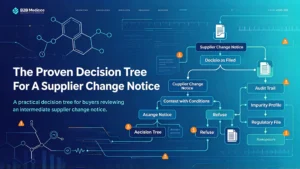
A buyer-side decision tree for handling an intermediate supplier change notice — what to accept, contest, or reject, and how to log the call.
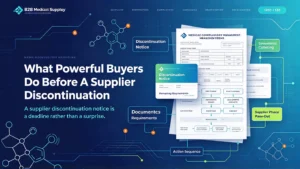
A supplier discontinuation is a deadline, not just bad news. The questions to ask in writing, the last-time-buy calculation, and the files to collect in time.

Manufacturer and supplier of pharmaceutical APIs and intermediates. Contact us for technical support and sourcing solutions.