Tianming Pioneers Eco-Friendly (R)-3-Chloro Synthesis at Scale

Founded in 2010, Tianming Pharmaceutical, as a leading company in the pharmaceutical industry and intermediates production, is committed to promoting the green transformation and sustainable development of pharmaceutical manufacturing through innovative technologies, based on more than 10 years of industry experience and technology accumulation.

Tianming Pharmaceutical: High-efficiency Synthesis Leads the Development of the Industry

In recent years, Tianming Pharmaceutical has made significant breakthroughs in the field of pharmaceutical intermediates.

With the continuous maturation and optimization of the technology, the R&D production capacity has achieved a qualitative leap, which not only greatly improves the product purity and production efficiency, but also successfully reduces the production cost, providing a more solid and efficient material basis for the research and development of new drugs. 

The new high-efficiency synthesis technology independently developed by the company has been successfully applied to the production of a number of intermediates, among which the latest R&D product (R)-3-Chloro-1-phenyl-1-propanol has been successfully commercialized and put into production, which has won wide recognition in the market with excellent product quality and competitive price, highlighting the great potentials of Tianming Pharmaceuticals in the API market.

It has successfully achieved commercial production with excellent product quality and competitive price and won wide recognition in the market, demonstrating the great potential of Tianming Pharmaceutical in the API market.

Product Introduction:(R)-3-Chloro-1-phenyl-1-propanol

(R)-3-Chlorophenylpropanol, also known as dextro-3-chlorophenylpropanol, with the chemical formula C9H11ClO and CAS No. 100306-33-0, is a key raw material for the synthesis of a wide range of drugs, the most famous of which is Dapoxetine. As an important pharmaceutical intermediate, its market positioning is high-end, innovative and green, with broad market prospects and full of opportunities.

Dapoxetine, a selective 5-hydroxytryptamine reuptake inhibitor, is used in the treatment of depression and related affective disorders/premature ejaculation in men. Dapoxetine, chemically known as N,N-dimethyl-1-phenyl-3-(1-naphthyloxy)-1-propanamine, contains one chiral carbon atom and a pair of corresponding isomers.

According to the literature [1], the pharmacodynamic activity of the S-isomer is 3.5 times higher than that of the R-isomer, and its chiral center is derived from the key intermediate (R)-3-chlorophenylpropanol.

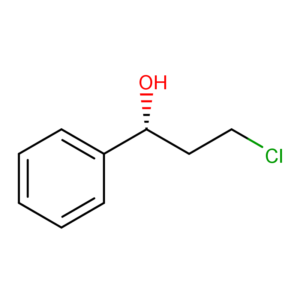
(1R)-3-Chloro-1-phenyl-propan-1-ol

(R)-3-Chloro Phenyl Propanol: a leap from laboratory to commercialization

The synthesis of (R)-3-Chlorophenylpropanol involves a variety of chemical reactions and process steps, including chlorination, addition and reduction reactions.

As a manufacturer, Tianming Pharmaceutical has experienced many challenges in achieving the commercialization and production of this product, but through unremitting efforts and innovations, we have finally succeeded in eliminating all difficulties. 

From in-depth R&D to process innovation, Tianming Pharmaceutical R&D staff optimized the conditions of chlorination, addition and reduction reactions to improve the purity and yield of the product, not only developed non-aqueous phase catalytic technology, but also set up a strict quality control system to conduct comprehensive quality testing and monitoring of raw materials, intermediates and finished products.

After completing the small-scale trials in the laboratory, we conducted pilot-scale production tests to verify the stability of the production line and the commercialization potential of the product.

Through the analysis and optimization of the pilot-scale data, the production process and parameters were further adjusted to prepare for large-scale production.

In Conclusion

In the future, Tianming Pharmaceutical will continue to increase its R&D investment in the field of pharmaceuticals and major healthcare, and utilize the company’s core technologies in synthetic chemistry, biotechnology and green chemistry to promote the development and industrialization of more innovative products, and provide more efficient and environmentally friendly solutions for the global pharmaceutical industry.

【1】 Robertson D-W, Thompson D-C, Wong D-T, et al. 1-phenyl-3-naphthalenyloxypropanamines and their use as selective serotonin reuptake inhibitors[P ]. USP: 5135947,1992-08-04

Related Blogs

B2B pharma API blog cover, particle size specification 5 checks, pharmaceutical particle analysis, COA quality data chart for chemical intermediates

5 Proven Checks For Your Particle Size Specification

Two suppliers can quote the same intermediate with completely different particle size lines, and both may be telling the truth. Here is how to read a particle size specification before you agree to one, so the number on the COA means what you think it means.

Read More »
Pharmaceutical quality agreement review, key clauses buyers overlook when negotiating supplier quality responsibilities

What Buyers Miss When Reviewing a Quality Agreement

A quality agreement divides quality responsibilities between you and your supplier before anything goes wrong. This guide shows intermediate buyers which clauses deserve the first read, what is worth negotiating, and what belongs somewhere else entirely.

Read More »
B2B pharmaceutical supplier validation graphic comparing qualified lab sample and failed trial order, sample vial, COA certificate, packaging and logistics risk illustration for chemical API buyers

Trial Order: 4 Failures a Sample Will Never Show

A sample proves the chemistry; a trial order proves everything around it — documentation, packaging, logistics, and how a supplier behaves when something slips. This guide walks buyers through both, in the order that costs least and reveals most.

Read More »
Scroll to Top

Contact us to Get the Best Product Solution